
Pakistan beat Hong Kong to seal Asian Games squash silver and final spot
Pakistan defeated Hong Kong 2-1 in the men’s team squash semi-final at the Nagoya Kinjo Futo Arena on Thursday to book a place in the Asian Games final, guaranteeing themselves at least a silver medal and a shot at their first gold in the event since 2010. The result builds on Wednesday’s quarter-final win over South Korea, which had already secured Pakistan a third overall Asian Games squash team medal. Reaching Thursday’s final upgrades that guarantee to silver, with the gold medal match to be played against the winner of the other semi-final between India and Malaysia. Pakistan’s top-ranked player, Noor Zaman, opened the tie against the experienced Tsz Kwan Lau, and the first game alone lasted 13 minutes of toe-to-toe squash. Lau opened the scoring, Noor levelled immediately, and the pair traded the lead through the opening exchanges before Lau pulled away to 6-3 and then 8-4. Noor, ranked 33rd in the world, responded with three straight points to close to 8-7, and from there the two went point for point: 9-8, 9-9, before Lau edged ahead again to move to game point. Noor saved it, fired in two of his own to reach game point himself, and converted to take the opener 12-10. Lau responded immediately in the second, racing to a 3-1 lead before Noor pulled one back at 3-2. Lau made it 4-2, Noor again replied to make it 4-3, and then Lau simply took over — reeling off six consecutive points to surge from 4-3 to 10-3 and sealing the game on his first attempt, 11-3, in just six minutes, to level the match at one game apiece. The third followed a similar arc. Noor opened with a three-point lead before Lau, the 30-year-old Hong Kong veteran, got on the board and gradually clawed his way level at 3-3, with each man retaking the lead before Lau drew level for a second time. From there Lau took control for the first time in the game, surging to an 8-4 advantage. Noor fought to close the gap, making it 9-6, but Lau reached game point and converted on his first attempt, winning 11-6 in seven minutes to move ahead in the tie for the first time. With the match on the line, Noor opened the scoring again in the fourth, but Lau levelled immediately and then pulled clear, racing to a 5-1 lead. Noor struck back, but Lau extended the gap to 7-2 and then 9-3 as Noor’s response — a point here, a point there — was never enough to seriously threaten. Lau reached match point and wrapped up an 11-5 win in five minutes, completing a 3-1 reverse in games (10-12, 11-3, 11-6, 11-5) that put Hong Kong 1-0 up in the tie. Mohammad Ashab Irfan levelled matters for Pakistan with a gutsy win over world No. 57 Chi Hin Henry Leung, needing just seven minutes to take the opening game despite a shaky start. Leung drew first blood, but Ashab levelled immediately and then pulled away, firing off four consecutive points to lead 4-1 and later extending that run to make it 8-2. Leung rallied to 8-4, but Ashab replied with two more to reach game point; the 31-year-old Leung saved the first, only for Ashab to convert his second attempt and close out the game 11-5. The second game proved to be the turning point of the entire tie. Leung came out firing, racing into a 6-0 lead that looked set to level the match in a hurry. Ashab, ranked 50th in the world, halted the slide with four consecutive points of his own and gradually dragged the score back level point by point — 7-5, 8-6, 9-6 — before Leung, after a long rally, reached game point. What followed was a stretch of pure resolve. Ashab saved three separate game points in succession, somehow levelling the score at 10-10 after a gruelling exchange. Leung moved to game point a fourth time and was denied again, before Ashab finally earned a game point of his own — his first lead of the entire game — and wrapped it up on the first attempt, 13-11, after 14 minutes, to put Pakistan 2-0 up in games. Ashab carried that momentum into the third, racing to a 5-1 lead after Leung’s opening point. Leung fought to stay in touch, closing to 6-3 and later 8-5, but Ashab kept finding answers, pushing the score out to 10-5 and a match point of his own. Leung saved two match points in a row, delaying the inevitable, before Ashab closed it out 11-7 in six minutes — leveling the tie at 1-1 and setting up a decider. That left it to the experienced Nasir Iqbal to seal Pakistan’s place in the final against Cheuk Nam Lai, and the decider went the full distance in dramatic fashion. The opening game was tight throughout — Nasir led 2-0 before Lai, 28, got on the board, and the pair traded the lead repeatedly before the Hong Kong player edged ahead for the first time. Nasir had to chase the game from there, drawing level at 9-9 and reaching game point himself, only for Lai to save it, level at 10-10, and then convert his own game point to take a gripping opener 12-10 in 15 minutes and put Hong Kong back in front. Nasir responded immediately in the second. Lai opened with a two-point lead, but Nasir tore off six consecutive points to seize control, and although Lai briefly steadied the score at 6-3, Nasir added four more without reply to reach game point and sealed it on his first attempt, 11-3, in just seven minutes — leveling the tie at one game apiece. The 32-year-old continued that form into the third, racing to a 5-1 lead after an early exchange of points. Lai chipped away, closing to 8-4 and then 9-4, but Nasir reached match point and, after Lai saved one, converted on his fifth attempt to win the game 11-9 in nine minutes and move Pakistan to the brink of the final. The fourth game produced the tie’s most dramatic finish. Nasir surged to an early 7-2 lead, but Lai refused to fold, clawing back to 8-7 and then 9-8 before the pair traded points again. Nasir reached match point, only for Lai to save it and then level at 10-10. From there Lai twice moved to game point of his own, and was denied by Nasir both times, before the veteran finally converted his second match point to close out a tense 14-12 win after 16 minutes — sending Pakistan through to the final. Pakistan’s run has been built around the same core of Noor Zaman, Ashab Irfan, Nasir Iqbal and Asim Khan that won silver at the 2022 Hangzhou Asian Games. A gold-medal finish in Nagoya would mark the country’s best Asian Games squash result since 2010. Pakistan’s run has been built around the same core of Noor, Ashab, Nasir and Asim Khan that won silver at the 2022 Hangzhou Asian Games, where they lost the final to India. A gold-medal finish in Nagoya would mark the country’s first Asian Games squash team title since 2010, when Pakistan beat Malaysia 2-0 in the final in Guangzhou. Ghulam takes shooting bronze Meanwhile, Pakistan’s veteran shooter Ghulam Mustafa Bashir claimed a hard-earned bronze medal in the men’s 25m rapid fire pistol event on Thursday, delivering the country’s first shooting medal of the Games. Ghulam finished third after a composed performance in the final at the Aichi Prefectural General Shooting Gallery. He had earlier secured qualification for the eight-man final by placing sixth overall with a score of 578 points and 19 inner tens across the two stages of the competition. China and South Korea dominated the top positions, but Ghulam held his nerve through the high-pressure rapid series to secure third place and step onto the podium.
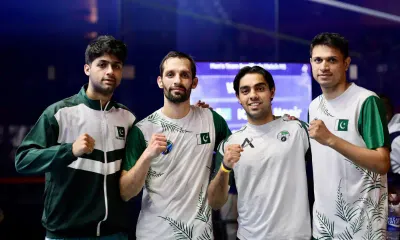
Pakistan defeated Hong Kong 2-1 in the men’s team squash semi-final at the Nagoya Kinjo Futo Arena on Thursday to book a place in the Asian Games final, guaranteeing themselves at least a silver medal and a shot at their first gold in the event since 2010.
The result builds on Wednesday’s quarter-final win over South Korea, which had already secured Pakistan a third overall Asian Games squash team medal. Reaching Thursday’s final upgrades that guarantee to silver, with the gold medal match to be played against the winner of the other semi-final between India and Malaysia.
Pakistan’s top-ranked player, Noor Zaman, opened the tie against the experienced Tsz Kwan Lau, and the first game alone lasted 13 minutes of toe-to-toe squash.
Lau opened the scoring, Noor levelled immediately, and the pair traded the lead through the opening exchanges before Lau pulled away to 6-3 and then 8-4.
Noor, ranked 33rd in the world, responded with three straight points to close to 8-7, and from there the two went point for point: 9-8, 9-9, before Lau edged ahead again to move to game point.
Noor saved it, fired in two of his own to reach game point himself, and converted to take the opener 12-10.
Lau responded immediately in the second, racing to a 3-1 lead before Noor pulled one back at 3-2.
Lau made it 4-2, Noor again replied to make it 4-3, and then Lau simply took over — reeling off six consecutive points to surge from 4-3 to 10-3 and sealing the game on his first attempt, 11-3, in just six minutes, to level the match at one game apiece.
The third followed a similar arc.
Noor opened with a three-point lead before Lau, the 30-year-old Hong Kong veteran, got on the board and gradually clawed his way level at 3-3, with each man retaking the lead before Lau drew level for a second time.
From there Lau took control for the first time in the game, surging to an 8-4 advantage. Noor fought to close the gap, making it 9-6, but Lau reached game point and converted on his first attempt, winning 11-6 in seven minutes to move ahead in the tie for the first time.
With the match on the line, Noor opened the scoring again in the fourth, but Lau levelled immediately and then pulled clear, racing to a 5-1 lead.
Noor struck back, but Lau extended the gap to 7-2 and then 9-3 as Noor’s response — a point here, a point there — was never enough to seriously threaten.
Lau reached match point and wrapped up an 11-5 win in five minutes, completing a 3-1 reverse in games (10-12, 11-3, 11-6, 11-5) that put Hong Kong 1-0 up in the tie.
Mohammad Ashab Irfan levelled matters for Pakistan with a gutsy win over world No. 57 Chi Hin Henry Leung, needing just seven minutes to take the opening game despite a shaky start.
Leung drew first blood, but Ashab levelled immediately and then pulled away, firing off four consecutive points to lead 4-1 and later extending that run to make it 8-2.
Leung rallied to 8-4, but Ashab replied with two more to reach game point; the 31-year-old Leung saved the first, only for Ashab to convert his second attempt and close out the game 11-5.
The second game proved to be the turning point of the entire tie.
Leung came out firing, racing into a 6-0 lead that looked set to level the match in a hurry.
Ashab, ranked 50th in the world, halted the slide with four consecutive points of his own and gradually dragged the score back level point by point — 7-5, 8-6, 9-6 — before Leung, after a long rally, reached game point.
What followed was a stretch of pure resolve. Ashab saved three separate game points in succession, somehow levelling the score at 10-10 after a gruelling exchange.
Leung moved to game point a fourth time and was denied again, before Ashab finally earned a game point of his own — his first lead of the entire game — and wrapped it up on the first attempt, 13-11, after 14 minutes, to put Pakistan 2-0 up in games.
Ashab carried that momentum into the third, racing to a 5-1 lead after Leung’s opening point. Leung fought to stay in touch, closing to 6-3 and later 8-5, but Ashab kept finding answers, pushing the score out to 10-5 and a match point of his own.
Leung saved two match points in a row, delaying the inevitable, before Ashab closed it out 11-7 in six minutes — leveling the tie at 1-1 and setting up a decider.
That left it to the experienced Nasir Iqbal to seal Pakistan’s place in the final against Cheuk Nam Lai, and the decider went the full distance in dramatic fashion.
The opening game was tight throughout — Nasir led 2-0 before Lai, 28, got on the board, and the pair traded the lead repeatedly before the Hong Kong player edged ahead for the first time.
Nasir had to chase the game from there, drawing level at 9-9 and reaching game point himself, only for Lai to save it, level at 10-10, and then convert his own game point to take a gripping opener 12-10 in 15 minutes and put Hong Kong back in front.
Nasir responded immediately in the second.
Lai opened with a two-point lead, but Nasir tore off six consecutive points to seize control, and although Lai briefly steadied the score at 6-3, Nasir added four more without reply to reach game point and sealed it on his first attempt, 11-3, in just seven minutes — leveling the tie at one game apiece.
The 32-year-old continued that form into the third, racing to a 5-1 lead after an early exchange of points. Lai chipped away, closing to 8-4 and then 9-4, but Nasir reached match point and, after Lai saved one, converted on his fifth attempt to win the game 11-9 in nine minutes and move Pakistan to the brink of the final.
The fourth game produced the tie’s most dramatic finish.
Nasir surged to an early 7-2 lead, but Lai refused to fold, clawing back to 8-7 and then 9-8 before the pair traded points again.
Nasir reached match point, only for Lai to save it and then level at 10-10. From there Lai twice moved to game point of his own, and was denied by Nasir both times, before the veteran finally converted his second match point to close out a tense 14-12 win after 16 minutes — sending Pakistan through to the final.
Pakistan’s run has been built around the same core of Noor Zaman, Ashab Irfan, Nasir Iqbal and Asim Khan that won silver at the 2022 Hangzhou Asian Games. A gold-medal finish in Nagoya would mark the country’s best Asian Games squash result since 2010.
Pakistan’s run has been built around the same core of Noor, Ashab, Nasir and Asim Khan that won silver at the 2022 Hangzhou Asian Games, where they lost the final to India.
A gold-medal finish in Nagoya would mark the country’s first Asian Games squash team title since 2010, when Pakistan beat Malaysia 2-0 in the final in Guangzhou.
Ghulam takes shooting bronze
Meanwhile, Pakistan’s veteran shooter Ghulam Mustafa Bashir claimed a hard-earned bronze medal in the men’s 25m rapid fire pistol event on Thursday, delivering the country’s first shooting medal of the Games.
Ghulam finished third after a composed performance in the final at the Aichi Prefectural General Shooting Gallery. He had earlier secured qualification for the eight-man final by placing sixth overall with a score of 578 points and 19 inner tens across the two stages of the competition.
China and South Korea dominated the top positions, but Ghulam held his nerve through the high-pressure rapid series to secure third place and step onto the podium.