
At Moscow moot, Pakistan says terrorism remains at core of Afghanistan's problems
Pakistan’s Special Representative for Afghanistan Mohammad Sadiq on Monday said that terrorism remained at the core of Afghanistan’s problems, reaffirming that Pakistan would continue to take “all appropriate measures” for ensuring the safety of its citizens, in accordance with international law. Sadiq made these remarks at the eighth meeting of Moscow Format Consultations on Afghanistan in the Russian capital. The moot brought together Afghanistan and other countries of the region to discuss the situation in Afghanistan and issues of regional concern, the Foreign Office (FO) said in a statement . Separately, Sadiq posted a transcript of his address at the meeting, according to which he told the moot that the roots of terrorism emanating from Afghanistan were in a “nexus between the Taliban regime and terrorist groups […] that operate with impunity on Afghan soil”. “The situation is worsened by external actors and spoilers who support proxies inside Afghanistan to target Pakistan and other countries in the region,” he added. Sadiq highlighted that five years into the Taliban rule in Afghanistan, “Pakistan faces the most serious security threat.” Over the last three years alone, he said, more than 4,700 Pakistanis had been killed due to terrorism emanating from Afghanistan. “No country would tolerate such a situation,” he remarked. “Thousands of innocent Pakistani civilians and security personnel have been martyred in the last few years. A result of terrorist attacks planned, financed, supported and carried out from Afghan soil. The Taliban regime is complicit in this. No responsible state can remain passive when its security is repeatedly undermined. and its people are viciously targeted.” The special representative said Pakistan’s counterterrorism operations were conducted in response to the terrorist attacks being perpetrated from Afghan soil. “These operations are precise, intelligence-based and defensive in nature. Pakistan’s actions are in exercise of its right to self-defence, to ensure the safety and security of its citizens. These actions are directed solely against the terrorist outfits based in Afghanistan that pose a threat to the region and beyond.” Sadiq continued that Pakistan had been, and would continue to take “all appropriate measures to uphold the safety and security of its citizens in accordance accordance with with international law, and based on the principles of necessity and as a measure of last resort”. “All measures taken by Pakistan constitute legitimate defensive actions against sanctuaries and bases used for planning, training and launching terrorist attacks inside Pakistan. “The scale and scope of our actions represent restraint, particularly in light of the severity of the challenge we face.” Sadiq said Islamabad desired peace in the region and had “remained patiently engaged” in political and diplomatic efforts aimed at addressing terrorism emanating from Afghan soil. “It is unfortunate that Pakistan’s numerous goodwill gestures and highly responsible approach were misconstrued, resulting in increased terrorist attacks from Afghan soil, with the active support and backing of the Taliban regime. “Pakistan reiterates its strong resolve and determination to uproot the menace of terrorism emanating from across the border. We call upon the Afghan authorities to end the impunity with which terrorist groups continue to operate from their soil,” he said. Sadiq also expressed hope that “countries in the region will work together to address the sources of instability in our immediate neighbourhood, with a view to achieving our collective objectives of regional peace, stability and prosperity”. “We expected the Taliban regime would take concrete and verifiable actions against those terrorist groups. Regrettably, they failed to act in complete disregard for the legitimate security concerns of Pakistan and other countries. We hope that the Taliban will honour their commitments made to the international community,” he said. Sadiq said Pakistan and Afghanistan were immediate neighbours having historical relations and fraternal bonds. “Peace and stability in Afghanistan is in the national interest of Pakistan.” Earlier in his address, Sadiq noted that the meeting was taking place at a “time of immense turmoil”. “The regional and global environment is fraught with challenges. Proliferating crises across the world, the ongoing conflict in West Asia, and disruptions in global energy markets have put unprecedented strain on our region and beyond. “At the same time, regional countries remain highly vulnerable to destabilising threats caused by terrorism, drug smuggling, illegal migration, and human trafficking,” he said. He noted that it had been five years since the transition in Afghanistan, with the Afghan Taliban taking the reins in Kabul in August 2021. This represented a “critical milestone” to assess the situation on the ground, he said. In the period after August 2021, Pakistan joined the regional countries in the efforts to help stabilise the situation in Afghanistan and address the humanitarian needs of people of Afghanistan, the special representative continued. “As a close neighbour, Pakistan engaged at the highest level, facilitated humanitarian relief efforts, and provided visas to vulnerable Afghans. Pakistan also extended trade and transit incentives to support Afghan economy, participated in regional initiatives and connectivity projects, and remained at the forefront of the efforts to facilitate Afghanistan’s integration into the international community.” These endeavours, he said, were driven by “our shared commitment to a peaceful, stable and prosperous Afghanistan”. “Our regional engagement had been central to assisting the Afghan authorities as they worked towards rebuilding their country.” However, he said, despite these efforts, Afghanistan stood at a critical juncture. “The country faces a deteriorating humanitarian crisis, and is grappling with multiple challenges driven by severe food insecurity, extreme climate shocks, water scarcity, and recurrent natural disasters and [a] permissive environment allowing terrorism to grow.” While it remained essential to call for sustained support, it was equally imperative to assess the progress towards resolving the legitimate concerns of regional states and the wider international community, Sadiq emphasised. “Nowhere is the lack of progress more evident than on the issue of counterterrorism, ensuring women’s rights and girls’ education, and promoting inclusivity. Continuing restrictions on women and girls, absence of any meaningful efforts to ensure broad-based governance, and the lack of progress on counterterrorism commitments not only impede Afghanistan’s long-term development and stability, they also threaten regional security and undermine our collective efforts towards regional peace and prosperity,” he said. Sadiq said the situation required careful reflection. “There is a need to ask whether the Taliban regime’s policies have advanced the collective objective of helping ordinary Afghans, and whether these policies have helped Afghanistan in responding to the legitimate concerns of the immediate neighbours,” he said. According to the FO statement, Russian Foreign Minister Sergey Lavrov also attended the session and addressed the participating delegations. The consultations at the meeting focused on regional peace and security, counterterrorism, economic cooperation and connectivity, as well as continued engagement with Afghanistan, the FO said. It added that apart from Sadiq, the delegation from Islamabad included Ambassador to Russia Faisal Niaz Tirmizi, Ambassador to Afghanistan Ubaidur Rehman Nizamani and other senior officials. The Moscow Format is a Russia-led regional consultation mechanism that was initiated in December 2016. Cross-border terrorism and fraught Pak-Afghan ties As its eighth meeting takes place, Islamabad continues to urge the Taliban administration in Kabul to dismantle terrorist sanctuaries on Afghan soil, particularly those linked to the banned TTP, that are used for attacks in Pakistan. Officials say these repeated appeals have gone unheeded. According to a UN Security Council-mandated monitoring report — covering the period from Dec 16, 2025 to June 9, 2026 — Afghan Taliban’s continued support for TTP has contributed to a rise in the frequency and lethality of terrorist attacks in Pakistan, even as Kabul has taken some initial steps to rein in the group. The report also points to growing operational and facilitation linkages among TTP, Al Qaeda, ISKP and BLA. Ties between the two neighbours have been strained in the past few years amid Islamabad’s concern over cross-border terrorism. On the night of February 26, following unprovoked firing by the Afghan Taliban from across the border, Pakistan launched Operation Ghazab lil Haq against terrorist hideouts. September witnessed another bout of conflict between Pakistan and Afghanistan. On Sept 21, in response to recent major terrorist attacks in Khyber Pakhtunkhwa, Pakistan conducted “calibrated” airstrikes in the border region with Afghanistan against terrorist hideouts, with the government saying more than 28 terrorists were killed. Information Minister Attaullah Tarar described the action as part of Operation Ghazab lil Haq, which was launched on the night of Feb 26 in response to unprovoked cross-border firing by the Afghan Taliban. Days later, Pakistan shot down eight drones launched from across the border that had entered Pakistani airspace near the Torkham border and Kohat. It was also reported that the Afghan Taliban engaged in unprovoked firing the night before near Kurram as security forces foiled an attempt by terrorists to cross into Pakistan. In retaliation to the drone incursion, Pakistan conducted “precision aerial and drone strikes” in 10 locations across Afghanistan. The Foreign Office (FO) said a demarche was also delivered to the Afghan side on account of an airspace violation by drones on Sept 23. The demarche was delivered on Sept 26, the FO spokesperson said in a statement. On Sept 25, the information ministry had also dismissed claims by the Afghan defence ministry of a Pakistani post having been destroyed near the Spin Boldak border — the frontier between Balochistan and Kandahar. Then last week, Inter-Services Public Relations (ISPR) Director General Lt Gen Ahmed Sharif Chaudhry said that Pakistan had the right to self-defence and “everything that is necessary will be done” in response to terrorism emanating from Afghanistan .
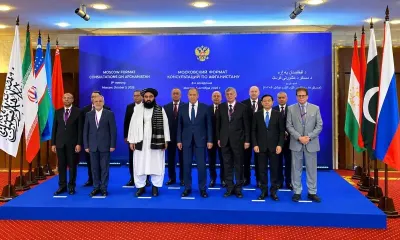
Pakistan’s Special Representative for Afghanistan Mohammad Sadiq on Monday said that terrorism remained at the core of Afghanistan’s problems, reaffirming that Pakistan would continue to take “all appropriate measures” for ensuring the safety of its citizens, in accordance with international law.
Sadiq made these remarks at the eighth meeting of Moscow Format Consultations on Afghanistan in the Russian capital.
The moot brought together Afghanistan and other countries of the region to discuss the situation in Afghanistan and issues of regional concern, the Foreign Office (FO) said in a statement .
Separately, Sadiq post a transcript of his address at meeting, according to which he told the moot that the roots of terrorism emanating from Afghanistan were in a “nexus between the Taliban regime and terrorist groups […] that operate with impunity on Afghan soil”.
“The situation is worsened by external actors and spoilers who support proxies inside Afghanistan to target Pakistan and other countries in the region,” he added.
Sadiq highlighted that five years into the Taliban rule in Afghanistan, “Pakistan faces the most serious security threat”.
Over the last three years alone, he said, more than 4,700 Pakistanis had been killed due to terrorism emanating from Afghanistan.
“No country would tolerate such a situation,” he remarked. “Thousands of innocent Pakistani civilians and security personnel have been martyred in the last few years. a result of terrorist attacks planned, financed, supported and carried out from Afghan soil. The Taliban regime is complicit in this. No responsible state can remain passive when its security is repeatedly undermined. and its people are viciously targeted.”
The special representative said Pakistan’s counterterrorism operations were conducted in response to the terrorist attacks being perpetrated from the Afghan soil.
“These operations are precise, intelligence-based and defensive in nature. Pakistan’s actions are in exercise of its right to self-defence, to ensure the safety and security of its citizens. These actions are directed solely against the terrorist outfits based in Afghanistan that pose a threat to the region and beyond.”
Sadiq continued that Pakistan had been, and would continue to take “all appropriate measures to uphold the safety and security of its citizen in accordance accordance with with international law, and based on the principles of necessity and as a measure of last resort”.
“All measures taken by Pakistan constitute legitimate defensive actions against sanctuaries and bases used for planning, training and launching terrorist attacks inside Pakistan.
“The scale and scope of our actions represent restraint, particularly in light of the severity of the challenge we face.”
Sadiq said Islamabad desired peace in the region and had “remained patiently engaged” in political and diplomatic efforts aimed at addressing terrorism emanating from Afghan soil.
“It is unfortunate that Pakistan’s numerous goodwill gestures and highly responsible approach were misconstrued, resulting in increased terrorist attacks from Afghan soil, with the active support and backing of the Taliban regime.
“Pakistan reiterates its strong resolve and determination to uproot the menace of terrorism emanating from across the border. We call upon the Afghan authorities to end the impunity with which terrorist groups continue to operate from their soil,” he said.
Sadiq also expressed hope that “countries in the region will work together to address the sources of instability in our immediate neighbourhood, with a view to achieving our collective objectives of regional peace, stability and prosperity”.
“We expected the Taliban regime would take concrete and verifiable actions against those terrorist groups. Regrettably, they failed to act in complete disregard for the legitimate security concerns of Pakistan and other countries. We hope that the Taliban will honour their commitments made to the international community,” he said.
Sadiq said Pakistan and Afghanistan were immediate neighbours having historical relations and fraternal bonds.
“Peace and stability in Afghanistan is in the national interest of Pakistan.”
Earlier in his address, Sadiq noted that the meeting was taking place at a “time of immense turmoil”.
“The regional and global environment is fraught with challenges. Proliferating crises across the world, the ongoing conflict in West Asia, and and disruptions in global energy markets have put unprecedented strain on our region and beyond.
“At the same time, regional countries remain highly vulnerable to destabilising threats caused by terrorism, drug smuggling, illegal migration, and human trafficking,” he said.
He noted that it had five years since the transition in Afghanistan, with the Afghan Taliban taking the reins in Kabul in August 2021.
This represented a “critical milestone” to assess the situation on ground, he said.
In the period after August 2021, Pakistan joined the regional countries in the efforts to help stabilise the situation in Afghanistan and address the humanitarian needs of people of Afghanistan, the special representative continued.
“As a close neighbour, Pakistan engaged at the highest level, facilitated humanitarian relief efforts, and provided visas to vulnerable Afghans. Pakistan also extended trade and transit incentives to support Afghan economy, participated in regional initiatives and connectivity projects, and remained at the the forefront of the efforts to facilitate Afghanistan’s integration into the international community.”
These endeavours, he said, were driven by “our shared commitment to a peaceful, stable and prosperous Afghanistan”.
“Our regional engagement had been central to assisting the Afghan authorities as they worked towards rebuilding their country.”
However, he said, despite these efforts, Afghanistan stood at a critical juncture.
“The country faces a deteriorating humanitarian crisis, and is grappling with multiple challenges driven by severe food insecurity, extreme climate shocks, water scarcity, and recurrent natural disasters and permissive environment allowing terrorism to grow.”
While it remained essential to call for sustained support, it was equally imperative to assess the progress towards resolving the legitimate concerns of regional states and the wider international community, Sadiq emphasised.
“Nowhere is the lack of progress more evident than on the issue of counterterrorism, ensuring women’s rights and girls’ education, and promoting inclusivity. Continuing restrictions on women and girls, absence of any meaningful efforts to ensure broad-based governance, and the lack of progress on counterterrorism commitments, not only impede Afghanistan’s long-term development and stability, they also threaten regional security and undermine our collective efforts towards regional peace and prosperity,” he said.
Sadiq said the situation required careful reflection.
“There is a need to ask whether the Taliban regime’s policies have advanced the collective objective of helping ordinary Afghans, and whether these policies have helped Afghanistan in responding to the legitimate concerns of the immediate neighbours,” he said.
According to the FO statement, Russian Foreign Minister Sergey Lavrov also attended the session and addressed the participating delegations.
The consultations at the meeting focused on regional peace and security, counterterrorism, economic cooperation and connectivity, as well as continued engagement with Afghanistan, the FO said.
It added that apart from Sadiq, the delegation from Islamabad included Ambassador to Russia Faisal Niaz Tirmizi, Ambassador to Afghanistan Ubaidur Rehman Nizamani and other senior officials.
The Moscow Format is a Russia-led regional consultation mechanism that was initiated in December 2016.
Cross-border terrorism and fraught Pak-Afghan ties
As its eighth meeting takes place, Islamabad continues to urge the Taliban administration in Kabul to dismantle terrorist sanctuaries on Afghan soil, particularly those linked to the banned TTP, that are used for attacks in Pakistan. Officials say these repeated appeals have gone unheeded.
According to a UN Security Council-mandated monitoring report — covering the period from Dec 16, 2025 to June 9, 2026 — Afghan Taliban’s continued support for TTP has contributed to a rise in the frequency and lethality of terrorist attacks in Pakistan, even as Kabul has taken some initial steps to rein in the group.
The report also points to growing operational and facilitation linkages among TTP, Al Qaeda, ISKP and BLA.
Ties between the two neighbours have been strained in the past few years amid Islamabad’s concern over cross-border terrorism.
On the night of February 26, following unprovoked firing by the Afghan Taliban from across the border, Pakistan launched Operation Ghazab lil Haq against terrorist hideouts.
September witnessed another bout of conflict between Pakistan and Afghanistan.
On Sept 21, in response to recent major terrorist attacks in Khyber Pakhtunkhwa, Pakistan conducted “calibrated” airstrikes in the border region with Afghanistan against terrorist hideouts, with the government saying more than 28 terrorists were killed.
Information Minister Attaullah Tarar described the action as part of Operation Ghazab lil Haq, which was launched on the night of Feb 26 in response to unprovoked cross-border firing by the Afghan Taliban.
Days later, Pakistan shot down eight drones launched from across the border that had entered Pakistani airspace near the Torkham border and Kohat. It was also reported that the Afghan Taliban engaged in unprovoked firing the night before near Kurram as security forces foiled an attempt by terrorists to cross into Pakistan.
In retaliation to the drone incursion, Pakistan conducted “precision aerial and drone strikes” in 10 locations across Afghanistan.
The Foreign Office (FO) said a demarche was also delivered to the Afghan side on account of an airspace violation by drones on Sept 23. The demarche was delivered on Sept 26, the FO spokesperson said in a statement.
On Sept 25, the information ministry had also dismissed claims by the Afghan defence ministry of a Pakistani post having been destroyed near the Spin Boldak border — the frontier between Balochistan and Kandahar.
Then last week, Inter-Services Public Relations (ISPR) Director General Lt Gen Ahmed Sharif Chaudhry said that Pakistan had the right to self-defence and “everything that is necessary will be done” in response to terrorism emanating from Afghanistan .