
Trump Administration Mounts ‘Largest Denaturalization Effort in Modern History’
The Justice Department filed denaturalization actions across multiple U.S. district courts against 40 individuals accused of “serious offenses.”
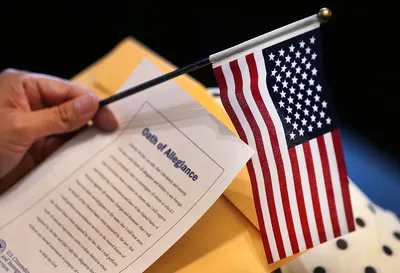
A woman holds an American flag during a naturalization ceremony at the John O. Pastore Federal Building in Providence, R.I., on July 22, 2026. —John Tlumacki—The Boston Globe/Getty Images
Forty foreign-born individuals may lose their U.S. citizenship after the Justice Department filed multiple lawsuits across the country seeking their denaturalization , in the latest instance of Donald Trump’s Administration seeking to remake what it means to be a U.S. citizen .
The Justice Department announced Monday that the denaturalization petitions were lodged against the 40 individuals between Aug. 10 and Oct. 2. They have been accused of a range of “serious offenses,” including child sexual abuse, fraud, and tax evasion.
“Today’s announcement marks the largest denaturalization effort in modern history,” Attorney General Todd Blanche said in the announcement. “From an individual convicted of espionage to others convicted of sexual offenses against minors, these defendants concealed critical facts from the U.S. government and represent serious criminal offenders.” (The Administration touted the “largest coordinated denaturalization effort” in Justice Department history, when it pursued denaturalization against 25 individuals in August.)
Nine of the individuals in the recent group of cases are from Mexico, four are from Pakistan, and two are from China. The other cases involved persons hailing from Afghanistan, Cambodia, Cameroon, Canada, Colombia, Cuba, Egypt, Ghana, Haiti, India, Iran, Nepal, Nigeria, Sierra Leone, Peru, the Philippines, the U.K., and Venezuela. One man’s country of origin is unknown.
More than half of the cases the Justice Department cited involved immigration or identity fraud, and several others involved sexual offenses.
The two people from China included a former U.S. Navy sailor named Jinchao Wei, who was convicted of espionage and was sentenced to more than 16 years in prison earlier this year. The other, a Floridian named Ping Li, was sentenced to four years in November 2024 for conspiring to act as an agent of the Chinese government without notification to the Attorney General.
The announcement this month is an escalation of previous denaturalization efforts that the Justice Department has worked on, as Trump Administration officials claim that the accused have “lied their way” into obtaining U.S. citizenship. In June, the department moved to revoke the citizenships of 17 alleged law violators , another 10 in July , and another 25 in August.
Ramping up denaturalization efforts
Since the 1967 Supreme Court ruling in Afroyim v. Rusk , U.S. citizenship has been largely irrevocable unless the bearer voluntarily renounces it. Foreign-born Americans who obtained their citizenship through naturalization—some 25.8 million based on recent figures —can involuntarily lose it if they lied in the process of obtaining citizenship or if they “illegally procured” it, and the Supreme Court in 2017 required a high bar of proof for stripping citizenship.
But what used to be a rare process reserved for the most egregious offenders has since become common during Trump’s presidential terms. According to the D.C. thinktank Migration Policy Institute , between 1990 and 2017, an average of 11 denaturalization cases were filed per year, and that increased to 25 annually in Trump’s first four years as President.
During his second term, President Trump has made denaturalization a priority again, and has warned about stripping U.S. citizens of their citizenship if they “deserve” it. At one point, Trump leveled the threat at his political enemies like New York City Mayor Zohran Mamdani and tech titan and on-again, off-again ally Elon Musk.
A June 2025 Justice Department memo set categories for priority denaturalization cases, including those against individuals who pose a national security threat, who committed felonies undisclosed during the naturalization process, and those who committed violent crimes, among several others.
An unnamed department official told CNN in June 2026 that the Administration plans to file at least 250 denaturalization cases by this October.
An August report by the Transactional Records Access Clearinghouse says that the true number of denaturalization cases may be higher than what is publicized, “since there is no reliable way to identify every court action,” and the Justice Department is “highly selective about which suits it publicizes and which ones it fails to make public.” Difficulties in accessing court documents also leave the public largely in the dark about the reasons for pursuing denaturalization actions against these individuals, the report added.