
Navi Mumbai leads Centre’s cleanliness rankings as Indore exits top city category
NEW DELHI: Maharashtra's Navi Mumbai ranked as the cleanest city in India in the Swachh Survekshan Awards 2025-26, the Central Government's annual cleanliness survey. It was followed by Surat in Gujarat and Vijayawada in Andhra Pradesh, while Madhya Pradesh's Rewa was declared the cleanest riverfront town and Uttarakhand's Rudrapur emerged as the cleanest Himalayan city.
NEW DELHI: Maharashtra's Navi Mumbai ranked as the cleanest city in India in the Swachh Survekshan Awards 2025-26, the Central Government's annual cleanliness survey. It was followed by Surat in Gujarat and Vijayawada in Andhra Pradesh, while Madhya Pradesh's Rewa was declared the cleanest riverfront town and Uttarakhand's Rudrapur emerged as the cleanest Himalayan city.
In the 10 lakh-plus population category, Greater Visakhapatnam emerged as the cleanest city, followed by Jabalpur and Lucknow. Among cities with a population of 3-10 lakh, Ujjain topped the cleanliness rankings, with Chandigarh and Guntur securing the second and third positions, respectively. The results of Swachh Survekshan 2025-26 were announced on Wednesday.
Indore, which had been ranked the cleanest city for eight consecutive years, was placed in a different category this year, securing the second position in the Mentor City category along with its partner town, Depalpur, under the newly introduced 'Swachh Shehar Jodi' initiative.
The initiative is a city-to-city mentorship and peer-learning programme launched under the Swachh Bharat Mission-Urban. It involves 72 mentor cities and around 200 mentee cities. Based on their performance in the cleanliness survey, top-performing cities have been identified as mentors and paired with lower-performing towns.
Ahmedabad and its partner town Sanand secured the top position in this category, while Tirupati and its partner town Kuppam ranked third.
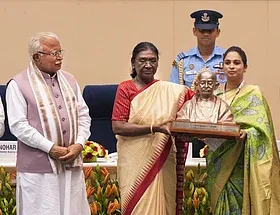
President Droupadi Murmu presented the awards to the winners at a ceremony in New Delhi. More than 4,700 urban local bodies participated in the survey.
In the cleanest riverfront towns category, Rewa topped the list, followed by Bilaspur and Varanasi. In the Swachh Coastal Town category, Puri secured the first position, followed by Kerala's Alappuzha and Maharashtra's Ratnagiri. Rudrapur emerged as the cleanest Himalayan city, while Jammu and Shopian secured the second and third positions, respectively.
Among urban local bodies with populations of 50,000 to three lakh, Madhya Pradesh's Dewas ranked first, followed by the New Delhi Municipal Council (NDMC) and Sagar. In the 20,000-50,000 population category, Maharashtra's Vita topped the list, followed by Aska in Odisha and Panaji in Goa.
NDMC Chairman Manoj Kumar Dwivedi and Vice-Chairperson Kuljeet Singh Chahal received the award at Vigyan Bhawan. The council's second-place ranking marks a change from the previous year, when it was recognised as a 'Super Swachh League City' in Swachh Survekshan 2024-25.
NDMC was ranked the cleanest small city in the country in the one-to-three-lakh population category in 2022 and was recognised as the cleanest Union Territory in 2023. It was also named the cleanest capital city in 2020 and topped the one-to-three-lakh category in 2018, 2019 and 2021, according to its year-wise performance records.
The council attributed its latest ranking to mechanised cleaning, night-time sweeping operations, scientific waste management and public participation.
NDMC has deployed 11 mechanical road sweepers and 20 gobbler machines, besides specialised jetting equipment for cleaning roads, footpaths and public spaces, Chahal said. It has also strengthened night-time cleaning operations to remove waste accumulated during the day without disrupting traffic and commercial activities.
The council processes around 300 tonnes of municipal solid waste every day against an available processing capacity of 509 tonnes. It has eight Micro Material Recovery Facilities and a network of Reduce, Reuse and Recycle centres to promote waste segregation and recycling.
Chahal said the recognition reflected the council's efforts to improve cleanliness through modern technology, mechanisation, scientific waste management and public participation. Dwivedi said the objective was not merely to secure a better position in cleanliness surveys but also to provide a clean and healthy environment to residents and visitors.
The Housing and Urban Affairs Ministry said the performance of cities participating in the mentorship programme had improved across several cleanliness indicators between the 2024-25 and 2025-26 surveys.
Visible cleanliness among mentee cities increased from 48 per cent to 70 per cent, while door-to-door waste collection rose from 52 per cent to 74 per cent. Source segregation improved from 16 per cent to 30 per cent, access to sanitation from 11 per cent to 38 per cent, and used water management from 32 per cent to 53 per cent. Advocacy for cleanliness increased from 48 per cent to 66 per cent, the ministry said.
More than 3,000 trained assessors conducted on-ground evaluations across the country, supported by real-time GPS-enabled monitoring. The ministry said the assessment process, from evidence submission to verification, was fully digital and subject to quality checks at every stage.
(With inputs from PTI)