
Isaias becomes the first hurricane of the Atlantic season as it surges towards US Gulf Coast
Isaias surged towards the U.S. Gulf Coast on Thursday after strengthening into the first hurricane of the Atlantic season, the National Hurricane Center said, prompting mandatory evacuations and school closures in some coastal areas of Florida. Forecasters warned Isaias could bring damaging hurricane-force winds to parts of the Florida Panhandle, southern Alabama and southern Mississippi, while also potentially causing a life-threatening storm surge along areas of the northern Gulf Coast.
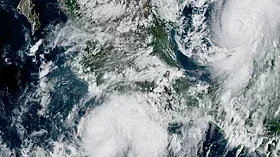
Isaias surged towards the U.S. Gulf Coast on Thursday after strengthening into the first hurricane of the Atlantic season, the National Hurricane Center said, prompting mandatory evacuations and school closures in some coastal areas of Florida.
Forecasters warned Isaias could bring damaging hurricane-force winds to parts of the Florida Panhandle, southern Alabama and southern Mississippi, while also potentially causing a life-threatening storm surge along areas of the northern Gulf Coast. It could also bring heavy rains of 3 to 7 inches (7 to 18 centimeters) across the central Gulf Coast, according to the hurricane center.
The center of the cyclone was about 460 miles (740 kilometers) south-southwest of the Mississippi River's mouth, with maximum sustained winds around 75 mph (121 kph), according to an advisory from the Miami-based hurricane center.
After the storm initially formed earlier Wednesday in the warm waters of eastern Mexico, communities in its potential path moved quickly to prepare with landfall forecast as soon as Friday evening. Some Gulf oil wells paused production, and at least four Florida school districts canceled classes for later in the week while Okaloosa County announced mandatory evacuations for some coastal areas. Governors in Florida and Alabama declared a state of emergency for dozens of counties.
The National Weather Service told communities from Ocean Springs, Mississippi, to Gulf County, Florida, to prepare for the possibility of "long-duration power outages."
The hurricane formed late in the season
Isaias is developing more than four months into the Atlantic hurricane season, nearly tying a 121-year-old record for the area's latest-forming hurricane. According to the National Weather Service, the record dates to 1905, when the year's first Atlantic hurricane formed on Oct. 8.
The Atlantic hurricane season has been unusually quiet this year because of a strong El Niño, which disrupts storm formation over that ocean. Storm activity has been above average in the Pacific, where Tropical Storm Simon formed Wednesday off Mexico.
Isaias is expected to strike along a wide swath of coastline that's very familiar with major hurricanes.
One of the 20th century's worst storms, Hurricane Camille, killed more than 250 people after hitting land near Waveland, Mississippi, in 1969. Hurricane Katrina in 2005 razed neighborhoods in Mississippi, flooded New Orleans and killed nearly 1,400 people. And Hurricane Michael leveled homes and buildings near Panama City, Florida, in 2018.
Oil production and tourism already affected
Ahead of the storm, oil and gas producers shut down a significant share of offshore production in the Gulf, which accounts for almost 15% of crude pumped annually in the U.S.
As of Wednesday about 25% of the oil production in the region was temporarily halted, taking about 511,000 barrels a day off the market, according to the Marine Minerals Administration. It said eight of the Gulf's 371 manned oil platforms were evacuated.
With oil prices already high, the production cuts are steep enough to affect markets, though other Gulf hurricanes have caused larger disruptions, said Jim Burkhard, global head of crude oil market research for S&P Global Energy. More concerning, he said, is whether Isaias strikes as a powerful storm near refineries.
As it moves inland, Isaias might also disrupt Saturday's college football showdown between rivals Georgia and Alabama, a game President Donald Trump has planned to attend.
In Alabama, the cities of Gulf Shores and Orange Beach issued a statement encouraging people in low-lying areas to voluntarily evacuate.
Gulf Shores resident Maranie Adams gathered water and other supplies as her family moved belongings, including a hot tub motor, to higher ground. Her family planned to ride out the storm at home, roughly a half-mile from shore, sheltering indoors alongside their flock of chickens.
"We're having to get crates to bring them into the house so they don't blow away," Adams said. "It's going to be noisy."
Alabama Gov. Kay Ivey issued a state of emergency for 40 counties, while Florida Gov. Ron DeSantis declared one for 25 counties in the Panhandle and Big Bend regions. The state also planned to deploy a Miami-based urban search and rescue task force.
In Pensacola, electric utilities were pre-positioning crews to quickly repair any power outages. City officials provided sand for residents to fill sandbags to protect their homes against flooding. And Mayor D.C. Reeves urged people to check on older adult neighbors and others who might need help.
"Obviously no need to panic at this point," Reeves told a news conference. "This is really about preparation."