
Israel's war on Lebanon threatens climate goals, minister says
Lebanon ’s climate targets are being threatened by the environmental destruction wrought by Israel's military campaigns and occupation of the south, Tamara El Zein, Lebanon's Environment Minister, has said. “If we don't take environmental recovery into consideration, some of our targets will not be reached,” Ms El Zein told The National in an interview at the Cop31 climate summit in Turkey. Lebanese Prime Minister Nawaf Salam is to address the talks on Thursday.
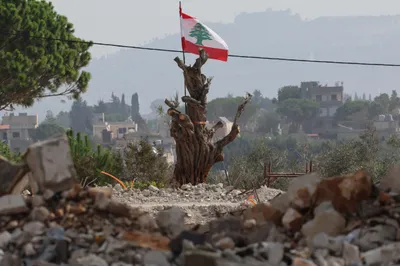
Lebanon ’s climate targets are being threatened by the environmental destruction wrought by Israel's military campaigns and occupation of the south, Tamara El Zein, Lebanon's Environment Minister, has said.
“If we don't take environmental recovery into consideration, some of our targets will not be reached,” Ms El Zein told The National in an interview at the Cop31 climate summit in Turkey.
Lebanese Prime Minister Nawaf Salam is to address the talks on Thursday.
Years of Israeli warfare have left farmland unusable, destroyed crops, forests and marine life, contaminated soil with phosphorus, and released toxins into the air over wide areas, said a report this year by Lebanon’s National Council for Scientific Research. In its foreword, Ms El Zein said the damage was an “act of ecocide”.
While some tree cover might be lost to forest fires in any year, the losses have multiplied as a result of Israeli attacks since 2023, Ms El Zein told The National in the Mediterranean city of Antalya, as heads of state gathered for the annual climate summit.
“From October 2023 until September 2026, we have already lost 16,000 hectares – completely burnt because of phosphorus bombardment or traditional munitions,” she said. Ms El Zein said a loss of 1,500ha a year would be more typical.
Alongside the burning of forest cover, which acts as a natural carbon sink and can help to reduce emissions, Ms El Zein said the uprooting of trees in Israeli operations and the spraying of glyphosate, a controversial herbicide, over areas of southern Lebanon were causing great damage to the environment.
The Israeli occupation also makes it difficult to monitor and fix environmental damage. “We cannot reach all the areas because it is still occupied by the Israeli army,” said Ms El Zein, a physical chemist by training.
In aiming to meet its climate commitments, “Lebanon is not going from the baseline zero,” but from “minus, minus, minus", she added.
Conflict broke out in Lebanon between Israel and the militant group Hezbollah in 2023 and continued throughout 2024 before a ceasefire was reached. Fighting broke out again in Lebanon in March 2026 after the US and Israel began a war with Iran.
Climate targets
Lebanon is a full signatory to Paris Agreement, a 2015 treaty to limit global warming, and has put forward targets to reduce carbon emissions to net zero by 2050, as well as to increase renewable energy generation.
As its nationally determined contribution – commitments made by countries to limit climate change under the Paris Agreement – it aims to reduce carbon emissions by at least 22 per cent and obtain a quarter of its electricity from renewable sources by 2035.
Ms El Zein said that the war had added “another layer” to existing environmental challenges but that Lebanon is “fully committed” to its climate goals. Nonetheless, its leaders face huge challenges in deciding how to spend their budget after the Israel-Hezbollah war.
Lebanon’s national adaptation plan to face the challenges of climate change needs $11 billion to the year 2035, but damage and losses from conflict since 2023 are estimated at more than $20 billion, Ms El Zein said.
“So priorities are, as you can see, shifting,” she said. It may be possible to link Lebanon’s adaptation to climate change with post-conflict reconstruction, but that will still need funding.
“We can somehow link between the two priorities, as we can consider that even reconstruction might be within a kind of concept of ‘build back better’ where environmental and climate resilience are included,” she said. “But still, as long as we don't have enough investment to move forward, it will be very, very difficult to implement.”
Postwar needs
Another challenge is the balance between environmental protection, tackling climate change, and the immediate realities of war-affected Lebanese struggling to get by every day. More than 300,000 people remain displaced, the UN said at the end of last month, and tens of thousands of homes have been damaged or destroyed.
The conflict has produced an estimated 26 million tonnes of rubble since 2023 and villagers wanting to go home “will not be waiting 'til you are doing sustainable rubble management", Ms El Zein said.
Lebanon is trying to approach the issue of rebuilding while being “environmentally and climatically compliant", she added. “It will be complicated because also it requires additional funding. It requires maybe more time. So we need to find the good balance between all these factors.”
Lebanon’s delegation at the Cop31 conference will highlight in negotiations the need for what Ms El Zein described as “special treatment” in climate financing funds for countries made fragile by war, whose situation can change drastically in the time it takes for applications to be approved.
“For all these multilateral funds, there must be a specific treatment for fragile countries like Lebanon, mainly after wars,” she said. “They should put also some kind of accelerated track, because our priorities are shifting from year to another, while any application will take at least two to three years to be approved.”