
Great Sphinx rocks reveal new species of crocodile
Fossils recovered a century ago in the rocks that make up the 45-million-year-old Mokattam Formation in Egypt have revealed a new species of crocodile. The rocks, used to build the Great Sphinx , contained the skull of a crocodile, missing only the tip of its snout. It has been named Herugavialis cairensis.
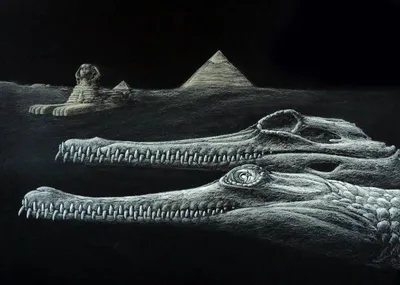
Fossils recovered a century ago in the rocks that make up the 45-million-year-old Mokattam Formation in Egypt have revealed a new species of crocodile.
The rocks, used to build the Great Sphinx , contained the skull of a crocodile, missing only the tip of its snout. It has been named Herugavialis cairensis.
“Given this coincidence with the famously missing nose of the Great Sphinx, we decided to name the new crocodile after the Egyptian god Heru, who was possibly the inspiration for this iconic monument,” said Prof Philip Mannion of University College London, who co-led the study published in the Royal Society Open Science journal.
It was thought the fossil belonged to the Tomistoma schlegelii species of freshwater crocodiles, but it has now been reclassified owing to analytical advances in palaeontology. A CT scan was used to look inside the skull, allowing an international team of researchers to identify several differences between the fossil and Tomistoma.
They belong to a group of crocodiles known as gavials, which are today found only on the Indian subcontinent and in South-East Asia. But the fossil record of gavials documents a near-global distribution, spanning more than 100 million years.
Herugavialis was not the only crocodile in Egypt at the time. The shallow marine environments that covered much of the region were also home to at least two other species of gavials.
“Throughout much of the last 50 million years, the Mediterranean region hosted a high diversity of crocodiles, including gavials,” said Dr Paul Burke, a researcher at the Swedish Museum of Natural History in Stockholm and lead author of the study. “However, this diversity fluctuated over time, seemingly corresponding to changes in global temperature and sea level, before the loss of all crocodiles in this region as a result of the drying of the Mediterranean approximately six million years ago.”
The Great Sphynx – with the head of a human and the body of a lion – lies on the west bank of the Nile in Giza. It was sculpted from the limestone rock of the Mokattam Foundation about 5,000 years ago and is 20 metres tall.