
Trump claims Xi won’t invade Taiwan as US sees China’s war plans delayed
China's military readiness has been hampered by Xi's sweeping anti-corruption purge
 TRUMPBUTT$TBUTT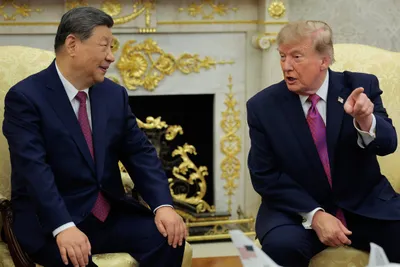
Want to bookmark your favourite articles and stories to read or reference later? Start your Independent Membership today.
American officials increasingly believe China is unlikely to attack Taiwan before 2028, despite President Xi Jinping ordering his military to be able to seize the island by force by 2027, according to sources familiar with Washington's assessments.
China's military readiness has been hampered by Xi's sweeping anti-corruption purge, while Beijing may also want to see the outcome of Taiwan's 2028 presidential election before deciding its next move, two serving US officials, a former official and another person familiar with the matter said.
But the risk of military action could rise significantly if Taiwan's ruling Democratic Progressive Party wins an unprecedented fourth consecutive presidential term, particularly if President Lai Ching-te is reelected.
"If that happens, I think 2028 becomes pretty sporty," one US official said.
Lai and the DPP champion Taiwan's separate identity, angering Beijing, which considers the self-governed island part of its territory. Taiwan rejects China's sovereignty claims and says its people can decide its future.
The assessment marks a shift from concerns about 2027, when Xi ordered the People's Liberation Army to be capable of taking Taiwan by force. US officials have long viewed the date, which marks the PLA's centenary, as a military readiness target rather than a firm invasion deadline.
Beijing has never publicly acknowledged plans to attack Taiwan in 2027 and continues to say it favors peaceful "reunification," while refusing to renounce the use of force.
US intelligence agencies have also previously identified signs of caution. In their annual threat assessment in March, they said Beijing had no fixed timeline for invading Taiwan and continued to prefer taking control of the island without war if possible.
The Pentagon declined to comment. The Chinese Embassy in Washington and Taiwan's representative office did not immediately respond to requests for comment.
Washington remains Taipei's primary global benefactor and defense vendor despite lacking official diplomatic relations, though American officials provided varying views regarding how heavily Beijing might weigh the outcome of the 2028 U.S. presidential election when evaluating potential military maneuvers.
Although three sources said Chinese strategists might want to gauge the U.S. political outcome—especially amid waning public enthusiasm in America for overseas military engagements—the primary U.S. official emphasized that Beijing considers both Democratic and Republican parties essentially unified in their firm backing of Taiwan.
While Chinese leadership might prefer a certain outcome in the 2028 American vote, "it doesn't become as decisive a factor in my opinion, as it might have been 15 years ago," the official said.
President Donald Trump has consistently minimized the threat of an imminent Chinese assault on Taiwan under his watch, claiming publicly last year that Xi personally assured him Beijing would abstain from invading while he remained in power.
Trump offered brief remarks on Taiwan after his bilateral meeting with Xi in Washington last week, confirming only that Taiwan came up during their exchange and that Xi fully understood his stance.
Beijing repeatedly describes Taiwan as its paramount political priority and a non-negotiable matter touching upon sovereign integrity.
China has persistently demanded a complete halt to American military aid to Taiwan. Following his May visit to Beijing, Trump suspended approval of an approximate $14 billion arms deal, characterizing the military assistance package as a leverage tool or "negotiating chip."
Decades of American policy have concentrated on bolstering Taiwan's defensive capacity, enabling the island to withstand an initial Chinese offensive until Washington and partner nations can intervene defensively.
Chinese leader Xi has not formally abandoned his directive ordering the People's Liberation Army to possess full operational capability to seize Taiwan by force next year, officials noted.
However, the armed forces failed to meet their target operational benchmarks over the past year because Beijing's extensive anti-corruption sweep disrupted progress, sources explained.
Since assuming power in 2012, Xi has spearheaded an uncompromising campaign targeting corruption and party disloyalty. Millions of bureaucrats across China's state apparatus have faced investigation, resulting in the downfall and removal of numerous high-ranking party leaders, officials, and commanders.
Recently, the People's Liberation Army became a primary focus of this internal purge. A wave of high-level inquiries and dismissals leaves only two active members on the once seven-person Central Military Commission, including Xi, who remains chair.
Chinese military maneuvers last year were visibly smaller in scale and less aggressive than in previous periods, according to the U.S. official. Although drills expanded somewhat this year, the official indicated top Chinese military commanders remained privately dissatisfied with force readiness levels.
The official noted Beijing appears to have extracted critical insights from recent conflicts in Iran and Ukraine, realizing that an invasion requires immediate, overwhelming success to prevent becoming entangled in an exhausting, prolonged war of attrition.
Significant operational hurdles remain unaddressed.
"There are way too many pieces that aren't quite in place yet for what would be the most difficult military operation any military has attempted probably since the Allied invasion of Normandy," the official said.
Join thought-provoking conversations, follow other Independent readers and see their replies