Lethal Hurricane Polo threatens to unleash deadly flash floods across US Southwest
Hurricane Polo has made landfall in Baja California with flash flooding and winds described by forecasters as a “life-threatening.”
Want to bookmark your favourite articles and stories to read or reference later? Start your Independent Membership today.
Flash flooding and winds meteorologists described as "life-threatening" accompanied Hurricane Polo as it made landfall early Tuesday in Baja California, Mexico.
According to the U.S. National Hurricane Center in Miami , the Category 2 storm hit land slightly south of Las Barrancas. Roughly 80 miles (130 kilometers) north of Cabo San Lazaro and 70 miles (115 kilometers) south of Mulege, the system carried maximum sustained winds of 110 mph (175 kph) and moved northeast at 13 mph (20 kph).
Officials noted that Polo had previously reached Category 3 status on Monday, recording peak winds of 115 mph (185 kph). Rainfall totals of 6-12 inches (about 15 to 30 centimeters) were projected to soak regions across Baja California Sur.
Heavy rain and severe flooding could also extend into portions of the U.S. Southwest as the week progresses, following earlier forecasts warning of dangerous winds and intense flash floods as Polo moved toward mainland Mexico.
Concurrently, Tropical Storm Rachel was tracking parallel to the Mexican coastline early Tuesday morning. About 300 miles (485 kilometers) west-southwest of Acapulco and 315 miles (505 kilometers) south of Manzanillo, Rachel had sustained winds of 60 mph (95 kph) as it moved west-northwest at 12 mph (19 kph).
Elsewhere in the Pacific , Hurricane Nolo remained a major storm on Monday evening, though it was gradually moving away from Hawaii .
Baja California peninsula was preparing for Polo
In the northern Mexican state of Sonora , officials announced Monday night the suspension of all "nonessential" public operations, halting academic, athletic, and non-critical work functions across the capital and over a dozen surrounding municipalities.
Naval forces in Mexico mobilized personnel along the northern Pacific shore, dispatching three ships equipped to deliver emergency supplies to seaside towns stranded by the weather. Local leaders on the Baja California Peninsula opened temporary shelters, while regional ports were shut down and local travel was halted.
Pacific storm activity greater than normal this season
Tropical weather in the Pacific basin has outpaced typical levels at the height of the season, National Weather Service lead forecaster Bob Oravec noted. He pointed out that this elevated activity aligns with El Niño cycles, which often produce more tropical systems.
Downpours are anticipated to spread across the U.S. Southwest, dropping several inches of rain over Texas , New Mexico , Utah , and Arizona . The region's dry terrain and sparse plant cover leave rocky canyons particularly vulnerable to sudden inundation, Andrew Mangham, senior service hydrologist for the National Weather Service based in Albuquerque , New Mexico, explained.
"We’re getting caught up here in a very, very short time," Mangham said. "And that’s not really what we want. We want nice rains, you know, all summer long."
Floods and mudslides remain a risk in Hawaii
By Monday, Hurricane Nolo was located roughly 425 miles (685 kilometers) west-southwest of Honolulu and 330 miles (535 kilometers) south-southeast of French Frigate Shoals. The storm maintained top winds of 120 mph (195 kph) while advancing north-northwest at 15 mph (24 kph).
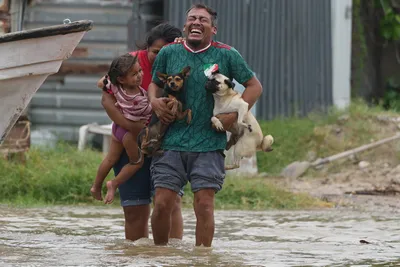
Over the weekend, Nolo brought heavy rainfall to southern and southeastern areas of Hawaii's Big Island . A Facebook update from the U.S. National Guard confirmed that Hawaii National Guard personnel pulled 19 residents to safety from floodwaters over the weekend.
As the system moved toward the Papahanaumokuakea Marine National Monument, a protected marine reserve, weather forecasters cautioned that hazardous conditions could affect the area beginning Tuesday.