
Bosnian Serb nationalist Dodik declares party victory in Bosnia election
Staunchly pro-Russia politician has dominated campaign and inflamed divisions despite not appearing on ballot Bosnian Serb nationalist politician Milorad Dodik has declared victory for his party in an election in Bosnia shaped by economic pressures, the prospect of the Balkan nation joining the European Union and ethnic tensions that have divided the country since its brutal 1992-95 war. Dodik is a staunchly pro-Russia politician who, despite not appearing on the ballot, has dominated the campaign and inflamed divisions with separatist rhetoric that has sparked fears of renewed instability in Bosnia. Continue reading...
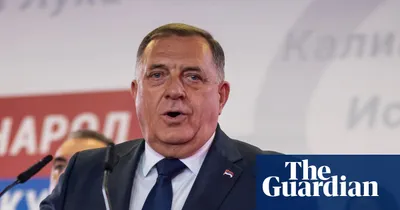
Staunchly pro-Russia politician has dominated campaign and inflamed divisions despite not appearing on ballot
Bosnian Serb nationalist politician Milorad Dodik has declared victory for his party in an election in Bosnia shaped by economic pressures, the prospect of the Balkan nation joining the European Union and ethnic tensions that have divided the country since its brutal 1992-95 war.
Dodik is a staunchly pro-Russia politician who, despite not appearing on the ballot, has dominated the campaign and inflamed divisions with separatist rhetoric that has sparked fears of renewed instability in Bosnia.
Formerly the president of the country’s Serb-majority entity of Republika Srpska, Dodik was banned from holding public office after being convicted last year of defying decisions by the international envoy overseeing the 1995 peace agreement that ended the war.
With nearly 90% of votes counted, Dodik’s ally Željka Cvijanović of the rightwing Alliance of Independent Social Democrats had more than 55% of the votes to take one of the three seats in the country’s tripartite presidency, leading her nearest opponent by about 30 percentage points.
Speaking at a news conference late on Sunday, Dodik said his nationalist party would also hold a “vast majority” in Republika Srpska’s assembly, and credited US president Donald Trump’s “magnificent victory” in 2024 and Russian president Vladimir Putin’s support for the election win.
“No one should ask us to change our politics,” Dodik said. “We will not give up, but continue for our people … I cannot believe that we smashed it like this.”
About 3.4 million voters were eligible to choose the three members of the country’s multi-ethnic presidency, lawmakers for the national parliament and heads of institutions for the country’s two entities: the Muslim-majority Federation of Bosnia and Herzegovina and Republika Srpska, which is dominated by ethnic Serbs.
With more than 94% of votes counted on Sunday, Darijana Filipović of the nationalist Croatian Democratic Union of Bosnia and Herzegovina held a commanding lead for the Croat seat on the presidency, while the incumbent Bosniak member of the presidency, Denis Bećirović of the Social Democratic party, led his nearest opponent, Bakir Izetbegović, by fewer than three percentage points.
Both Filipović and Bećirović declared victory in their races late Sunday before all votes were counted.
Bosnia’s central election commission said that 1,432,269 votes were cast in total, a turnout of 42% that was down by about 8% from Bosnia’s last election in 2022.
Bosnia has a complex web of governing institutions that were created by a US-brokered peace agreement in 1995 in an effort to manage the ethnic divisions between Muslim Bosniaks, Orthodox Serbs and Catholic Croats that gave rise to the war.
Yet Dodik has consistently tested those limits, openly defying Bosnia’s national government in the capital Sarajevo and making moves for Republika Srpska to separate from the country.
At his party’s final election rally on Friday night in Banja Luka, Republika Srpska’s administrative capital, Dodik told supporters that Bosnia “is dead”.
“It is an impossible country. It doesn’t make any sense,” Dodik said at the rally, which was also attended by Russian ambassador Igor Khalabukov.
Such political and ethnic divisions – in which the country’s Bosniaks, Serbs and Croats largely vote along ethnic lines – have blocked Bosnia’s progress toward joining the EU despite the bloc’s efforts to encourage the country’s divided leaders to work together for reform.
Dragan Bursać, an analyst, said that despite Dodik not appearing on the ballot for the first time in nearly 30 years, he “is still in command. He is everywhere.”
“It is obvious that these measures to ban him from political life are not working, and he is using them,” Bursać said.
One of the poorest countries in Europe, Bosnia is still struggling to recover decades on from the war, which started in 1992 after the country declared independence from the Serb-led former Yugoslavia and ethnic Serbs took up arms to carve out their own state and join Serbia. The conflict killed more than 100,000 people and displaced millions.
Bosnia’s wartime wounds were recently revived by a public homage in Serbia and among Bosnian Serbs to the wartime army commander Ratko Mladić, who died in late August while serving a life sentence for genocide and other war crimes.