
‘All I want to do is cry’: trauma of 7 October survivors three years after the attacks
Israeli communities shattered by Hamas masacres are torn between rebuilding their lives and remembering lost friends and relatives Keith Siegel spent many of his long hours in Hamas captivity in Gaza etching everything that happened after 7 October 2023 into his memory. For 484 days, he recited to himself every place he was held, the dates he was moved and every attack or humiliation he endured or witnessed. He aimed to store intelligence that could help Israeli forces free other hostages if he was released, to keep track of time as the days slid by and be able to tell his family what happened to him. Now his body is free, but he cannot loosen those memories. Continue reading...
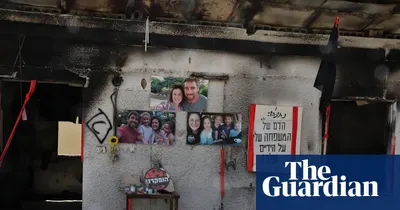
Israeli communities shattered by Hamas masacres are torn between rebuilding their lives and remembering lost friends and relatives
Keith Siegel spent many of his long hours in Hamas captivity in Gaza etching everything that happened after 7 October 2023 into his memory. For 484 days, he recited to himself every place he was held, the dates he was moved and every attack or humiliation he endured or witnessed.
He aimed to store intelligence that could help Israeli forces free other hostages if he was released, to keep track of time as the days slid by and be able to tell his family what happened to him. Now his body is free, but he cannot loosen those memories.
“I’m living a kind of dual life,” he said in an interview in Tel Aviv. “I’m here for some of the time, and I’m in Gaza some of time. It’s very challenging to convey in words what it was like.”
Siegel and his wife, Aviva, were among 251 people taken captive to Gaza on the deadliest day in Israel’s history, when Hamas militants broke across the border to launch a wave of attacks on kibbutzim, border towns, military bases and music festivals.
Israel’s security forces were caught by surprise, and by the time they regained control of the area, 1,209 people had been killed, the majority of them civilians, including 36 children, according to records kept by the Israeli newspaper Haaretz.
The cemetery at Nir Oz contains two lines of fresh headstones, marking lives that all ended on that same date. A shared plot for a family of five – a mother, father and their three young children – has been made into a garden with space left for their still-living grandparents.
Caretaker Shlomo Margalit, who will soon turn 89, points to the graves of three of his oldest friends, founding members of the kibbutz who came to Nir Oz from Haifa with him in the 1950s.
“This is my life project, as well as my home,” Margalit said, explaining why he has come back to a place of such loss. He is waiting for a new house but, for now, staying in the former home of Gadi Moses, 82, who survived 482 days as a hostage.
The graves he tends are a silent testament to the brutality of the attacks and the scale of the state’s failure, which in Nir Oz was staggering, even on a day of terrible failures.
A five-person volunteer defence force held Hamas at bay for at least two hours, Margalit said. When they had all been shot, the kibbutz was taken over and sacked, homes burned, families slaughtered and kidnapped.
Then, before the first Israeli soldier arrived, the Hamas forces, other Palestinian gunmen and civilian looters all left. Nir Oz had been forgotten by the army and ripped apart without the military firing a single shot to defend it.
In total, 47 people were killed and 76 taken to Gaza, including Shiri Bibas , her 10-month-old baby Kfir and four-year-old Ariel, who were killed in Gaza. The dead and hostages represented more than a quarter of the small community.
Revisiting that terrible day, and the trauma that followed, is painful and exhausting for Margalit, but he still accepts interviews for a simple reason. “I want people to know what really happened here,” the 89-year-old said.
The third anniversary of the 7 October attacks falls a few weeks before national elections, and much of the country is caught up in a furious debate about responsibility for the deadliest day in Israel’s history and the conduct of the war that followed.
Survivors and bereaved relatives are avoiding the political fray, still grappling with the trauma and the struggle to rebuild something like normality.
In Nir Oz, there is a terrible, almost irreconcilable struggle between re-establishing the kibbutz as a living community, and preserving physical testimony of the attack.
The cemetery echoes with the sound of construction and families have already moved into several rows of new houses near the kibbutz entrance.
But on the other side of the compound, paths still lead between blackened ruins and memorials to the dead. Some bereaved survivors want the homes of loved ones preserved this way as permanent monuments to mark their loss.
“There are families that can’t [bear to] live here, but want a memorial place to come to visit,” Margalit said. “On the other hand, can you build a new kibbutz where children grow up running around between burnt houses?”
He is on the remembrance committee and, two years on, they are struggling to reach a decision on this impossible choice. “Is there right or wrong here? No,” he said. “We are dealing with that, trying to find an answer.”
One compromise might be a memorial garden on the border of the kibbutz. For now, there are plaques with the stories of families attacked on that day and a memorial house to remember the dead and kidnapped.
When the kibbutz took a collective decision to return and rebuild, Margalit and his wife, Hanna, knew they wanted to join. His only concession to the trauma was asking for a new home that did not face Gaza.
“I’ve found myself building this place for the second time,” he said. “I know when I’m gone, I will have done something with my life. I took part in putting this spot on the map.”
The Siegels, who lived in the nearby kibbutz of Kfar Aza, also among the worst hit, have decided not to return as they focus on mental and physical recovery. Aviva was 62 when she was kidnapped. Keith was 64.
“ What happened to me in Gaza, what happened with Keith in Gaza, it’s there all the time,” said Aviva.
“I understand that it’s going to be a process of healing. There’s always things that remind me, and if I don’t remember, then he reminds me. If I’m cooking lunch or making a cup of tea and I turn around and see Keith with tears in his eyes, because he just read something or let himself feel.”
The days approaching the anniversary have been particularly difficult, she said. Last year, at this time, she was still campaigning for the release of other hostages, her own emotions held at bay by the urgency of that campaign.
For a time, she tried to deal with the trauma by telling herself, over and over again “I must feel lucky,” simply because she had made it back alive.
Now she has allowed herself to feel again, and as 7 October approached, she has realised how raw the wounds still are. “Getting ready [for the anniversary] has been very very painful,” she said. “The last couple of weeks all I want to do is cry. Now I’m feeling things I didn’t feel before.”
“When I hear my grandson say he is afraid of being kidnapped in the middle of the night, it breaks my heart.”
She has written a book, Survived to Tell , about the ordeal, which she describes as therapy and an act of celebration. She wrote so her grandchildren could read about what she and Keith endured, for other hostages who couldn’t tell their own stories and to inspire a broader audience in Israel and beyond.
After the exhausting campaign to get Keith and other hostages home, she said she had struggled to concentrate on the election. Keith’s political focus is an independent inquiry into 7 October to prevent other families suffering as his has.
He said: “There needs to be an investigation to understand how this happened, in order to do everything possible that it won’t happen again. So many people were killed, injured, traumatised.”
Benjamin Netanyahu, the prime minister, has fiercely opposed an independent state commission of inquiry. Critics say he is afraid it would expose his own failings.
In the immediate aftermath of the attacks, few people inside or outside Israel expected him to stay in power long, particularly as the country’s coalition governments have rarely served out their full terms.
Netanyahu had for years championed a foreign and security policy based on the premise that Hamas was “contained” in Gaza, behind unbreachable layers of fortifications.
The security officials who were in command that day have all stepped down yet, three years on, Netanyahu is still in power, having deflected all demands for his resignation.
Yaakov Godo, a bereaved father, interrupted Netanyahu’s speech at the official commemoration event this year to accuse him of negligence.
“You did not protect my son on 7 October, you did not protect 1,200 people murdered in one day. Shame!” he shouted, before being ushered away.
Both US and Israeli officials have said Netanyahu rejected ceasefire deals that could have halted the war in Gaza and brought many Israeli hostages home sooner. But criticising the prime minister means venturing into a vicious political debate where age and loss offer little protection.
Yocheved Lifshitz, 88, was taken hostage from Nir Oz with her husband Oded, whose magnificent cactus garden blooms at the heart of the kibbutz. He died in Gaza, she survived and since her return she has been a vocal critic of Netanyahu.
A candidate for Netanyahu’s Likud party, Itzik Bonzel, said last month that he wished he could turn back the clock and return her to Hamas captivity. He later apologised, blaming grief for his son who died fighting in Gaza, but Lifshitz denounced it as a proxy attack driven by the prime minister.
Netanyahu, who is battling a corruption trial and could be more vulnerable legally if he loses power, is pushing to intensify Israeli attacks on Gaza and his coalition partners are calling for ethnic cleansing and annexation of Palestine .
The war Israel launched in response to 7 October has killed more than 74,000 Palestinians, the majority of them civilians, including about 20,000 children.
Netanyahu has also waged a years-long campaign to dismantle institutions protecting democracy inside Israel’s 1967 borders. Palestinians under Israeli military rule in the occupied West Bank do not have the rights of Israeli citizens.
Many Israelis opposed to this rightwing vision of perpetual war in a state with diminished institutions consider this election the most critical since Israel was founded in 1948, among them Margalit.
Nir Oz, like many communities targeted by Hamas, had its roots in the leftwing Zionist movement, and although the brutality of 7 October pushed some to the right, others saw their pain as bitter proof that war alone cannot offer long-term security.
“I don’t believe we can ignore the fact that Palestinians live here,” Margalit said. “We have to find a way we can live here with them and be secure. I don’t have an answer, I just know we are here to stay and they are here to stay. Maybe we need someone from the outside.”