
US-led coalition ends mission in Iraq years after IS defeated
After more than a decade, the US-led coalition yesterday ended its mission in Iraq, having helped save the country from the Islamic State (IS) while causing persistent friction. Coalition troops deployed to Iraq and Syria in 2014 to fight the IS, which had seized large swathes of both countries, and
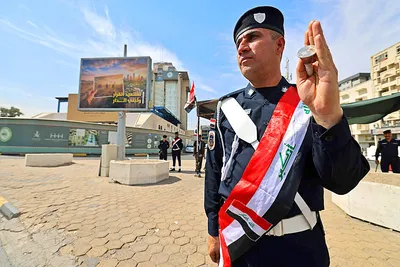
After more than a decade, the US-led coalition yesterday ended its mission in Iraq, having helped save the country from the Islamic State (IS) while causing persistent friction.
Coalition troops deployed to Iraq and Syria in 2014 to fight the IS, which had seized large swathes of both countries, and committed massacres and atrocities.
The group was defeated in Iraq in 2017 and in Syria in 2019, but coalition forces stayed on to battle the group’s remnants.
Baghdad and Washington agreed in 2024 to wind down the coalition’s mission, and its troops withdrew gradually from bases across the country, restricting their presence to the autonomous northern Kurdistan region. Their final withdrawal from there was yesterday.
The Iraqi government believes the coalition’s withdrawal removes the excuse powerful Tehran-backed militant factions have used to retain their weapons.
Iraqi Prime Minister Ali al-Zaidi declared that Oct. 1, the day following the coalition’s departure, should be celebrated as Sovereignty Day.
It is “a national occasion that affirms the completion of Iraq’s path toward sovereignty and consolidates the presence of the state and its institutions,” the heads of the executive, legislative and judicial branches said on Monday.
They added that “the presence of weapons outside state authority must be addressed ... in line with timelines set by the government, in a manner that strengthens state sovereignty.”
Al-Zaidi, who came to power this year with the US’ blessing, has vowed to reinforce the state’s monopoly on arms and ensure that armed factions hand over their weapons to the state.
His government initially set yesterday as the deadline for factions to disarm, but later withdrew the time limit as talks continued to “regulate” weapons — an issue that has fueled tensions and is expected to take much longer to resolve.
With several powerful groups refusing to disarm, senior politicians have intervened and are now hoping to work out a compromise deal.
Factions have put forward conditions that include not only the withdrawal of foreign troops, but also an end to US political and economic interference.
The powerful Kataeb Hezbollah group said in a statement on Monday that the withdrawal of “the occupation forces ... is a start towards achieving full sovereignty.”
However, the group also threatened al-Zaidi’s government.
“A government that doesn’t work for the good of its people will be brought down by all possible means,” it said.
During the battle against the IS, the US-led coalition and Tehran-backed factions fought the militants, their common enemy.
However, after the IS’ defeat, the presence of the coalition turned into a persistent point of contention between Iraqi authorities and the factions.
Those groups demanded the withdrawal of US troops and began targeting them with drones and missiles, triggering US retaliatory strikes that killed several faction commanders over the years.
During the Middle East regional war, Iran and its allied factions intensified their attacks, targeting US-led troops in the Kurdistan region.
Kurds in Erbil, capital of the Kurdistan region, said they are increasingly anxious about who will protect them from drones that have repeatedly targeted their autonomous canton, once the coalition interceptors leave.
The coalition left Syria earlier this year.
UNITY: Lai thanked the nations who spoke up for Taiwan, saying that democracies must stand together to face global authoritarian expansion Taiwan yesterday thanked eight European and Indo-Pacific countries for opposing unilateral changes to the “status quo” in the Taiwan Strait in a joint statement earlier this week, as well as three of Taiwan’s allies for speaking up for the nation’s participation in the UN at the body’s General Assembly in New York.
Minister of Foreign Affairs Lin Chia-lung (林佳龍) welcomed the support and expressed his appreciation for the countries’ stance, the Ministry of Foreign Affairs said in a statement. Foreign ministers and senior representatives of Australia, France, Germany, Japan, New Zealand, Poland, South Korea and the UK issued a statement on Tuesday
PLEA: How the UN addresses Taiwan’s security issue would be a test of its strength and relevance, Marshall Islands President Hilda Heine told the UN General Assembly Only Taiwan’s elected government can represent the people of Taiwan, Marshall Islands President Hilda Heine said on Friday at the UN General Assembly, calling for the nation’s inclusion in the UN. Taiwan and its 23 million people are a reality, and only its democratically elected government can represent it, Heine said when addressing the 81st session of the UN General Assembly General Debate.
Appropriate ways must be found for Taiwan’s substantive participation in UN meetings if the UN is to be truly inclusive and effective in years to come, she said. UN member states would experience pressure to accept a
FACTS DISTORTION: The MAC rejected Xi’s remarks that the US and ‘China’ fought side-by-side during WWII, saying the ROC was Washington’s true ally during the war Taiwan yesterday denounced Chinese President Xi Jinping’s (習近平) comments to US President Donald Trump on the nation’s future, after Xi appeared to push Trump for a subtle change in stance that could erode US support for Taiwan. Xi told Trump in Washington on Thursday that he hoped the US would adhere to the “correct position” of opposing Taiwanese independence, according to a Chinese readout of the talks.
That would be a tougher version of Washington’s long-standing formulation that it does not “support” independence. There was no immediate White House readout of the exchange. Xi’s remarks represent “the consistent Chinese approach of distorting facts
RESILIENCE: Keeping the defense industry’s assembly lines open would prove essential should the nation be involved in a prolonged conflict, a source said The Ministry of National Defense has prepared a NT$22 billion (US$692.3 million) program to acquire about 200 improved Hsiung Feng anti-ship missiles from next year to 2035, a source said. Commenting on condition of anonymity, a high-ranking defense official said the ministry’s plan for enhanced-capability Hsiung Feng II and Hsiung Feng III missiles would be funded as part of the regular defense budget.
The 200 missiles would be added on top of the 1,400 missiles being funded via the Sea-Air Combat Power Improvement Plan, they said. The program is not about padding missile numbers, but expanding the capability to defeat