
Sleep-deprived Japanese compete for best-rested
In diligent, exhausted Japan, self-described elite “competitive sleepers” vied to lie down, relax and nap the fastest and deepest in a contest organized by a mattress company.In the Tokyo competition, dubbed “Matt Race,” dozens of participants on Monday fitted with sleep tracking devices sprawled on
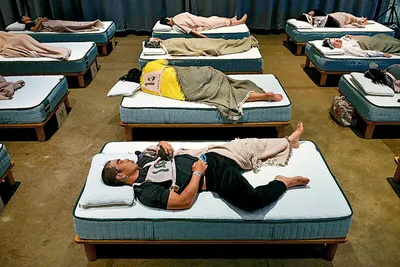
In diligent, exhausted Japan, self-described elite “competitive sleepers” vied to lie down, relax and nap the fastest and deepest in a contest organized by a mattress company.
In the Tokyo competition, dubbed “Matt Race,” dozens of participants on Monday fitted with sleep tracking devices sprawled on comfy mattresses to slumber for up to 90 minutes, competing for the top prize of more than ¥2 million (US$12,645).
“Japan is often described as a country suffering from sleep deprivation, and people here are very diligent,” said Riichiro Nakama, creative director at organizer Koala Sleep Japan, the mattress company.
Inside a dimly lit room, participants slept with monitors attached to their heads, some cradling stuffed toys in their beds.
“By turning it into an event like this, I think we can get people to sleep together, raise interest in sleep,” Nakama said.
Organisation for Economic Co-operation and Development (OECD) data showed in 2021 that Japanese slept an average seven hours 24 minutes a day — the least of all OECD nations within the group — with experts citing long working and commuting hours and a busy nightlife economy as among contributing factors.
“It was over in an instant. I almost wish I could have slept a little longer,” participant Chisato Honda, 32, said.
“It was a happy competition,” he added.
The winner was chosen based on how quickly and soundly they slept.
“I want to live on my own, so I think I’ll use the money for the moving costs,” said Suimii, the contest winner who only gave her nickname.
“I also want a bed like a princess’, so I think I’ll buy that bed,” she added.
Japan has started its first nationwide survey of animal cafes amid concerns over animal welfare, hygiene and public health, a government official said, bringing greater scrutiny to the popular but lightly regulated sector. The desktop survey, which began this month, will examine the number of facilities, the types of animals they house and the conditions they are held in, and how visitors interact with the animals. Exotic animal cafes, where visitors can interact with species ranging from otters to owls and marmots, have become popular attractions for Japanese and foreign tourists.
However, researchers say some facilities keep threatened species, raising
STRAIN ON TIES: The police arrested a 20-year-old man who matched the description of a suspect caught on CCTV leaving a hotel in Naha with the victim’s belongings A US Marine stationed on Japan’s southern island of Okinawa was arrested on suspicion of the murder of a Japanese woman, police said yesterday. The suspect “killed the 39-year-old woman at a hotel in Naha and stole her wallet on Saturday,” a local police spokesman said.
US Ambassador George Glass posted on social media that he had spoken with Japan’s foreign ministry and Okinawa’s governor to offer “our sincere condolences and pledging full cooperation as the investigation continues.” Japanese Prime Minister Sanae Takaichi called the crime “exceptionally brutal and vicious” on X. The government has urged the US “to provide maximum cooperation
A US lawmaker has called on Starbucks to close its first stores in Xinjiang, China, calling it a “morally bankrupt decision” to do business in a region where Uighurs face repression. China denies widespread accusations about abuses of the Uighurs, a mainly Muslim people, saying its policies there were aimed at combating terrorism, separatism and religious extremism. Starbucks opened its first two stores this week in Xinjiang’s capital, Urumqi, including one at the city centre’s grand bazaar and a second at its international airport.
John Moolenaar, chairman of the Select Committee on China of the House of Representatives, called on Starbucks to “immediately
A shark stranded in a canal in the South Korean port of Busan has become the country’s latest wildlife sensation, with the city saying about 600,000 people have flocked to see it over the past two weeks.
The 3.5m shark was first spotted in a narrow waterway in North Port on Sept. 18.
As the days passed without the shark finding its way back to the ocean, authorities on Tuesday launched a rescue operation to guide it out, but the effort failed.
The South Korean Coast Guard and other agencies deployed vessels to spray jets of water behind the shark