
Shen, Chiang open to debate over drug policy in Taipei mayoral race
Democratic Progressive Party (DPP) Taipei mayoral candidate Puma Shen (沈伯洋) proposed a debate on drug policy yesterday, while Taipei Mayor Chiang Wan- an (蔣萬安) of the Chinese Nationalist Party (KMT) said the issue could be discussed at a formal debate as controversy over Shen’s past writings cont

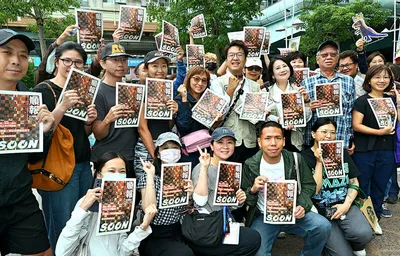
Democratic Progressive Party (DPP) Taipei mayoral candidate Puma Shen (沈伯洋) proposed a debate on drug policy yesterday, while Taipei Mayor Chiang Wan- an (蔣萬安) of the Chinese Nationalist Party (KMT) said the issue could be discussed at a formal debate as controversy over Shen’s past writings continued.
Chiang, seeking re-election, said he and Shen have reached a preliminary agreement to take part in a TVBS-organized debate, with details to be negotiated by their aides.
Speaking while distributing campaign newspapers outside Zhongxiao Fuxing MRT station yesterday morning, Shen accused Chiang’s team of misrepresenting his drug policy positions and suggested making the issue the subject of their first debate.
Chiang said all municipal issues, including drug policy, as well as the candidates’ positions on them, were open for discussion.
“This year will be no exception. I will definitely participate,” he said, referring to the tradition of debates in Taipei mayoral elections.
The dispute centers on a September 2014 article Shen wrote for Thinking Taiwan following actor Kai Ko’s (柯震東) arrested in China for taking marijuana.
The article criticized a New Taipei City proposal to add drug screening to school health examinations and argued that punishment-focused policies could reinforce inequalities and stigmatize disadvantaged students.
Shen discussed decriminalization, assistance for people with addiction and research into the social causes of drug use.
If decriminalization was considered too radical, he suggested Taiwan could follow other countries by establishing community centers that provided drugs and clean needles alongside social worker support.
In response to the criticism in recent days, Shen said his article discussed harm-reduction measures, citing methadone treatment and needle-exchange programs already implemented in Taipei. The 2014 article did not specifically mention methadone.
Methadone is classified as a Category 2 narcotic in Taiwan but also has lawful medical uses. It is administered orally under medical supervision to treat heroin dependence, while needle-exchange programs are a separate harm-reduction measure.
Chiang questioned Shen’s explanation that his 2014 proposals concerned policies already in place, asking why he had criticized measures that were being implemented at the time.
Chiang argued that Shen had either misunderstood those policies or was now reinterpreting his earlier position for electoral purposes.
The controversy widened yesterday afternoon when KMT lawmakers Lo Chih-chiang (羅智強) and Niu Hsu-ting (牛 煦庭) held a news conference questioning Shen’s past comments on the legalization of cannabis.
Lo cited a separate 2014 social media post in which, he said, Shen wrote that legalization was needed to address the underlying problems surrounding cannabis. He asked whether Shen still supported that position and the provision of drugs at community centers.
Responding later yesterday, Shen campaign spokesperson Tsai I-kae (蔡一愷) said studying a policy and advocating its implementation were different things.
Shen does not support cannabis legalization and opposes drugs entering schools, Tsai said, adding that a thesis Shen had supervised concluded Taiwan was not suited to legalizing cannabis.
Tsai accused the KMT of distorting academic research for electoral purposes, saying the attacks stigmatized higher education as well as Shen.
The donation of offshore patrol vessel Kinmen to the Philippines includes provisions that protect Taiwanese fishers and facilitate security cooperation across the First Island Chain, officials said yesterday. The comment was made during the Cabinet’s comprehensive administrative report at the legislature after Chinese Nationalist Party (KMT) Legislator Hsu Yu-chen (許宇甄) expressed concerns about the decision to give a ship to a country whose coast guard had in 2013 fired on a Taiwanese trawler and killed its captain without provocation.
The Cabinet should lay out the safeguards that have been established to prevent the Philippine government from using the Kinmen to harass, expel
GROWING TIES: The CGA is planning a goodwill mission to the Philippines, in what would be the first time since 1975 a Taiwanese paramilitary vessel has visited the country The Coast Guard Administration (CGA) plans to significantly expand its participation in international security cooperative frameworks and its operational capabilities, a budget proposal for next year showed. The budget indicates a transformation of the CGA from a maritime law enforcement arm into a national defense and intelligence gathering entity capable of tackling larger regional security matters.
The proposal showed that personnel from the coast guard’s Intelligence Division and Special Action Support Center are to participate in high-level national security talks with the US. As the CGA has dealt with China’s rising “gray zone” threats around Taiwan, it has become a valuable asset to
A patrol vessel donated by the Coast Guard Administration (CGA) to the Philippines was commissioned into the Philippine Coast Guard (PCG) on Friday, a Philippine non-governmental organization said. The CGA on Sept. 16 confirmed media reports that Taiwan had donated a retired 500-tonne patrol vessel to the Philippines. The Manila-based We Protect Our Seas (WPS) foundation, which served as an intermediary in the transfer, said that the vessel was formerly the CGA’s 500-tonne petrol vessel Kinmen (CG123).
The WPS, in a statement issued on Friday, said the vessel, renamed as the BRP Sarangani, had been commissioned into the PCG the
‘GRAY ZONE’ TACTICS: Beijing sent two China Coast Guard vessels to escort a ‘supposedly private research ship,’ a Philippine Coast Guard spokesman said The Coast Guard Administration (CGA) yesterday confirmed that it had recently deployed three patrol vessels to waters in Taiwan’s overlapping exclusive economic zone with the Philippines to monitor three Chinese vessels. CGA Deputy Director-General Hsieh Ching-chin (謝慶欽) said the agency regularly monitors Chinese vessels around Taiwan, and that the deployment south of Oluanpi (鵝鑾鼻), Taiwan proper’s southernmost point, was carried out in accordance with standard procedures.
He added that the waters fall within the overlapping exclusive economic zones of Taiwan and the Philippines, which extend 200 nautical miles (370km) from their coastlines. Hsieh made the comments when asked about a