
Malaysia begins repatriation of Burmese nationals
Malaysia yesterday began repatriating Burmese nationals, including women and children, under a voluntary program, despite warnings from the UN refugee agency and rights groups that conditions in the country remain unsafe.The 1,476 people being sent back are among 5,000 Burmese nationals who are to b
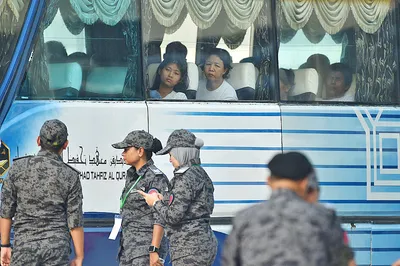
Malaysia yesterday began repatriating Burmese nationals, including women and children, under a voluntary program, despite warnings from the UN refugee agency and rights groups that conditions in the country remain unsafe.
The 1,476 people being sent back are among 5,000 Burmese nationals who are to be repatriated in stages from Malaysia, where as of Aug. 15, 10,388 Burmese nationals were being held at immigration detention depots nationwide, the Malaysian Ministry of Home Affairs said.
Buses believed to be carrying Burmese returnees arrived at a stadium in Manjung town in Malaysia’s central Perak state early yesterday, amid tight security. Ships believed to be from Myanmar were docked at the nearby Lumut naval base.
Home ministry official Makhzan Mahyuddin was quoted by national Bernama news agency as saying the returnees comprised 1,370 men, 79 women, 20 boys and seven girls, aged eight to 60.
The ministry said they would be sent back safely on two Myanmar navy warships and a hospital ship. It is unclear if any of the returnees were minority Muslim Rohingya, who are rejected by the Myanmar government. The ministry did not provide further details of their identities and circumstances, but stressed their return was voluntary.
“This move also sends a clear signal that the government is serious about addressing irregular migration and the issue of undocumented foreign nationals through law enforcement, repatriation and more systematic management and data collection,” the ministry said in a statement.
The UN High Commissioner for Refugees (UNHCR) and rights groups slammed the repatriation, saying the security and humanitarian situation in parts of Myanmar remains volatile and returnees could face serious risks, such as persecution and forced military conscription in an active war zone.
Myanmar is involved in an armed conflict and political instability following the military’s seizure of power in 2021.
Malaysia is home to about 215,600 refugees and asylum seekers registered with the UNHCR, including about 126,000 Rohingya who make up one of Southeast Asia’s largest refugee communities. Despite hosting them, Malaysia is not a party to the UN Refugee Convention and treats refugees as undocumented migrants.
The government recently launched a system to register refugees and asylum seekers in Malaysia and to build a biometric database, as it seeks to manage and regulate the population independently from the UNHCR.
Rohingya have faced growing public hostility in Malaysia due to their growing numbers, fueled by concerns over jobs, public services and security.
Malaysian Prime Minister Anwar Ibrahim has defended the repatriation policy as a diplomatic effort to find a long-term solution, saying Malaysia cannot host refugees indefinitely and Myanmar must take responsibility for its citizens.
Anwar said he plans to invite Burmese President Min Aung Hlaing to Malaysia to discuss the long-running refugee and undocumented migrant issue that has dragged on for decades.
“I am inviting him to say that we can be friends and trade, we can accept Myanmar, but Myanmar must accept them back,” he said in a podcast posted online on Sept. 16. “To me, that’s better diplomacy than just shouting angrily at Myanmar.”
UNITY: Lai thanked the nations who spoke up for Taiwan, saying that democracies must stand together to face global authoritarian expansion Taiwan yesterday thanked eight European and Indo-Pacific countries for opposing unilateral changes to the “status quo” in the Taiwan Strait in a joint statement earlier this week, as well as three of Taiwan’s allies for speaking up for the nation’s participation in the UN at the body’s General Assembly in New York.
Minister of Foreign Affairs Lin Chia-lung (林佳龍) welcomed the support and expressed his appreciation for the countries’ stance, the Ministry of Foreign Affairs said in a statement. Foreign ministers and senior representatives of Australia, France, Germany, Japan, New Zealand, Poland, South Korea and the UK issued a statement on Tuesday
PLEA: How the UN addresses Taiwan’s security issue would be a test of its strength and relevance, Marshall Islands President Hilda Heine told the UN General Assembly Only Taiwan’s elected government can represent the people of Taiwan, Marshall Islands President Hilda Heine said on Friday at the UN General Assembly, calling for the nation’s inclusion in the UN. Taiwan and its 23 million people are a reality, and only its democratically elected government can represent it, Heine said when addressing the 81st session of the UN General Assembly General Debate.
Appropriate ways must be found for Taiwan’s substantive participation in UN meetings if the UN is to be truly inclusive and effective in years to come, she said. UN member states would experience pressure to accept a
FACTS DISTORTION: The MAC rejected Xi’s remarks that the US and ‘China’ fought side-by-side during WWII, saying the ROC was Washington’s true ally during the war Taiwan yesterday denounced Chinese President Xi Jinping’s (習近平) comments to US President Donald Trump on the nation’s future, after Xi appeared to push Trump for a subtle change in stance that could erode US support for Taiwan. Xi told Trump in Washington on Thursday that he hoped the US would adhere to the “correct position” of opposing Taiwanese independence, according to a Chinese readout of the talks.
That would be a tougher version of Washington’s long-standing formulation that it does not “support” independence. There was no immediate White House readout of the exchange. Xi’s remarks represent “the consistent Chinese approach of distorting facts
RESILIENCE: Keeping the defense industry’s assembly lines open would prove essential should the nation be involved in a prolonged conflict, a source said The Ministry of National Defense has prepared a NT$22 billion (US$692.3 million) program to acquire about 200 improved Hsiung Feng anti-ship missiles from next year to 2035, a source said. Commenting on condition of anonymity, a high-ranking defense official said the ministry’s plan for enhanced-capability Hsiung Feng II and Hsiung Feng III missiles would be funded as part of the regular defense budget.
The 200 missiles would be added on top of the 1,400 missiles being funded via the Sea-Air Combat Power Improvement Plan, they said. The program is not about padding missile numbers, but expanding the capability to defeat