Will the Trump-Xi wartime ally nostalgia prompt a Japanese rethink on China ties?
Japanese Prime Minister Sanae Takaichi is reportedly trying to arrange a phone call with Donald Trump following the US president’s nostalgic invocation of the alliance with China during World War II, references that sent shock waves through Tokyo. Trump made the references as he welcomed Chinese President Xi Jinping to the White House on Thursday for his first state visit to Washington in over a decade. Both Trump and Xi repeatedly invoked their nations’ wartime alliance against Japan in their...
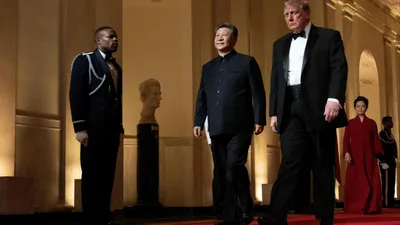
Japanese Prime Minister Sanae Takaichi is reportedly trying to arrange a phone call with Donald Trump following the US president’s nostalgic invocation of the alliance with China during World War II, references that sent shock waves through Tokyo.
Trump made the references as he welcomed Chinese President Xi Jinping to the White House on Thursday for his first state visit to Washington in over a decade.
Both Trump and Xi repeatedly invoked their nations’ wartime alliance against Japan in their remarks – an unusual historical reference that immediately unsettled Tokyo.
Takaichi said on Friday that Tokyo and Washington were “allies bound by very strong ties” based on mutual trust. But she pointedly declined to comment on the Trump-Xi summit.
To avoid being sidelined completely, Takaichi had rescheduled her address to the United Nations General Assembly in New York, moving it up by two days to secure a 35-minute meeting with Trump on Tuesday.
Japanese media reported that Takaichi was considering calling Trump for a direct briefing on the summit.
Japanese analysts warned that the wartime nostalgia boded poorly for Japan, though they cautioned against reading too much into the rhetoric.
Chinese observers, meanwhile, argued that the moment should prompt Tokyo to rethink its approach towards Beijing.
Shin Kawashima, professor of international relations at the University of Tokyo, said the main question was why Washington was embracing the wartime framing now.
“Trump’s remarks could easily be interpreted by China as indicating that the US and China are in agreement on issues of historical perception and that the US supports China’s rhetoric condemning the [Takaichi] administration as a form of ‘new militarism’,” Kawashima said.
Hotaka Machida, a visiting senior research fellow at the Institute of Geoeconomics in Tokyo, said Japan would find Trump’s historical references “surprising and awkward”, but noted that the remarks were made in the context of the US-China relationship.
Still, he cautioned: “Japan needs to be careful about the possibility of the Chinese side taking advantage of the amicable atmosphere presented this time as a propaganda tool.”
Kenichi Doi, senior research fellow at the same institute, called Trump’s description of wartime China as an ally “striking”.
But the bigger question was whether that shared history would be used to cast doubt on present-day Japan. It would be a mistake to assume that Trump had endorsed Beijing’s criticism of Tokyo, he said.
Rintaro Nishimura, a senior associate at The Asia Group strategic advisory firm, said that while concerning, the single statement was unlikely to weaken the US-Japan alliance.
Tokyo was also less concerned because Takaichi coordinated with Trump on issues related to China ahead of the Xi-Trump summit, he added.
“[But] it does not bode well for Tokyo that Washington and Beijing are both emphasising the fact that the two countries were wartime allies,” Nishimura said.
Beijing and Tokyo have remained largely out of official contact since November, when Takaichi suggested that a blockade of Taiwan would be a “survival-threatening situation” for Japan.
Official relations went into a tailspin but Japanese business and legislative delegations have made sustained efforts to visit Beijing to gauge Chinese thinking.
Another business delegation, led by former Japanese foreign minister Takeshi Iwaya, will go to China on Sunday in the latest attempt to bridge the diplomatic impasse.
Nishimura expected Tokyo to “stay the course” when engaging with Beijing, using legislative and commercial dialogue to tease out potential openings for government-level talks, with an end goal of securing a Takaichi-Xi meeting at the Apec summit in Shenzhen in November.
“Japan will be looking to see if there are any signs that Washington is ready to compromise regional security for a deal, perhaps economic, with Beijing.”
Meanwhile, Tokyo’s discomfort is seen as an inevitable consequence of stabilising US-China ties, with analysts saying the warm tone from the summit should prompt Tokyo to reassess its own approach to Beijing.
Kawashima noted that Japan-China relations would “grow more tenuous” if US-China ministerial engagement deepened and might prompt Tokyo to conclude that it was better to improve relations with China to some extent.
Wang Guangtao, deputy director of the Centre for Japanese Studies at Fudan University, said Japan’s anxiety was an inevitable result of further stabilisation between Beijing and Washington.
“The sheer fact that Chinese and American leaders can have such frequent interactions this year should serve as a prompt for Tokyo to change its perceptions towards China and rethink its posture,” Wang said.
Zhang Yun, professor of international relations at Nanjing University, said Tokyo harboured deep concern about the prospect of another 1972 “Nixon shock”, when the US normalised ties with China without consulting its closest East Asian ally.
Takaichi’s push to meet Trump ahead of his talks with Xi reflected this anxiety, he said.
“Compounded by Trump’s transactional approach towards its traditional alliances and tariff actions, these dynamics are fuelling deep-seated anxieties in Tokyo over Washington’s reliability, leaving Japan’s position adrift,” Zhang said.
According to Cho Sung-min, associate professor of international relations at Sungkyunkwan University in Seoul, the memory of US-China military cooperation against Japan has long been a Chinese talking point.
“Trump’s reference to America’s past partnership with China against Japan, a US ally in the present, suggests how far he was willing to go to maintain a cordial relationship with Xi,” Cho said.