
Netflix Adapted a Great American Classic. What Have They Done to It?
John Steinbeck’s East of Eden considers matters of good and evil. Zoe Kazan’s version does something else.
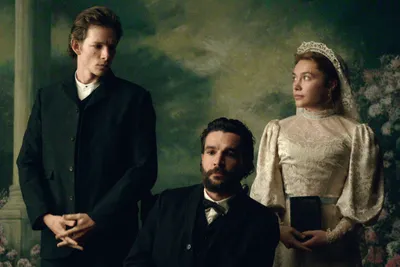
John Steinbeck’s 1952 novel East of Eden is bursting with character and incident, a decades-long story spanning from the America of the Civil War to the America of World War I, wrapping in topics from the impact of anti-Chinese immigration laws to improvements in refrigeration technology to the mnemonic devices people employed to remember how to start a Model T. It’s a deeply enjoyable book you should revisit out of your own free will, if your only memory of previous readings was (like mine) tied up with learning about Biblical allusion in high school English.
It’s also hefty, clocking in at around 600 pages, depending on the edition. The new Netflix adaptation, created by Zoe Kazan, whose grandfather Elia directed the 1955 movie starring James Dean, has only seven hourlong episodes, so it must make choices in bringing certain elements to the screen. Elia Kazan trimmed East of Eden into a two-hour movie by focusing only on the novel’s final quarter; Zoe Kazan has slimmed down Steinbeckian overabundance by almost completely excising one of the two families that make up the book’s dramatis personae.
Ninety percent of the novel’s material about the Hamilton family, Steinbeck’s experiment in fictionalized memoir (the Hamiltons were based on his real-life grandparents), is gone. What Zoe Kazan found compelling instead was everything having to do with Cathy Ames (played in the new show by Florence Pugh), Steinbeck’s tough-as-nails female villain who, born missing a conscience but gifted with intelligence and beauty, kills and manipulates her way through life.
The series hits Netflix on Thursday, but I’m already weary of the brewing debate over this new adaptation’s biggest zag: Pugh and Kazan want to make you feel sorry for Cathy. On a panel at the Atlantic Festival earlier this month, Kazan said that she was “freeing up Steinbeck’s better instincts” by making Cathy into more of a “person,” describing Cathy’s “journey” and efforts to make it “relatable to an audience and not something to gawk at.”
Pugh, for her part, added, “It’s my job to make people sympathize and maybe fall in love with her a little bit.” Unsurprisingly, there are people in the comments of the YouTube video of this panel describing this approach as “woke,” which I guess it is. (Kazan did describe Steinbeck’s intention in writing East of Eden as containing both “humanism” and “inevitable midcentury white male racism and misogyny,” phraseology that likely triggered that response.)
As a book reader, a viewer, and a critic, I don’t much care if the new East of Eden is “woke.” The better question is: Does it work? Long story short, I’m sorry to say, I don’t think it does.
Pugh’s smooth, catlike face is very Cathy Ames, Christopher Abbott does what he can with the role of her simp husband Adam Trask, and Mike Faist is fun, cast against his usual good-boy type as Adam’s meaner, stronger brother Charles. The actors are fine, but Kazan seems to have looked at Steinbeck’s story and determined it’s terminally out of fashion to consider matters of good and evil. The novel offered a wide array of interpretations of these questions, in the form of its characters: Cathy is inherently bad, maybe what we would now call a sociopath, and always acts out of self-interest.
Adam is good, but weak. Charles and Cal (the son born to Cathy as one of a pair of twins) are cynical, knowing, and forceful—but they also, each to his own degree, feel love, and act on it. Aron, Cal’s twin, is so good that, by the end of the book, he has become judgmental, with a “purity” “a little on the self-indulgent side,” as Steinbeck wrote. Only Samuel Hamilton, the Hamiltons’ patriarch, and the family’s longtime servant Lee (more on him in a bit) are good and act out of goodness.
The goings-on between these characters loses something significant when you start to pity Cathy, and even begin to cheer her on as a kind of misunderstood girlboss. Early on, Cathy kills her parents; in the novel, she does it after her father lectures her, threatening her, speaking of “the authority God had given him over his child and of how this natural authority had been armed by the state.” The show’s script modernizes this speech a bit, having Mr.
Ames tell his daughter that she is his “property,” a term that feels designed to evoke the viewer’s outraged gasp. Steinbeck means this scene to demonstrate the total powerlessness of Cathy’s parents, who she soon kills in a house fire while faking her own death, while Kazan holds the father in front of us as yet another in a parade of examples of men who do Cathy wrong. In both book and show, Cathy loves the story of Alice in Wonderland , because of Alice’s ability to drink from a tiny bottle and shrink until she vanishes from human perception.
Does Cathy love this idea because she was—as the show heavily implies in an invented scene where an older boy holds two pieces of wrapped candy toward young Cathy as she sits in a field—sexually assaulted when she was 5, or because vanishing from people and everything they expect is yet another way for a bad person to escape accountability? Perhaps because we’ve been inundated in the past few decades with stories about villains with traumatic pasts, the second idea simply feels more original, more unusual, and more interesting to me these days.
The problem is not just that trying to ground Cathy in a backstory of male rape, assault, and control, as Kazan and Pugh are doing, feels like some kind of unwelcome modernization of the story. The problem is that Cathy’s pure evil was the thing the rest of the characters orbited around, and softening her changes everything for the worse. The role of Adam Trask is a tough one—he’s the “better” brother in childhood, then an impassioned and completely benighted husband whose first definite life choice, to move to California despite Cathy’s objections, gets cast as patriarchal in Kazan’s interpretation.
After Cathy, postpartum, shoots Adam and leaves the family, changing her name to become the brothel madam Kate (you go, girl!), Adam spends a decade sitting on a chair on a porch, mourning the wife he barely knew, who everyone else can see faked her way through their marriage. Christopher Abbott does his best, but Adam Trask, “good” though he may be, is acted upon by life far more than he acts, and that’s a tough thing for a TV character.
If Cathy is evil, Adam is a victim; if Cathy has some good in her, Adam made a totally different kind of mistake.
Charles vanishes from the story when Adam and Cathy move to California and he stays in Connecticut on the Trask farm. The show would clearly like this trio of handsome actors to have more screentime together, and so invents a sequence in which Faist’s Charles appears as a ghost to Kate in later episodes, speaking to her and appearing in her mirror before she dies by suicide, suffering from arthritis, fearing a past crime will be revealed, and feeling like she’s losing control of men’s attention as she ages.
This occasionally tender memory of Charles, like Pugh’s operatic depiction of Kate’s show-invented breakdown when she sees her “good” son Aron (Joe Anders) appear at her brothel, gives Kate entirely too much credit—and makes Charles, who in the novel tolerates Cathy for only as long as she’s in his immediate vicinity, even more complicit in Kate’s evil.
Although it’s sexier for publicity purposes to represent this tale as a love triangle between the two brothers and Cathy, the actual third anchor of the story—and the person at the heart of the parts of the show I most enjoyed watching—is Lee, the Chinese American housekeeper, tutor, and surrogate parent , played with a grave kindness by the actor Hoon Lee. Lee, despite not even making it into some East of Eden adaptations, like the 1955 movie, is one of the most interesting characters in the novel, a highly educated man who, because he happens to be employed by the family when Cathy abandons her newborns and Adam recedes into grief, ends up a de facto parent to Cal and Aron, living with the family for decades.
The moments in the show when Lee chides Cal (Joseph Zada) or Aron for putting their feet up on the wall or flicking light switches (“Electricity costs money!”) are warm and sweet, but Kazan’s adaptation can’t help but make the subtext text, having a fellow Chinese American tell Lee, when he describes his situation and wonders if he will ever have a home and a wife of his own, that it seems like he’s already “somebody else’s wife.”
At one point, in the novel, Lee leaves the family for a few days, intending to start a bookstore in San Francisco; although the show invents a reason involving racist exclusion for him to surrender this dream, in the novel he just gives up because he’s lonely. Lee’s kindness sets him up, along with a big dose of “wrong place, wrong time,” to live a life he never meant to live. That’s a soft trap, and that’s fascinating—it’s a subtle thing, unlike anything else that happens in the Netflix series, to its own detriment.
How would I adapt East of Eden , if this were my assignment? Make Lee into the point-of-view character? Turn it into science fiction, have Cathy reveal she’s really an evil alien in a human suit? Go for broke and propose a maximalist approach: 27 hours of television, covering everything from the heartbreaking death of my favorite Hamilton, Dessie, to the secret corruption of Abra Bacon’s father? Perhaps the truly messy spirit of the novel can’t be corralled on screen. Maybe that’s why this just-so story about Cathy, which seems so proud of itself, bothers me more than it should.