China-US dialogue will ease concerns, but competition will remain, Paul Chan says
Competition between China and the US will persist, but increased dialogue between the two economic superpowers will provide greater global certainty and ease geopolitical concerns, with Hong Kong positioned to play a unique role, the city’s financial secretary has told the South China Morning Post. In a wide-ranging interview, Paul Chan Mo-po said more communication and dialogue between the two nations would be “good for everyone”, as Chinese President Xi Jinping and his US counterpart, Donald...
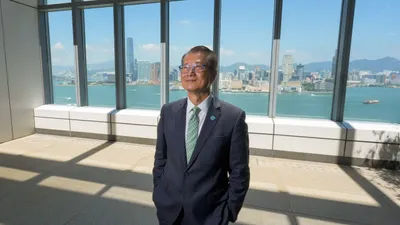
Competition between China and the US will persist, but increased dialogue between the two economic superpowers will provide greater global certainty and ease geopolitical concerns, with Hong Kong positioned to play a unique role, the city’s financial secretary has told the South China Morning Post.
In a wide-ranging interview, Paul Chan Mo-po said more communication and dialogue between the two nations would be “good for everyone”, as Chinese President Xi Jinping and his US counterpart, Donald Trump, wrapped up a historic summit in Washington last Friday, local time.
Chan also shed light on his expectations for the coming Apec Finance Ministers’ Meeting, which takes place in Hong Kong on October 20 and 21, and will bring together hundreds of global leaders in the city. He anticipated that visiting political leaders would see Hong Kong and its vibrancy with their own eyes.
The event will take place ahead of this year’s Asia-Pacific Economic Cooperation summit, which will be held in Shenzhen on November 18 and 19.
Chan said Beijing supported Hong Kong’s hosting of the finance ministers’ meeting, as the central government wanted to elevate the city’s profile as a global financial centre.
With the current Hong Kong administration having less than a year before the new term, Chan was also asked about his future plans.
He said that officials had worked hard under the “capable leadership” of the chief executive.
“At the moment, we are concentrating our energy and efforts on pushing forward the various policy agendas and initiatives. So this will remain our priority focus,” he said.
Chan also touched on the three-day China-US summit last week, which saw tensions ease and a trade truce extended by two months until January.
“We do believe more communication and dialogue are good for everyone,” he said.
“And this is important, not just for the two countries or Hong Kong but for the global community, providing more certainty and removing some of the geopolitical concerns.”
But Chan anticipated China-US competition would persist in areas such as financial services, adding that Hong Kong would strengthen its status as an international financial centre to further attract foreign capital and connect mainland China to the rest of the world.
“So for us, under the ‘one country, two systems’ arrangement, we play the unique role of connecting the mainland with the rest of the world,” he said.
Despite geopolitical tensions, Chan said Hong Kong had become a destination for investors to park their money over the past two years.
Net inflows into Hong Kong-domiciled funds stood at HK$118 billion (US$15 billion) in the first five months of 2026 following a 118 per cent year-on-year surge to HK$357 billion in 2025.
Total assets under management also grew by 20 per cent to HK$42.2 trillion in 2025 from a year earlier, with most coming from outside the mainland and Hong Kong.
“Capital investors really vote for Hong Kong with their feet,” Chan said.
He said China-US relations were bound to have “ups and downs,” and Hong Kong’s top priority was to ensure financial stability while taking advantage of development opportunities.
At the core of Hong Kong’s financial development was the city’s stock market, which had recorded robust trading volumes and a larger number of new listings in recent years, Chan said.
The stock market is also set to benefit from a series of measures floated in the policy address and the city’s first five-year plan, which were both released earlier this month.
Proceeds raised in initial public offerings (IPOs) in the first eight months of 2026 were 153 per cent higher than in the same period last year, at HK$342.4 billion.
The eight-month total has already surpassed last year’s IPO proceeds of HK$286.9 billion. The 2025 figure already represented growth of 226 per cent year on year.
“So all these indicate that we remain focused on doing the right thing, enhancing our competitiveness, improving our listing regime, for example, expanding the possibility of attracting additional liquidity. Then, quality companies will come,” Chan said.
“We are taking this window to further build, further strengthen our equities market. But at the same time, develop FIC [fixed income and currencies], develop commodities, trading and gold. This takes time, but we move on; we’ll invest in it.”
Chan also highlighted plans to expand the global use of the yuan.
While Hong Kong currently served as “a firewall” for the wider nation’s financial security, the city also planned to drum up yuan product offerings to raise liquidity and act as a testing bed for yuan products, the finance chief said.
Hong Kong has the world’s biggest pool of yuan outside the mainland, sitting at about 1.1 trillion yuan (US$163 billion).
“Our idea is that if we want to gather more liquidity, gather more investors coming to our market, then we need to enrich the product offering. We need to build the necessary infrastructure. We also need to provide the liquidity that is needed,” Chan said.
He added that several central banks were planning to increase their yuan holdings in an effort to pursue diversification, which would generate more investment opportunities.
Asked whether the push risked diminishing the role of the Hong Kong dollar – which is pegged to the US dollar – amid so-called de-dollarisation, Chan said “no”, and remained adamant that the linked exchange rate system, which debuted in 1983, had worked well and was an anchor for the city’s currency regime.
“This is very core to us in terms of strength,” he said. “We have no intention at all to change this. This is very fundamental.”
As the city is fast-tracking its push into gold trading and storage and a commodity ecosystem, Chan said the government planned to launch a “gold connect scheme” to facilitate more cross-border trade.
Hong Kong and the mainland already operate various connect schemes that grant global financial institutions access to mainland stock and bond markets through the city.
“The competition is keen,” Chan said, referring to competition between gold markets in Hong Kong, London and Singapore.
“But our advantage is the strong hinterland. China is a major user of gold. The Shanghai gold exchange is very keen and has a strong market, but it needs to have an international connection. Hong Kong can play the role.”