‘Right now, it’s fine’: Trump brushes off questions about summit talk on Taiwan
Comments follow Xi Jinping’s push for the US to take an explicit stand on the issue.
 TRUMPBUTT$TBUTT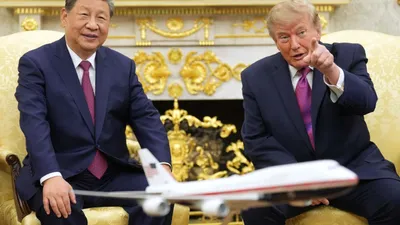
US President Donald Trump has sought to play down exchanges with his Chinese counterpart Xi Jinping on Taiwan independence, saying on Saturday that they touched on the subject only briefly.
“We didn’t talk about it too much. Right now, it’s fine. It’s just moving along,” Trump said. “We didn’t spend a lot of time talking about Taiwan. He understands very much how I feel.”
During the summit in Washington last week, Xi pressed Trump to take an explicit position against Taiwan independence – a stand that would go beyond the US’ traditional formulation of “not supporting” independence.
In an interview with American broadcaster CNBC on Friday, US ambassador to Beijing David Perdue reaffirmed that “there’s no change in the Taiwan policy”.
Perdue said Trump remained fully committed to the US “one China” policy, anchored by the Taiwan Relations Act, the three joint communiques and the six assurances.
“We’re not changing the language. We’re not changing our position there. We want peace across the [Taiwan] Strait,” Perdue said. “We don’t support independence, and we think that President Xi has gotten that message.”
The island of Taiwan remains the most sensitive core issue in US-China relations.
Beijing sees Taiwan as part of China to be reunited by force if necessary. Most countries, including the United States, do not recognise Taiwan as an independent state, but Washington is opposed to any attempt to take the self-ruled island by force and is committed to supplying it with weapons.
Taipei moved quickly to welcome the post-summit signals from Washington.
Wu Chih-chung, the island’s deputy foreign minister, said on Saturday that maintaining Taiwan Strait peace and stability was surely in the global interest. And ensuring that Taiwan’s semiconductor sector continued to serve the global market was a key interest for the US, he said.
Wu also expressed confidence that the US would follow through on planned arms sales to the island, according to a report by the island’s Central News Agency.
Zhu Songling, a specialist in Taiwan affairs at Beijing Union University, said other signs from the summit were positive signals for Beijing, including Trump’s references to the US-China alliance in World War II.
He said those references hinted at Washington’s recognition of Beijing’s perspective on the post-war international order.
The recovery of Taiwan to China from Japanese rule was itself a key outcome of the Allied victory in World War II, Zhu said, citing the Cairo Declaration’s clause that all territories stolen by Japan from China, including Taiwan – should be restored.
Zhu also highlighted that both countries agreed to build a constructive relationship of strategic stability on the basis of “respect, fairness, and reciprocity”.
He said these principles should be applied when handling the Taiwan issue.
“If the US talks about strategic stability on one hand while providing political support for Taiwanese separatist activities on the other, it would be like building a bridge while simultaneously dismantling it.”
Zhu added that as US midterm elections approached, the Trump administration’s posture on Taiwan could become erratic, as it saw the issue as a tactical bargaining chip rather than an ideological position that could not be compromised.
Wang Yiwei, director of the Institute of International Affairs at Renmin University of China in Beijing, agreed with Zhu’s emphasis on the shared consensus regarding World War II and the recovery of Taiwan from Japanese colonial control.
He also said that Washington’s restatement that nothing had changed was simply standard practice.
“The US has a long-standing policy of ‘strategic ambiguity’ on the Taiwan issue, and Trump is just continuing that approach,” Wang said.
Wang added that the Taiwan issue took a back seat because both nations had established a baseline understanding during Trump’s visit to Beijing in May.
During that trip, Trump cautioned Taipei against moves that could drag the US into a conflict.
“We’re not looking to have somebody say, ‘Let’s go independent because the United States is backing us,’” he told Fox News.