Remote section of China’s Great Wall damaged by 20 years of mine waste dumping
While foreign leaders and their families walk the iconic restored sections of the Great Wall around Beijing, the ancient stones of a remote Ming-era stretch of the structure in northern central China have been sacrificed for cheaper dumping of coal-mining waste. For nearly 20 years, a section of the wall in Ningwu county, Shanxi province, was used as a short cut to dump slag, despite whistle-blowers repeatedly raising the alarm to officials, according to a report by Chinese state broadcaster...
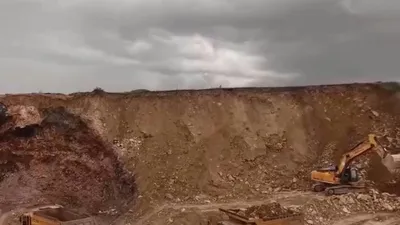
While foreign leaders and their families walk the iconic restored sections of the Great Wall around Beijing, the ancient stones of a remote Ming-era stretch of the structure in northern central China have been sacrificed for cheaper dumping of coal-mining waste.
For nearly 20 years, a section of the wall in Ningwu county, Shanxi province, was used as a short cut to dump slag, despite whistle-blowers repeatedly raising the alarm to officials, according to a report by Chinese state broadcaster CCTV.
The damage to the Great Wall’s Guojiayao section began in 2007, when an unlicensed miner, Ningwu Chaokai Coal Industry, dug a trench through the structure as a way to dispose of excavation waste, the report said.
In 2013, Shenda Chaokai Coal Industry was established through the consolidation of multiple mining teams and continued using the breach to dump slag, bypassing the long mountain roads.
CCTV said that local authorities did not respond to repeated reports by whistle-blowers that started in 2015, allowing the vandalism to persist for nearly two decades and leaving a six-metre (19-foot) gap in the wall.
Ancient Chinese rulers built the Great Wall to safeguard their territories, with construction continuing through the Ming dynasty (1368-1644), when it became the world’s largest military structure, stretching more than 21,000km (13,000 miles) across northern China.
As China’s most iconic World Cultural Heritage site and a symbol of Chinese civilisation, the wall is a globally renowned tourist destination.
Its sections around Beijing, particularly Badaling and Mutianyu, are the most popular and also serve as key venues for diplomatic exchanges when world leaders visit the Chinese capital.
The Great Wall has welcomed multiple world leaders and their families, including Russian President Vladimir Putin, former US president Barack Obama and his wife Michelle, as well as US first lady Melania Trump.
In 2017, during President Donald Trump’s state visit, the US first lady toured Mutianyu while her husband departed for a summit in Vietnam. Trump’s son Eric and daughter-in-law Lara also visited the ancient landmark when they accompanied him in May.
Far from the spotlight, the lesser-known Guojiayao section’s remote location left it vulnerable to neglect and vandalism, despite legislation enacted in 2006 to protect the wall.
The Regulation on Protection of the Great Wall requires cultural relics authorities to take immediate control measures and notify higher-level authorities upon receiving reports of damage to the structure.
The law also dictates the installation of physical protection markers. However, boundary posts were not erected along the Guojiayao section until 2025, the report said.
Local officials told the state broadcaster that past damage to the wall went unnoticed because of weak conservation efforts and infrequent inspections.
No penalties were issued nor higher authorities notified because the mining enterprise stopped excavation within the protected cultural relics zone after 2019 and officials had failed to prosecute past violations, they said.
The provincial authorities did not step in until March this year when, driven by persistent public complaints and media exposure, Shanxi established a special task force to investigate the coal company’s alleged illegal mining and cultural heritage destruction.
The company was later fined a total of 1 million yuan (US$149,000) for executing construction projects within a cultural relic control zone without approval, as well as severely damaging the historical site. Its former executive and actual controller were detained in May.
According to the CCTV report, the problem extends beyond Guojiayao, with similar severe damage to multiple other sections of the Great Wall in Ningwu caused by earlier unmonitored mining.
Dong Yaohui, former executive vice-president of the Great Wall Society of China, noted in the report that the destruction in Ningwu served as a stark warning of regulatory failure for local governments.
“Heritage conservation cannot rely solely on public pressure. It demands daily oversight, detecting and resolving issues promptly, so as to nip destruction in the bud before it leads to grave consequences,” he was quoted as saying.
On Tuesday, the Ningwu county government issued a formal notice promising a sweeping crackdown on heritage damage and illegal slag dumping.
Local officials promised that emergency repairs and structural reinforcements would be carried out alongside ecological restoration in the surrounding areas.
The county also confirmed that historical official negligence and duty breaches were now under active investigation, promising strict disciplinary and legal handling as it moved to strengthen long-term protection mechanisms.