
Scientists unlock the longevity secrets of 194-year-old Jonathan the giant tortoise
The secret to Jonathan the tortoise’s extreme longevity may be in keeping genes tidy
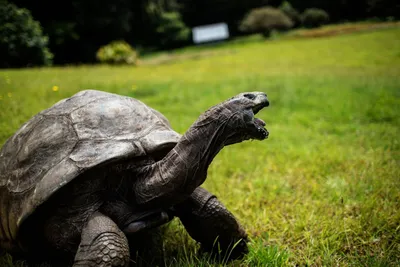
The oldest known land animal is 194. How did he get so ancient?
The secret to Jonathan the tortoise’s extreme longevity may be in keeping genes tidy
Jonathan the Aldabra giant tortoise is the oldest known land animal.
Jonathan, an Aldabra giant tortoise on the South Atlantic island of Saint Helena, appears fully grown in a photograph researchers say was taken around 1882. That means he’s survived to at least 194 years old, about a century past his species’ usual upper limit. In a new Science Advances study, scientists read his DNA to try and figure out why .
To get the tortoise’s DNA material, Jonathan’s veterinarian Joe Hollins pretended to feed him, wedged his mouth open with a hard glove and scraped cells from inside his cheek. “It was quite tricky and dangerous,” says study co-author Stephen Clark, a researcher at the Kallel Foundation, a longevity nonprofit in Nashville.
But it was worth the maneuver: the researchers found that, compared with other Aldabra tortoises, Jonathan has unique variants in 287 genes, some involved in DNA repair. The surprise finding, Clark explains, came from chemical tags on DNA called methyl groups that help switch genes on and off. With age and without constant maintenance, these tags drift . Young organisms tend to have consistent tags from cell to cell, so the switch will flip reliably.
Over time, the tags fall off or attach chaotically, meaning tags are inconsistent between cells and genes start turning on unpredictably. Scientists measure this disorder as entropy. “If I had to define what aging is, it’s increasing entropy,” Clark says. The overall entropy in Jonathan’s tags was higher than in tortoises aged 12 and 90, as expected. But they were not higher everywhere.
If you're enjoying this article, consider supporting our award-winning journalism by subscribing . By purchasing a subscription you are helping to ensure the future of impactful stories about the discoveries and ideas shaping our world today.
Jonathan the tortoise ( bottom left ) in Saint Helena in the late 1800s.
In 272 of Jonathan’s genes, many tied to the cells’ power-generating mitochondria, the switches’ chemical tags stayed as orderly as in a youngster. Because keeping order takes energy, which mitochondria supply, Clark suspects part of Jonathan’s longevity secret might be a feedback loop. “Mitochondria that make energy are being kept pristine, so they keep making energy that keeps them pristine,” he says.
“The authors identify new candidate genes associated with longevity,” says João Pedro de Magalhães, a comparative genomics researcher at the University of Birmingham in England, who was not involved in the study. “In the long term, perhaps we may find ways in which this knowledge could be applied to improve human health.” First, though, Clark and his colleagues have to make sure they’ve got their candidate genes right.
Cheek cells yield shorter, bacteria-contaminated genetic material, so gaps in Jonathan’s genome had to be filled in using a younger tortoise’s DNA. “The result is a Frankenstein sequence, roughly 95 percent Jonathan,” Clark says. If any of Jonathan’s unique variants were hiding in the borrowed stretches, he explains, they would have been missed. This problem, Clark argues, could have been solved by instead drawing a blood sample from the tortoise, but Saint Helena’s officials forbade it.
“Drawing blood from a tortoise may be tricky and in itself dangerous for an elderly individual,” says Joanna Bagniewska, a zoologist at the University of Oxford, who was not involved in the study. “Considering Jonathan’s iconic status on Saint Helena, were anything to happen to the tortoise, it could lead to resentment toward researchers in general.”
Clark notes that researchers can’t yet say whether unusual tidiness in Jonathan’s genes keeps him alive or is a by-product of something else entirely. “We can’t really put a flagpole in something and say, ‘Oh, this is why he lived this long,’” he says. “This work is just the first step.”
Great science journalism requires human expertise, time, effort and creativity. And it costs money. That’s why I and the journalists here at Scientific American hope you’ll join our community.
When you subscribe, you are supporting staff and freelance journalists who are passionate about telling science stories that are true, important and compelling. Our editors and reporters are often experts in their fields, which means they understand the nuances of big discoveries and can untangle the breakthroughs from the hype. With a subscription, you are also supporting rigorous fact-checking to ensure the words we publish are precise and accurate.
And you’re supporting original illustrations, graphics and photos that bring you closer to an advanced laboratory, an ice sheet in Antarctica or a space mission in orbit. You’re helping us craft other types of high-quality journalism as well: Our newsletters are carefully written, edited and curated by staffers you have or will come to know and love. Our Science Quickly podcast is based on original reporting, collaboration with editors and scientists and exacting production.
Subscriptions keep this engine running so we can continue to deliver thoughtful, rigorous and independent science journalism to you. In an era of viral misinformation, this work is crucial. If you value what we do, I hope you’ll consider joining us as a subscriber
Jeanna Bryner, Editor in Chief, Scientific American