
Three years on from the 7 October attacks, war has redrawn the map of Palestine
More than 74,000 Palestinians have been killed in the war launched by Israel following the 7 October, 2023 Hamas attacks. Palestinian territory has also become increasingly fragmented – in Gaza, the occupied West Bank and East Jerusalem.
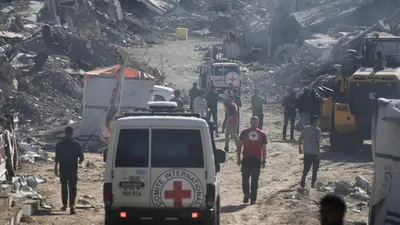
More than 74,000 Palestinians have been killed in the war launched by Israel following the 7 October, 2023 Hamas attacks. Palestinian territory has also become increasingly fragmented – in Gaza, the occupied West Bank and East Jerusalem.
“What is unfolding in Gaza, the West Bank and East Jerusalem are not isolated incidents, but rather a malicious colonial project aimed at making life more difficult for Palestinians in their homeland and forcing them to leave,” Palestinian Authority President Mahmoud Abbas told the United Nations on 24 September.
Few territorial disputes are as visibly reflected in changing maps as that of Palestine – from British Mandate Palestine in 1946, the 1947 UN Partition Plan , the borders that emerged after the 1948-1949 Arab-Israeli war to the fragmented Palestinian territories of today.
Even before the Hamas-led attacks on Israel of 7 October, 2023 and the war that followed, the territory envisaged for a Palestinian state had been steadily shrinking.
Palestine – now recognised as a state by 158 of the UN’s 193 member states – comprises the West Bank, East Jerusalem and the Gaza Strip. The International Court of Justice regards them as a “single territorial unit” whose unity and integrity should be preserved.
In reality, no such territorial continuity exists.
After the 1948-1949 war, Israel controlled around 6,000 square kilometres more than the territory allocated to a Jewish state under the UN partition plan. Following the 1967 war, it occupied Gaza and the West Bank, including East Jerusalem.
Since then, land confiscation, settlement construction and expropriation have progressively altered the geography of the Palestinian territories.
“If Israel is regarded as a democratic and liberal state, it will be assumed that a comprehensive peace can be achieved through negotiations,” Thomas Vescovi, a historian specialising in Israel and Palestine, told RFI.
“If, on the other hand, we consider another paradigm – namely that Israel is first and foremost the product of colonisation and remains a colonial state – then no form of negotiation can lead to peace.”
Since the 7 October attacks, he argues, that process has accelerated dramatically.
Three years of war have transformed the Gaza Strip physically as well as demographically.
More than 74,000 Palestinians have been killed, while the UN says more than 90 percent of Gaza’s housing stock has been damaged or destroyed . By May 2026, Israeli forces, controlled around 60 percent of the enclave.
Once one of the world’s most densely populated areas, most of Gaza's inhabitants are now concentrated in roughly a third of the enclave.
Israel withdrew its settlers and permanent military installations from Gaza in 2005, but continued to control most access by land, sea and air. International bodies, including the United Nations, have therefore continued to regard Gaza as occupied territory.
Calls to re-establish Israeli settlements in Gaza were for years largely confined to Israel’s nationalist and religious right. Since 7 October, that idea has moved closer to the political mainstream.
Vescovi says the war revived an issue that had previously been marginal.
“After 7 October, the army entered the Gaza Strip and we saw the resurgence of an issue that had been marginal in this part of Palestine: that of the return of Israelis to Gaza via settlement expansion,” he said.
Around a third of Israelis now support renewed settlement in Gaza.
“For 20 years, we have spoken of this as a pipe dream; today, it is also a realistic plan of action,” Finance Minister Bezalel Smotrich said in 2025. “Gaza is an inseparable part of the Land of Israel.”
Prime Minister Benjamin Netanyahu said in May that Israel controlled 60 percent of the Gaza Strip and that he wanted that figure increased to 70 percent.
For Vescovi, Israel’s return to Gaza has opened the door to a more permanent presence.
“Netanyahu, today, is clear in his stance: ‘We will not leave Gaza’,” he said. “His objective is clear."
Israeli Defence Minister Israel Katz reinforced this in September, saying the army remained ready to “finish the job” against Hamas and referring explicitly to implementing a “migration plan”.
The occupied West Bank has, meanwhile, seen a sharp expansion of Israeli settlements, alongside increasing settler violence, raids and displacement of Palestinians.
More than 1,000 Palestinians have been killed by Israeli forces or settlers in the West Bank since 7 October, 2023, while around 40,000 people have been forcibly displaced , according to UN figures.
Settlement construction reached a record level in 2025 – the highest since the UN began systematically monitoring it in 2017.
According to Israeli anti-settlement organisation Peace Now , 146 settlements in the West Bank and 15 in East Jerusalem have been established over the past two years. Some 750,000 Israelis now live in settlements across the occupied territories, alongside hundreds of smaller outposts.
The geography of Palestinian self-rule established by the Oslo Accords has also come under increasing pressure.
In July, the Israeli army issued at least 15 land confiscation orders in the Jenin governorate, including in what are referred to as Areas A and C. Under the Oslo agreement, Area A was intended to be administered by the Palestinian Authority while Israel retained full control over Area C.
“With such a project, Israel is deliberately fragmenting the territory, tearing Palestinian communities apart and hindering their freedom of movement,” Amnesty International warned.
Peace Now says the policy is pushing Israel towards “an undeclared annexation of the Palestinian territories”.
Settlement also affects roads, water supplies, farmland and economic activity, binding parts of the West Bank more closely to Israel while separating Palestinian communities from one another.
The planned E1 settlement project , between Jerusalem and Ma’ale Adumim, is considered especially significant. Critics say it would effectively cut the West Bank in two and make a contiguous Palestinian state far harder to establish.
European governments have repeatedly described E1 as a red line.
East Jerusalem, occupied by Israel in 1967 and unilaterally annexed in 1980, is another focus of the territorial dispute.
Palestinians see it as the capital of a future state, while Israel considers the entire city of Jerusalem its capital.
Since the 7 October attacks, settlement expansion and attempts to remove Palestinian residents from strategic neighbourhoods in the city have intensified.
“The Israeli authorities are stepping up their long-standing illegal policy of displacing Palestinian residents from neighbourhoods around Jerusalem’s Old City, in order to replace them with Israeli settlers,” Human Rights Watch said in June. “These Israeli measures aimed at altering the demographics of Jerusalem constitute war crimes.”
In an advisory opinion in July 2024, the International Court of Justice found that Israeli settlement policies, forced evictions and extensive house demolitions violated international law, including protections against the forcible transfer of an occupied population.
For Vescovi, events in Gaza, the West Bank and East Jerusalem reflect the same broader strategy.
“This desire to fragment and separate is truly a strategy that has always existed on the Israeli side, but one that has really been nurtured, fuelled and reinforced over at least the last 20 years, and even more so since 7 October, 2023,” he told RFI.
Vescovi says that Netanyahu understands both the international criticism Israel faces and the potential historical significance of what his government is doing.
“He knows that pressure will be brought to bear on him and that he will be condemned,” he said. “But in the history of Israel, he will be thanked for having resolved a problem that no one had resolved before.”
He draws a historical parallel with Israel’s founders, who remain national heroes despite the displacement of hundreds of thousands of Palestinians during what Palestinians call the Nakba – meaning "catastrophe".
“Perhaps if Netanyahu manages to succeed in his gamble, he will be celebrated in the future as the man who resolved the problem of Gaza and the West Bank,” Vescovi said. “There is a sense of continuity.”
The result, he believes, is that the vision of a negotiated two-state solution is becoming increasingly difficult to reconcile with realities on the ground.
“We have reached a point of no return today,” Vescovi concluded.
“If we genuinely want a Palestinian state, this requires exerting significant pressure on Israel – through force, sanctions and so on – which no Western ally currently seems prepared to bring to bear.”
This article has been adapted from the original version in French by Anne Bernas.
Daily newsletter Receive essential international news every morning
Keep up to date with international news by downloading the RFI app