
Kenya breaks ground on $16bn refinery as environmental concerns grow
East Africa is accelerating its push for greater energy independence with a new $16 billion refinery in Kenya – but the project is raising fears over the environmental cost of an expanding oil economy.
East Africa is accelerating its push for greater energy independence with a new $16 billion refinery in Kenya – but the project is raising fears over the environmental cost of an expanding oil economy.
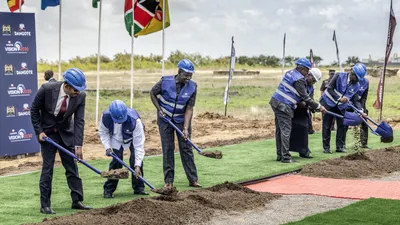
Nigerian billionaire Aliko Dangote joined Kenyan President William Ruto and several African leaders on Wednesday to break ground on the Dangote East Africa Petroleum Refinery at the Indian Ocean port of Lamu.
Once completed, the refinery is expected to process 700,000 barrels of crude oil a day, producing petrol, diesel and jet fuel for Kenya and markets across East Africa.
“This is Africa coming together to build Africa,” Dangote said. “Today we are not simply breaking ground for a refinery, we’re breaking ground for a new chapter in Africa’s industrial journey.”
Dangote, who launched Africa's largest oil refiniery in Nigeria in 2023, presented the project as part of the solution to a long-standing paradox – an oil-producing continent that exports much of its crude while importing refined products.
“For too long, our continent has actually been rich in resources but poor in value creation and addition,” he said.
“Africa cannot build lasting prosperity by exporting what it has and importing what it needs.”
Africa produced around 6.8 million barrels of crude oil a day in 2024 while consuming some 4.5 million barrels a day of refined petroleum products, according to figures cited by Ruto.
Yet refining capacity remains limited in many countries, leaving them exposed to international fuel markets and forcing governments to spend valuable foreign currency on imports.
Dangote argues increased refining capacity could allow most African countries to become self-sufficient in fuel by 2030 .
Asked whether the Lamu refinery marked a turning point in East Africa’s push for greater energy independence, Victor Abuso of RFI’s Kiswahili service said the answer was “yes and no”.
On one hand, he said, speeches at Wednesday's ceremony by Ruto and Ugandan President Yoweri Museveni reflected frustration with the region’s long dependence on foreign suppliers and overseas refining.
A refinery on the scale of Lamu could begin to change that. But Kenya does not yet commercially produce enough oil to supply a refinery of this size.
Dangote said the plant would initially import crude by sea from the Middle East, the United States and elsewhere, before potentially drawing more heavily on African producers as regional production expands. Its location at a deep-water port is central to that strategy.
The complex will also include a 1,000-megawatt power facility built to supply the refinery, with excess output expected to feed into Kenya’s electricity grid.
Environmental groups sue TotalEnergies over 'devastating' East Africa oil pipeline
Abuso said the Lamu project also exposed persistent divisions within the East African Community, with governments pursuing competing oil and refining strategies.
Uganda is preparing to exploit its own oil reserves and plans to build a smaller refinery in the district of Hoima, in the west of the country. Meanwhile the East African Crude Oil Pipeline, or EACOP , is being built to carry Ugandan crude more than 1,400 kilometres to the Tanzanian port of Tanga.
Uganda and Tanzania have also discussed developing a refinery and energy hub at Tanga – the same port initially considered for Dangote’s project before he opted for Lamu.
Abuso said this suggested East Africa’s emerging oil economy may be driven as much by national rivalry as regional integration.
The “economic rivalry” between Kenya and Tanzania in particular was likely to continue “for many, many years to come”, he said.
Museveni attended Wednesday’s ceremony and welcomed the Lamu project, while making clear Uganda intends to proceed with its own refinery ambitions.
Indigenous Kenyans forced off ancestral lands in name of conservation: NGOs
The region's drive for greater energy independence also comes with a potentially substantial environmental price.
EACOP has already drawn criticism over land acquisition, biodiversity, carbon emissions and its potential impact on communities along its route.
Lamu now faces many of the same questions.
The region is home to Lamu Old Town, a Unesco World Heritage site and one of the oldest surviving Swahili settlements in East Africa. Its coastline, islands and mangrove forests are a major tourist attraction, while fishing remains central to the local economy.
Abuso said environmental concerns were already growing, particularly over the mangroves and the possibility of pollution reaching the Indian Ocean.
“The biggest worry is the possibility of oil spills in the Indian Ocean,” he said.
Local fishermen fear pollution could affect their catches, Abuso said, while residents are concerned that industrial development could hurt tourism.
“A lot of people who live in Lamu depend on tourists,” he said, adding that communities wanted clearer assurances from the government about how their livelihoods would be protected.
Land rights have also become a flashpoint. Local residents have gone to court , asking that their rights to ancestral land be recognised before the development progresses further.
According to Abuso, residents say they were “not properly informed about this project and the negative effects that could come with it”.
A court allowed Wednesday’s ground-breaking ceremony to proceed while the legal case continues. Another hearing is scheduled on 14 October.
Ruto has promised that land and environmental concerns will be dealt with “lawfully and fairly”.
Lamu also presents a security challenge. The county lies close to Kenya’s border with Somalia and has suffered attacks and abductions linked to the Al-Shabaab Islamist militant group.
Abuso said security was a “genuine concern”, with reports that Kenya could establish a dedicated military presence near the refinery to protect the facility and surrounding communities.
Daily newsletter Receive essential international news every morning
Keep up to date with international news by downloading the RFI app