
French school protests spread to universities as blockades intensify
High school protests in France spread to universities on Thursday as students demanding more funding, smaller classes and the replacement of absent teachers continued blockades across the country. The government has announced a new consultation platform for high school students, after days of protests that have left students and police injured.
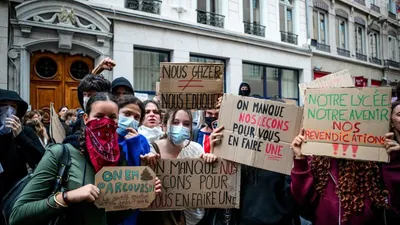
High school protests in France spread to universities on Thursday as students demanding more funding, smaller classes and the replacement of absent teachers continued blockades across the country. The government has announced a new consultation platform for high school students, after days of protests that have left students and police injured.
Around 30 university campuses were blocked on Thursday morning, the Union Étudiante (Student Union) said, including sites in Paris, Strasbourg, Marseille, Lyon, Reims, Poitiers and Nanterre.
High schools were also blocked in several cities.
The movement began in high schools about a week ago and had spread to 356 schools across the country by Wednesday, the Interior Ministry said.
Student grievances range from timetables, class sizes and a shortage of teachers to overheated classrooms during this year's heatwaves.
On Thursday, hundreds of pupils in Strasbourg blocked traffic and a tram line outside Couffignal high school and set rubbish containers on fire. In Saint-Denis, north of Paris, clashes broke out between young people and police, with mortar fireworks and tear gas used.
In Nantes, a fire broke out at Nelson Mandela high school after a rubbish-bin fire spread to the building, students told French daily Le Parisien .
The latest incidents follow violence at school blockades earlier in the week.
On Wednesday, 625 people were detained during high school blockades, Interior Minister Laurent Nuñez said – noting an "expansion of the movement" and condemning an "escalation of violence" outside certain schools.
Eighty-three police officers and gendarmes were wounded.
The minister condemned the "targeting of law enforcement officers, the throwing of projectiles, acts of violence, verbal abuse, attempted arson, and what amounts... to urban violence".
Authorities reported burning rubbish bins, mortar fireworks and barricades in several locations.
Since the blockades began, 119 students and school staff have been injured, Education Minister Edouard Geffray said.
Clashes between French teens, police as school blockades intensify
The ministry was preparing to roll out a consultation platform allowing all high school students to submit their concerns and demands, he added.
A national review of the proposals will then be used to provide what the government called “structured responses”.
Speaking to reporters on Wednesday, President Emmanuel Macron said: “I hear and I understand the anxieties, sometimes the anger, that our youth can have, whether about the climate, technological changes, or geopolitical situations.”
He said he and the government were trying to respond “in the most concrete way possible”.
However, Macron said none of these debates or fears could justify the unrest and criticised hard-left politicians he accused of "legitimising violence".
Hundreds held, dozens wounded as French school protests escalate
France's police watchdog, the General Inspectorate of the National Police (IGPN), has opened three investigations into incidents in which students were injured during protests, Nuñez said.
The investigations concern incidents in Sevran, north-east of Paris, Saint-Ouen-l'Aumône, north-west of the capital, and Tours in central France.
In Tours, a young man was injured in the head on Wednesday and taken to hospital. The public prosecutor said his injuries were “compatible” with being caused by a projectile fired from a police LBD , a type of non-lethal weapon.
Nuñez defended the conduct of the security forces, saying they had intervened “with a great deal of proportionality”.
USL, France 's second-largest student union, called on Wednesday for protests to go into a “second act”.
It invited unions, associations and political organisations to join Thursday's demonstrations and further protests on 6 October, demanding “massive funding” for schools and universities.
The UNEF, France's third-largest student organisation, has also called on students to take to the streets across the country.
It is protesting against what it describes as a mass reduction in university places, as well as a freeze on housing benefit payments.
Daily newsletter Receive essential international news every morning
Keep up to date with international news by downloading the RFI app