
France pledges more support to fight DRC Ebola outbreak as deaths top 4,000
France will step up its support for efforts to control Ebola in eastern Democratic Republic of Congo, Foreign Minister Jean-Noël Barrot said on Saturday during a visit to a region hit by the virus. The outbreak has killed more than 4,000 people, Congolese authorities said, as they struggle to contain what has become the fastest-growing Ebola outbreak in history.
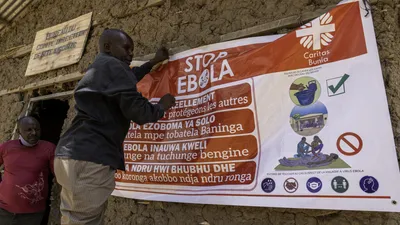
France will step up its support for efforts to control Ebola in eastern Democratic Republic of Congo, Foreign Minister Jean-Noël Barrot said on Saturday during a visit to a region hit by the virus. The outbreak has killed more than 4,000 people, Congolese authorities said, as they struggle to contain what has become the fastest-growing Ebola outbreak in history.
The latest figures released by DRC's health ministry on Thursday showed that 4,042 people have died, among 8,376 cases recorded since the outbreak was declared in eastern Congo on 15 May.
Barrot is one of only a few Western politicians to visit the north-eastern Congolese city of Bunia in Ituri province, which is at the epicentre of the outbreak.
France allocated €13.4 million to the fight against Ebola between January and July.
Barrot said he would propose additional humanitarian funding for Ebola during upcoming discussions on the French budget , which is already stretched thin by record public debt.
A national humanitarian conference is due to be held in Paris on 6 October, where Ebola is on the agenda.
"Ebola may seem far away to some people or political leaders, but it can return very quickly. Our responsibility is to prevent those resurgences," Barrot told reporters in Bunia.
Ebola outbreak slows in parts of DR Congo but crisis remains severe
The current outbreak is on track to exceed the deadliest on record, West Africa 's regional outbreak between 2014 and 2016, which killed 11,000 people, the World Health Organisation has said.
The number of newly confirmed cases is falling, but that could be attributed to insecurity and challenges in getting communities to cooperate in some of the hot spots, the Africa Centres for Disease Control and Prevention said this week.
Confirmed cases fell from around 850 cases and 470 deaths a week in mid-July to an average of 490 cases and 230 deaths in September.
While the spread of the disease has slowed in some areas, it has accelerated in others.
The aid group Doctors Without Borders (MSF) said on Friday the outbreak has particularly worsened in the North Kivu province, accounting for 40 percent of new confirmed cases since the end of August.
"It is like fighting a wildfire," said Stephanie Hoffman, MSF coordinator in the city of Butembo in North Kivu. "Multiple outbreaks are developing at the same time, with varying intensity and in different locations."
Violence against healthcare workers in DRC hampers Ebola response
Speaking at a press conference on Friday, DRC health minister Roger Kamba said that the outbreak had peaked.
He pointed to government figures showing 19 out of 63 zones affected have not recorded any cases for at least three weeks.
"The epidemic is no longer beyond our control," Kamba said. "We were following the epidemic, but now we are anticipating it."
Barrot praised Congolese authorities, UN agencies, humanitarian organisations and medical workers for containing the epidemic and preventing it from spreading to major urban centres in Congo and beyond.
"First and foremost, we must fight the epidemic where it emerges," Barrot said when asked whether the virus could spread after a case was reported in France.
A doctor had tested positive for the virus after returning to France on 23 June from a humanitarian mission in DRC, but later made a full recovery.
Daily newsletter Receive essential international news every morning
Keep up to date with international news by downloading the RFI app