
EU approves tougher migration rules in latest push to tighten borders
European Union interior ministers agreed on Thursday to toughen the bloc's migration policies, particularly on returns of undocumented migrants. They also want to step up social media monitoring to prevent further mass movements of people after the crisis in the Spanish exclave of Ceuta this summer.
 Tensions Migratoires$CEUTA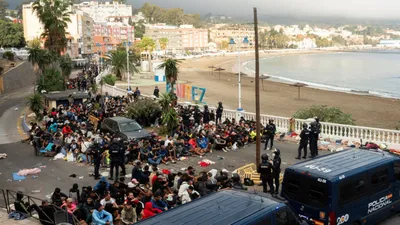
European Union interior ministers agreed on Thursday to toughen the bloc's migration policies, particularly on returns of undocumented migrants. They also want to step up social media monitoring to prevent further mass movements of people after the crisis in the Spanish exclave of Ceuta this summer.
The talks in Luxembourg were EU ministers' first in-person meeting since this summer's migrant rush to Ceuta tested European border security.
The influx of 70,000 migrants crossing over from Morocco in late July triggered a diplomatic spat between Spain and Italy, whose anti-immigration government has been pushing the EU to take a harder line.
At Thursday's meeting , the EU Council gave final approval to tougher new rules "enabling more effective returns" for people with no legal right to stay in the EU, a statement said.
They allow member states to impose a broader range of penalties on people who fail to follow the order to leave and authorise special measures for those who are deemed to pose a security risk, including indefinite entry bans and extended detentions.
They also open the door to so-called return hubs – reception centres in countries outside the EU where members of the bloc can send adult migrants who cannot safely return to their country of origin.
"All measures related to return must be carried out in full respect of fundamental rights," the EU Council said.
The rules are due to come into force within weeks.
They follow on from the Pact on Migration and Asylum , reforms enforced since June that hardened EU border procedures and overhauled the asylum process.
Critics such as Human Rights Watch say they make it easier for EU countries to detain asylum-seekers and rush decisions on their claims.
"Around two in three people ordered to leave the EU do not actually leave. The revised return rules adopted today will assist member states in implementing swift returns effectively," Jim O'Callaghan, Ireland's Minister for Justice, Home Affairs and Migration , said after Thursday's meeting.
"This is crucial to deliver a common approach to migration management under the Pact on Migration and Asylum."
What's in the landmark EU migration reform hardening border protections?
The pact also set out an emergency response in the event of unexpected surges in migration, allowing governments to reduce protections for asylum-seekers when large numbers of people arrive at once or when hostile third countries "instrumentalise" migratory flows.
Spain has accused networks linked to Russia, Israel and international far-right groups of spreading disinformation about the Ceuta migration crisis.
An RFI investigation found many suspect accounts helped amplify calls for a new mass crossing in August.
At Thursday's meeting, ministers heard proposals to step up surveillance of online platforms as part of a European Commission plan to prevent sudden, large-scale arrivals. They would see EU border agency Frontex given more powers to monitor social media.
"Europe is beginning to consider alerts that should be triggered in good time," said Croatia's interior minister Davor Bozinovic, who suggested this could involve, among other things, monitoring "incitement to such activities on social media".
While sending asylum seekers home to potential danger runs counter to international humanitarian law, Dutch migration minister Bart van den Brink advocated for the possibility of doing so in the event of a crisis.
Faced with large numbers of people being incited to cross EU borders, he argued it should be possible to "send them back immediately".
"Such a large group of people simply crossing a border – or even storming it – is quite simply a border violation," he said.
Fake accounts and false rumours drive new Ceuta crossing campaign
A legal framework for the establishment of return hubs was agreed by the EU Council and the European Parliament in June 2026.
Proponents say return hubs – which would serve either as the final destination or as transfer centres for those expelled – could facilitate repatriations and act as a deterrent for would-be irregular migrants.
But critics question their effectiveness, pointing to the hurdles faced by similar projects and arguing they could leave migrants stranded in limbo with little oversight.
The United Kingdom abandoned a scheme to deport undocumented migrants to Rwanda , while Italian-run facilities to process migrants in Albania have faced legal challenges and slow uptake.
Denmark – along with Austria, Greece, Germany and the Netherlands – has been exploring options to set up such centres in third countries.
"When it comes to return hubs it's progressing very well," Danish interior minister Morten Bodskov told reporters as he arrived at Thursday's meeting.
"We are moving in the right direction," he said, without providing further details.
This week Greek migration minister Thanos Plevris said his country was aiming to open a centre in 2027 in an African country "that we have already agreed on" but could not yet be named.
Daily newsletter Receive essential international news every morning
Keep up to date with international news by downloading the RFI app