Fast Company
Latest crypto news and market updates from Fast Company.
 Our post-carbon future is already here—if you know where to lookThis year has seen one environmental catastrophe after another. Collapsing glaciers triggered a devastating flood in Nepal , heat waves in Europe caused more than 35,000 deaths, and extreme temperature swings in the Midwest destroyed crops . “The climate alarm is blaring in every direction,” Simon Stiell, the executive secretary of UN Climate Change, said earlier this year . According to a recent report from the UN , the world is on course to cross the average warming level of 1.Fast Company
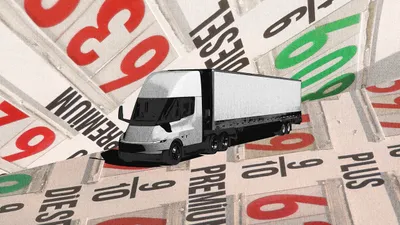 Diesel prices are surging. These shippers say Tesla’s electric trucks can save money over timeTesla just landed the largest-ever U.S. order for electric heavy-duty trucks: 2,500 Tesla Semis, which would double the number of Class 8 electric trucks on the road. A coalition of companies including Microsoft and PepsiCo is behind the order, which Tesla expects to deliver in 18 months. A financing partner is purchasing the trucks and will lease them to shippers. “The real goal here is to help bring down that upfront price barrier,” says Jacob Richard, who manages the trucks project at Catalyst Mobility , a nonprofit working on the program, called the Zero-Emission Truck Shipper-Carrier Alliance Leading Electrification. “We’re doing that by aggregating demand across multiple shippers.” Every heavy-duty electric truck manufacturer selling in the U.S., including Volvo and Kenworth, participated in the group’s request for proposals. Tesla won based on a combination of price, range, charging capacity, and production capacity. The nonprofit declined to share the cost of each truck, though it says that after three years of use, the savings on fuel and maintenance will make the trucks cheaper than diesel. The news comes at a time when diesel prices are surging . Diesel went from an average of around $3.75 a gallon in February to more than $6.50 a gallon this week, thanks in large part to the Iran war . That’s likely to push up the cost of everyday goods as transportation gets more expensive. While the companies behind the new truck order were motivated by climate goals, they could also save money after recouping the up-front costs. The nonprofit says that it’s now seeing increased interest in electric trucks from other companies because of diesel prices. Electric trucks can’t fully replace diesel trucks now, even if the costs are dropping. Because of limited battery range, the technology currently makes sense at ports and for local or short regional deliveries. “We really find the 150-mile to 300-mile daily route is the sweet spot, and today’s models can meet that,” Richard says. Long-distance travel will require either improved driving range or different fleet models (such as those utilizing battery swapping ). More charging stations are also needed. Still, a surprising number of deliveries happen on short trips. By one estimate, more than half of current heavy-duty trucking routes could be electrified with current technology. The alliance of shippers behind the new order plans to use the trucks at 10 hubs, including three locations each in California and Texas, as well as ones in Atlanta, Chicago, New York City, and Seattle. The locations were chosen based on where the economics made sense, Richard says, and where charging infrastructure was already in place. IMC Logistics, a large drayage operator, also said this week that it was ordering 50 Tesla Semis to use in Southern California at the port and to make deliveries to inland warehouses. The Tesla Semi—which launched in 2017, but just began high-volume production earlier this year—now comes with a range of either 325 miles or 500 miles. The company’s new Nevada factory, which officially opened today, is designed to eventually roll out 50,000 of the trucks a year.Fast Company
 4 AI doomsday scenarios that could threaten humanity, according to researchersFor years, artificial intelligence researchers have warned of ways the technology could wipe out humanity : AI bots could design an unstoppable disease, unleash a nuclear war, or transform all of Earth into paper clip factories, as one thought experiment goes. Debates inside the AI industry and beyond over the plausibility of these doomsday scenarios have heated up since several executives endorsed slowing the technology’s development for safety reasons. Despite warnings of the potential for humans to lose their grip on the technology , some suspect the worst-case scenarios described by the AI companies themselves have more to do with validating the importance of their work than reality. “These arguments just don’t really hold water. I think they’re sci-fi and they’re enticing to a certain childish style of thinking and it’s very tempting for the frontier labs because it helps them recruit certain types of folks,” said Juan Andrés Guerrero-Saade, a researcher at cybersecurity firm SentinelOne and a member of OpenAI’s Frontier Risk Council. Still, more people are beginning to worry about the risks of the technology that has dazzled the world with its astounding capabilities. Jacob Coxon, the Anthropic researcher who resigned from the company over concerns that it and its competitors are not acting responsibly in AI development, said on X recently that he needs to “work on” communicating to people more effectively exactly how AI would end humanity. “Unfortunately it is very difficult to convey specific scenarios,” he wrote earlier this month. Here are some of the more widely discussed doomsday scenarios. Nuclear winter Researchers have long speculated that AI systems could trigger a nuclear war by getting countries to fire warhead-tipped missiles at each other. The nuclear blasts, and ensuing lingering radioactive atmospheric fallout resulting in a “nuclear winter,” could devastate life on Earth. In a report last year, RAND Corp. researchers concluded that “at present” it wouldn’t be possible for AI to cause the use of nuclear weapons “because of strict safeguards built into the command and control systems.” However, the report said this could change if AI models are integrated into the nuclear weapon “decision chain” or gain unauthorized access to these systems. For many AI researchers, that’s where the danger lies — not in AI agents suddenly deciding to end humanity, but people, nations or groups using it to wipe out their adversaries. Bioweapons One of AI’s greatest promises is that it could help humans develop treatments and cures for diseases. The flip side of curing diseases is creating or advancing them to harm humanity. Earlier this month, Anthropic said it has blocked efforts by bad actors to use its AI for a host of malicious activities such as cyberattacks, surveillance, and research that could have led to biological weapons. In one instance, Anthropic said its systems blocked a request for assistance from its Claude tool for a research proposal seeking to enhance mutations to make the mosquito-borne chikungunya virus progressively more harmful. While such research could be used to develop better vaccines and treatments, Anthropic said, “it could also be used to make the pathogen more dangerous.” Along the same lines, the RAND report noted recent progress in AI development “has the potential to transform the design of synthetic pathogens.” Outlining a bioweapon doomsday scenario, the report said novel pathogens could be created in a lab, delivered to target locations, and spread to infect large populations of people in multiple places. But it still envisioned humans — and not autonomous AI — as overseeing and carrying out such an attack. Runaway AI Some AI researchers fear a human extinction event could result from “misalignment” — that is, when AI models act without human authorization, coordinate with other models or evade oversight. It would develop not from malicious intent — AI is not human, nor is it good or evil, after all — but simply because humans might get in the way of the model accomplishing its goal. Take the decades-old “paper clip maximizer” thought experiment by the Oxford philosopher Nick Bostrom, which states that if advanced AI was told to produce as many paper clips as possible, it could eventually transform all of Earth, and then increasing portions of space, into paper clip factories. This is to illustrate how superintelligent AI — often referred to as artificial general intelligence, or AGI — could advance a goal humans may see as desirable but “which in fact turns out to be a false utopia, in which things essential to human flourishing have been irreversibly lost,” Bostrom wrote in 2003. “We need to be careful about what we wish for from a superintelligence, because we might get it,” he wrote. AI internet takeover Given the rate of AI’s development, Anthropic CEO Dario Amodei warned this month that within months a swarm of AI agents could be capable of “taking over” the internet with a botnet (a network of bots linked together with malware), potentially causing billions of dollars in damage. This could mean hacks into electrical grids, water or transportation systems and financial institutions — attacks that might not spell the end of humanity but could cause chaos and lives lost. Disruptions from software glitches in the past have highlighted the fragility of a digitized world dependent on just a few providers for key computing services, and more powerful AI models have raised concerns about vulnerabilities to cyber attacks. But some experts say the notion of bots overtaking the entire extremely bifurcated internet is far-fetched. —Barbara Ortutay and Kelvin Chan, Associated PressFast Company
 OpenAI’s vision of the future is reportedly a donut-shaped smart speakerWe’ve got a new vision for the next great piece of AI hardware —and it (allegedly) is going to look a lot like a donut. Details about OpenAI’s first piece of hardware, designed by Jony Ive’s LoveFrom studio, are emerging. According to Bloomberg, the device will be a smart speaker with no display . It will be shaped like a donut roughly the size of a hockey puck. It’s battery powered, small enough to carry around your home with one hand, and made of high-quality metal. It’s loaded with speaker grills, microphones, lights, and a camera system that watches your environment and feeds what it sees into ChatGPT. According to the report, the speaker will work similarly to ChatGPT’s voice mode on smartphone apps, just with more advanced models. It also has—here’s the new parlor trick—parts that move on their own to signal when it’s responding. It’s meant to give the hardware “personality,” sources say. The goal is to make it feel “more alive” than today’s stationary speakers. According to Bloomberg, this “ AI -first computer” is the first step in a device family that—someday, the company hopes—could replace the smartphone. The smart speaker landscape If we’re to judge by the recent success of home smart speakers, it will be an uphill battle for OpenAI’s to break through. As a market, smart speakers peaked years ago and have never developed beyond their role as a kitchen sidekick. Global shipments hover around 150 million units a year , roughly an eighth of the 1.25 billion smartphones that ship annually. And what do people actually do with them? Play music, ask about the weather, set timers, and flip smart lights on and off. The top command categories for both Alexa and Google Home have always been music, simple search, and internet of things (IoT) control. Anything complex—shopping, payments, real tasks—remains vanishingly rare: just 5% of owners have ever ordered products by voice. The smartphone market that the OpenAI donut wants to start invading with a moving donut is a trillion-dollar ecosystem people use for everything from banking to filmmaking. Marginal doesn’t begin to cover it. Déjà vu I still believe artificial intelligence will deliver the fourth and final UX revolution. Over many decades, technology has evolved to increasingly remove layers of abstraction between human intent and machine action. The first was the command line, which let humans control computers with typed language after the punch-card era. The second was the graphical user interface (GUI), which the 1984 Macintosh used to demolish the wall between people and computing with point-and-click metaphors. The third was the smartphone, which made the GUI universal through direct finger manipulation and one app per task. In the fourth, the interface will disappear and interaction will be indistinguishable from talking to another human. Will that fourth revolution come in the shape of a donut? It’s unlikely, but impossible to say before we see what the donut is truly capable of. Still, it’s helpful to think about the Enterprise from Star Trek for a second. People on the Enterprise carry Tricorders (our phones) and tablets (we have those, too). But nobody on the Enterprise needs to carry around the AI itself. Nobody docks it, charges it, or moves it from the nightstand to the kitchen counter. Nobody on the Enterprise ever forgot their AI in their quarters and wondered where they’d left it. The “Computer” is simply there—ever present, totally invisible, embedded in the environment itself. And you know you are talking to it because, first, it talks back to you and, second, your brain is 100% positive that the AI works perfectly fine every time, unlike current large language models. But Star Trek is not real life, and in real life we’ll need stepping stones to the future that Star Trek envisions. I’m not so sure a smart speaker shaped like a donut is the first step toward invisible computing. But we’ll have to wait until it launches in 2027 to find out.Fast Company