Business Recorder
Latest crypto news and market updates from Business Recorder.
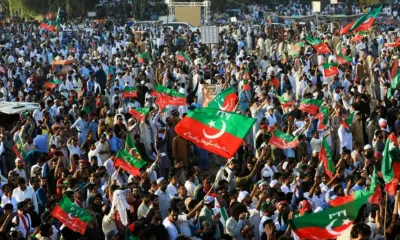 PTI defers long march to October 4Pakistan Tehreek-e-Insaf (PTI) has decided to postpone its long march, originally scheduled for September 27, to October 4. Khyber Pakhtunkhwa Chief Minister Sohail Afridi anounced the development during a press conference on Friday “The march will commence on Sunday, October 4, from Peshawar,” he said, adding that the decision was made unanimously during a meeting of the party’s political committee earlier in the day. Earlier, media reports suggested that the march had been deferred till October 5. According to the reports, the decision was taken at a meeting of the party’s political committee held at the Chief Minister House in Peshawar, chaired by PTI Chairman Barrister Gohar Ali Khan. Khyber Pakhtunkhwa Chief Minister Suhail Afridi, members of the provincial cabinet and parliamentarians also attended the meeting. It said the committee agreed on October 5 as the new date, but a formal announcement would be made only after taking into confidence Leader of the Opposition in the National Assembly Mahmood Khan Achakzai and Leader of the Opposition in the Senate Raja Nasir Abbas. The committee resolved that the long march would go ahead in any case, the sources added. A proposal was also floated during the meeting that the party should avoid committing to a final date and instead keep announcing different dates, in order to sustain pressure on the government. The meeting, however, exposed differences among party leaders over the long march, the sources said. Some PTI leaders complained that the party had not appeared to be actively mobilising for the September 27 march. In response, Achakzai, Raja Nasir Abbas and several leaders of PTI’s Punjab chapter maintained that Chief Minister Afridi had announced the September 27 date without any consultation. Most members from Khyber Pakhtunkhwa proposed that the long march be deferred and an all parties conference (APC) be convened in early October instead. The participants also agreed to further strengthen coordination among opposition parties. Meanwhile, Khyber Pakhtunkhwa Governor Faisal Karim Kundi said consultations were under way on the imposition of governor’s rule in the province. Talking to the media in Peshawar, Kundi said imposing governor’s rule was not an unconstitutional step, noting that it had been enforced in various provinces, including Khyber Pakhtunkhwa, in the past. Commenting on the situation in the province, the governor alleged that Khyber Pakhtunkhwa was witnessing corruption, lawlessness and terrorism, adding that the provincial police were the lowest paid in the country. He further alleged that the provincial government wanted to turn the police into a “Tiger Force,” and vowed to stand like a wall against any such move. Regarding the long march, Kundi claimed that PTI had made no preparations and that its workers were seeking a way out. He said party members were voluntarily courting arrest, which showed that the party was backing away from the march. “I feel PTI will announce calling off the long march today or tomorrow,” he said.Business Recorder
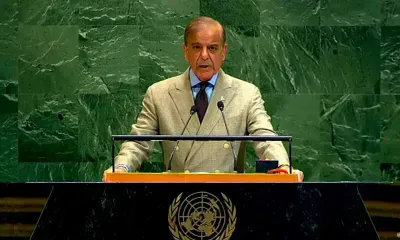 PM Shehbaz set to address 81st UNGA sessionPrime Minister Shehbaz Sharif is set to address the 81st session of the United Nations General Assembly (UNGA) on Friday. According to Pakistan’s Mission at the UN, the prime minister will present Pakistan’s perspective on the evolving regional and international security environment, stressing dialogue, diplomacy, restraint and the peaceful resolution of disputes, state-run Pakistan TV reported. The statement said these principles have been a consistent feature of Pakistan’s foreign policy and have guided its approach during its current term on the UN Security Council. The prime minister will also outline Pakistan’s priorities on sustainable development, climate change, counter-terrorism, Islamophobia, global economic challenges, UN reform and the Sustainable Development Goals. A particular focus will be the Global South, with a call for greater cooperation on the intertwined development, economic, climate and security challenges facing developing countries. The prime minister will also draw the world’s attention to prolonged occupation and the denial of the right to self-determination in Indian Illegally Occupied Jammu and Kashmir and Palestine. He will stress that both issues must be addressed in line with relevant Security Council resolutions. PM in New York The prime minister arrived in New York on Monday, leading a small delegation to the UNGA session. He was received by Ambassador Asim Iftikhar Ahmad, Pakistan’s Ambassador to the US Rizwan Saeed Sheikh and other mission officials. He is accompanied by Deputy Prime Minister and Foreign Minister Ishaq Dar. On Tuesday, the prime minister attended the opening session of the General Assembly, during which US President Donald Trump described him as a “terrific man” while referring to the May 2025 Pakistan-India conflict. On Wednesday, PM Shehbaz addressed the 40th anniversary session of the Declaration on the Right to Development, calling for reform of the international financial architecture, action on debt distress and support for climate adaptation and loss-and-damage financing. On the sidelines, he met IMF Managing Director Kristalina Georgieva and told her that Pakistan was moving from macroeconomic stabilisation towards economic recovery. The two also discussed the forthcoming IMF programme review. He also met European Commission President Ursula von der Leyen and European Council President António Costa, highlighting the importance of GSP Plus for Pakistan’s economy, as well as Syrian President Ahmed al-Sharaa, Bosnia and Herzegovina Presidency Chairman Denis Bećirović and Gates Foundation Chair Bill Gates, with whom he discussed polio eradication and agricultural reforms. Speaking to the media, the premier said Islamabad had “not lost hope” of de-escalating tensions between the United States and Iran. On Thursday, the prime minister met Iranian President Masoud Pezeshkian to discuss the regional situation and bilateral relations. He also met US-based Pakistani business leaders, inviting them to invest in Pakistan, and a delegation of Pakistani youth professionals.Business Recorder
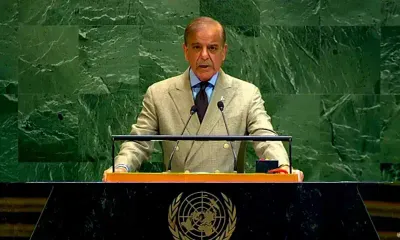 PM Shehbaz set to address UNGAPrime Minister Shehbaz Sharif is set to address the 81st session of the United Nations General Assembly (UNGA) on Friday. According to Pakistan’s Mission at the UN, the prime minister will present Pakistan’s perspective on the evolving regional and international security environment, stressing dialogue, diplomacy, restraint and the peaceful resolution of disputes, state-run Pakistan TV reported. The statement said these principles have been a consistent feature of Pakistan’s foreign policy and have guided its approach during its current term on the UN Security Council. The prime minister will also outline Pakistan’s priorities on sustainable development, climate change, counter-terrorism, Islamophobia, global economic challenges, UN reform and the Sustainable Development Goals. A particular focus will be the Global South, with a call for greater cooperation on the intertwined development, economic, climate and security challenges facing developing countries. The prime minister will also draw the world’s attention to prolonged occupation and the denial of the right to self-determination in Indian Illegally Occupied Jammu and Kashmir and Palestine. He will stress that both issues must be addressed in line with relevant Security Council resolutions. PM in New York The prime minister arrived in New York on Monday, leading a small delegation to the UNGA session. He was received by Ambassador Asim Iftikhar Ahmad, Pakistan’s Ambassador to the US Rizwan Saeed Sheikh and other mission officials. He is accompanied by Deputy Prime Minister and Foreign Minister Ishaq Dar. On Tuesday, the prime minister attended the opening session of the General Assembly, during which US President Donald Trump described him as a “terrific man” while referring to the May 2025 Pakistan-India conflict. On Wednesday, PM Shehbaz addressed the 40th anniversary session of the Declaration on the Right to Development, calling for reform of the international financial architecture, action on debt distress and support for climate adaptation and loss-and-damage financing. On the sidelines, he met IMF Managing Director Kristalina Georgieva and told her that Pakistan was moving from macroeconomic stabilisation towards economic recovery. The two also discussed the forthcoming IMF programme review. He also met European Commission President Ursula von der Leyen and European Council President António Costa, highlighting the importance of GSP Plus for Pakistan’s economy, as well as Syrian President Ahmed al-Sharaa, Bosnia and Herzegovina Presidency Chairman Denis Bećirović and Gates Foundation Chair Bill Gates, with whom he discussed polio eradication and agricultural reforms. Speaking to the media, the premier said Islamabad had “not lost hope” of de-escalating tensions between the United States and Iran. On Thursday, the prime minister met Iranian President Masoud Pezeshkian to discuss the regional situation and bilateral relations. He also met US-based Pakistani business leaders, inviting them to invest in Pakistan, and a delegation of Pakistani youth professionals.Business Recorder
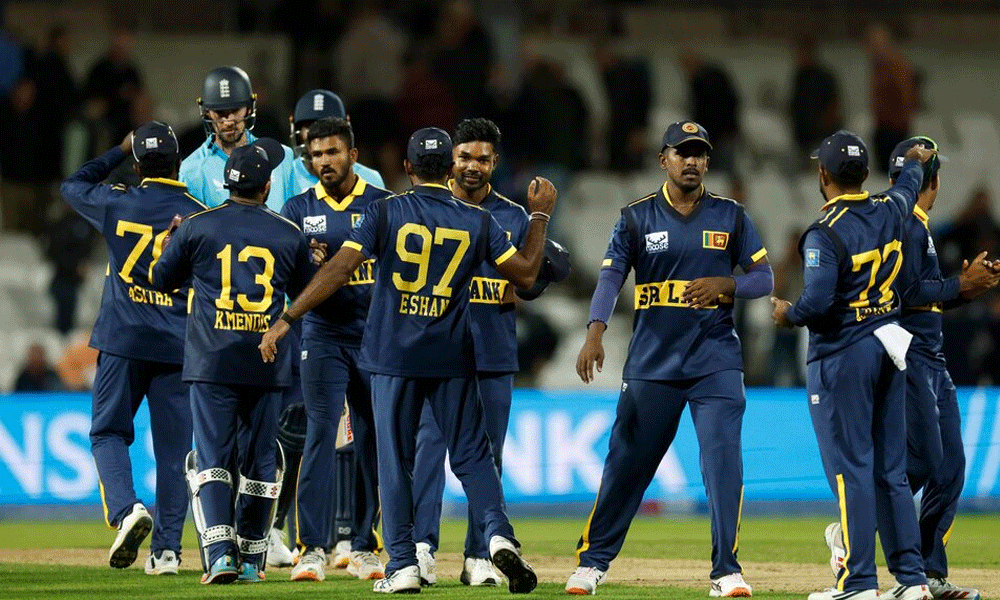 Sri Lanka grab dramatic win over England to square seriesLEEDS: Sri Lanka pulled off a dramatic 16-run win over England in the second one-day International at Headingley on Thursday to level the three-match series despite a heroic effort from injured Jos Buttler. England scored 305-9 in reply to Sri Lanka’s 321-6, which included a century from captain Kusal Mendis in a high-scoring clash in which Buttler looked to be taking England to a comfortable triumph before damaging his hamstring. He retired hurt on 67, but as Sri Lanka pulled themselves back into the contest with key wickets, a limping Buttler came back to the crease, with England needing 20 runs off the last two overs. He was, however, only able to add two more runs before being caught at deep mid-wicket, with his dismissal effectively ending home hopes. England had needed only 63 runs off their last 10 overs to seal the series but were pinned back by the Sri Lankan bowlers, who got their side over the line for their first success of the tour after suffering a 3-0 whitewash in the Twenty20 internationals. Sri Lanka skipper Mendis won the toss and elected to bat, leading from the front as he scored 121 and shared a second-wicket partnership of 137 with Kamindu Mendis, who made 54. Expensive drop Kusal Mendis was dropped on 17 by Gus Atkinson at fine leg in an expensive slip off Jamie Overton’s bowling and had another life one run short of his century when he was given out caught behind off Overton but reviewed immediately and the TV umpire found there had been no nick. He cover drove the next ball to complete a seventh ODI century. Pavan Rathnayake added 48 off 39 balls before being run out, and Janith Liyanage contributed 32 before becoming Jofra Archer’s only wicket as the England paceman returned expensive figures of 1-65. England’s reply began in impressive fashion. They took advantage of sub-standard Sri Lankan bowling, allowing Tom Banton and Ben Duckett to put together an opening stand of 143 inside the opening 20 overs. But almost out of nowhere, left-arm spinner Dunith Wellalage bowled Duckett (67) and had Banton stumped for 73 off 61 balls, before trapping captain Harry Brook for a single. He finished his 10 overs with figures of 3-49. Buttler turned the tide in England’s favour again before his injury, but stretching to complete a run, he looked to suffer a torn muscle. England won the first ODI by 89 runs at Chester-le-Street on Tuesday, and the decider will be at The Oval in London on Sunday.Business Recorder
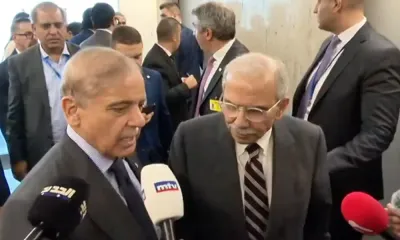 Civil, military leadership working in tandem to revitalise Pakistan’s economy: PM ShehbazPrime Minister Muhammad Shehbaz Sharif on Thursday said that Pakistan’s civil and military leadership are working in tandem to revitalise the national economy and strengthen diplomatic ties. Speaking to journalists alongside Lebanese Prime Minister Nawaf Salam on the sidelines of the 81st session of the United Nations General Assembly (UNGA) in New York, the prime minister noted: “Allah Almighty is blessing the mutual consultations and efforts of the Pakistani leadership to make the country’s economy strong.” Sharif said that Pakistan was intensifying its regional peace initiatives under the framework of the Islamabad Memorandum of Understanding, reiterating a firm commitment to collaborative stability efforts across the region. Reaffirming solidarity with Beirut, the prime minister described Pakistan and Lebanon as brotherly nations. He stated that Islamabad “strongly supports Lebanon’s territorial integrity and independence”, while continuing to unequivocally condemn external aggression and the loss of innocent civilian lives. The Lebanese prime minister commended the efforts being made by Pakistan to calm down situation in the region and find a diplomatic solution to the conflict. He appreciated the efforts made by Pakistan regarding Lebanon. “Lebanon cannot isolate itself from the wider conflict in the region and we are hopeful that Pakistani efforts will succeed in bringing down the tensions in the region and hopefully a diplomatic solution will be found.” Talking about the situation in Straits of Hormuz and Bab al Mandab in Red Sea, PM Shehbaz said brotherly and friendly countries were making efforts to de-escalate the situation. To a question about his meeting with the president of Iran, he affirmed that he took the Iranian president into confidence about Pakistan’s efforts to de-escalate regional tensions. He said during the detailed meeting, he told the president of Iran that establishment of peace in the region was need of the hour. “Iran is our brotherly neighbouring country and like before Pakistan’s civil and military leadership will continue collective efforts for peace,” he remarked. He said the president of Iran appreciated efforts of Pakistan and said the Islamabad Memorandum of Understanding was fully acceptable to Iran, which was ready to work further on it. “Allah is blessing efforts of Pakistan for peace,” he remarked. To another question, he said terrorists coming from Afghanistan were perpetrating terrorist activities in Pakistan and were martyring innocent people and military and police officers and personnel. “The incidents of terrorism are very condemnable and Pakistan is befittingly responding to this terrorism,” he said adding, Pakistan will not sit idle till the complete eradication of terrorism from the country.Business Recorder
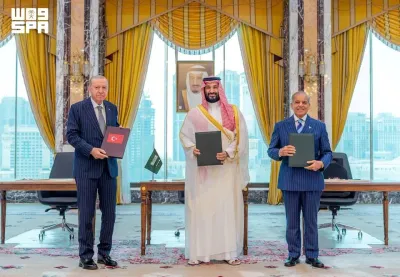 Allies unite behind Saudi Arabia as Houthis step up attacksRIYADH/CAIRO: Saudi Arabia, Turkiye and Pakistan will hold an urgent, high-level meeting under a joint defence pact to discuss ways to support the kingdom amid attacks by Yemen’s Houthis, while Tehran sought to distance itself from the rapid advance of its Houthi allies. The Houthis have launched strikes on the Saudi-backed government in Yemen and repeatedly fired into Saudi Arabia, disrupting oil flows from the world’s largest energy exporter, as part of a wider Middle East war that began with US and Israeli strikes on Iran in February. The Houthis said they had fired dozens of missiles and drones at Saudi targets on Thursday, while authorities in Saudi Arabia said they had intercepted six ballistic missiles fired by Houthi fighters. Saudi Arabia earlier had issued emergency alerts for areas including the holy city of Makkah, Jeddah and Yanbu, the main Saudi Red Sea oil port. Saudi King Salman condemns Houthis as ‘terrorist militia’ in rare statement Saudi Arabia’s top religious authority called on soldiers in the kingdom to be ready to lay down their lives to fight the Houthis until the group is ousted from power, a statement posted on the Saudi state news agency said. Amid the fighting, the Saudi, Pakistani and Turkish foreign ministers met within the framework of the Makkah Joint Defence Agreement, according to a Saudi foreign ministry statement. They condemned the attacks targeting Makkah and other civilian sites, while affirming Saudi Arabia’s right to defend itself, the statement said. “The ministers also discussed arrangements for holding an urgent meeting of the chiefs of staff of the three countries to discuss ways to support Saudi Arabia under the Makkah Joint Defence Agreement, which stipulates that an attack against any one of the parties constitutes an attack against all parties,” the statement said. The meeting was announced shortly after Iranian President Masoud Pezeshkian sought to distance Iran from the Houthis in an American television interview on Thursday. “The Houthis are responsible for their own actions,” Pezeshkian told the Fox News program “Special Report with Bret Baier” a day after he appeared before the UN General Assembly in New York. The Pezeshkian interview and speech took place amid a pause in fighting between the US and Iran and a brief attempt at diplomacy in New York, with Qatar serving as intermediary between the warring parties. Iran’s Foreign Minister Abbas Araqchi told reporters on Thursday that Tehran had conveyed a proposal to the United States via intermediaries under which the Strait of Hormuz would be reopened if Tehran’s conditions were met. Under Iran’s proposal, hostilities would end on all fronts, including Lebanon, within seven days. The United States would lift its blockade on Iranian ports, release Iran’s frozen funds and waive its oil sanctions, he said. “The Strait of Hormuz will be reopened on the last day,” Araqchi said, adding that talks with the United States on other issues, including Iran’s nuclear issue, would then start. A senior Iranian official told Reuters on Wednesday that Tehran was reviewing Washington’s response to its peace proposals. The war, which US President Donald Trump launched alongside Israel in February, has killed thousands of people and disrupted global energy supplies, pushing up oil prices. While the US and Iran have largely stood down from direct combat, Iranian allies are engaged in the region with Hezbollah confronting Israel in Lebanon and the Houthis advancing in Yemen. Iran and its allies have significantly pressured oil exports from Saudi Arabia, a US ally. The Houthis have disrupted ship traffic at the mouth of the Red Sea while Iran has effectively limited tanker traffic at the Strait of Hormuz, the conduit for 20% of the world’s oil exports before the start of the war. An attack by Iranian-backed militias in Iraq also temporarily knocked Saudi Arabia’s East-West Pipeline out of service. Security experts have debated exactly how much Iran directly influences the Houthis, a Shia movement that evolved from a local insurgency into a powerful armed group controlling much of northern Yemen. Pakistani among 11 civilians wounded in Houthi attack on Saudi Arabia as kingdom warns of wider threat However, Yemeni government, Iranian and regional sources have said the Houthis’ advance down Yemen’s Red Sea coast was carried out with direct guidance from Iran’s Islamic Revolutionary Guard Corps. With the US-Israeli war against Iran largely stalemated for months on the battlefield, Washington has announced a shift in tactics to extend the reach of its financial sanctions by targeting companies from third countries that do business with Iranian firms, a practice known as “secondary sanctions”. Iranian airlines were barred from neighbouring countries including the UAE and Oman on Thursday in response to new US sanctions, the first big impact of a shift in US policy to target companies in third countries that do business with Iran. Houthis push for control of Yemen highlands A flight ban, if sustained, could deepen Iran’s isolation and worsen an economic crisis in the country, which is already facing a US blockade of its ports at sea. “We are living in an open-air prison,” a retired teacher in Tehran told Reuters by text message on condition her name not be used.Business Recorder
 Oil prices fall as markets look to Iran truce, but remain wary of attacks on oil facilitiesPERTH: Oil prices fell slightly on Friday as markets weighed the possibility of a truce between the US and Iran against the bombing of Saudi Arabia by Houthi rebels after a week of price spikes. Brent was down 87 cents, or 0.82%, at $105.73 a barrel at 0212 GMT, while West Texas Intermediate (WTI) was down $1.56, or 1.65%, at $93.05 a barrel. The sluggish opening was a contrast to a week of volatility when oil prices rose to a one-week high on Thursday. Both contracts rose as much as 5%. Brent settled up 3.4% and WTI was 2.7% higher. Brent notched its highest close since September 15. It was the first rise in days for WTI, which was down 13% over the prior six sessions and is down 6.42% for the week, compared with Brent’s 2.09% rise. The spread between Brent and WTI is the widest it has been since May at $12.68 when it was over $13. Fears of a US ban on diesel exports that could flood the domestic market are largely responsible for the price bifurcation, given that the two benchmarks usually rise and fall in tandem, despite the US contract usually selling for a discount. “The unusually wide WTI-Brent spread also reflects the different regional risk profiles at play,” said Tim Waterer, chief analyst at KCM Trade. US and Iranian negotiators in New York are exploring a phased path out of war that would involve Tehran reopening the Strait of Hormuz and Washington lifting its economic blockade of Iran, sources close to the talks said this week. Since the war began at the end of February, around a fifth of the world’s oil and gas shipments have been curtailed, pushing up prices by 50% in March alone while driving liquefied natural gas buyers to look further afield for new, stable supplies of the super-chilled fuel. On Thursday, Iranian President Masoud Pezeshkian said it was up to the US to choose when the Iran war will end. “It’s America that must choose whether it wants to end this or not,” Pezeshkian said, responding to a question in an interview aired on Thursday on Fox News. Saudi Arabia intercepted six ballistic missiles fired by Yemen’s Houthis, thwarting attacks on the southern province of Taif and the Yanbu area on the Red Sea, the Saudi-led coalition in Yemen said. Ongoing attacks “serve as a clear reminder that critical oil assets remain firmly in the firing line,” Waterer said. Saudi Arabia is building up crude pumping volumes through its East-West Pipeline that runs to its Red Sea export hub of Yanbu, although crude tanker loadings have yet to resume, according to industry sources, satellite imagery and shipping data.Business Recorder
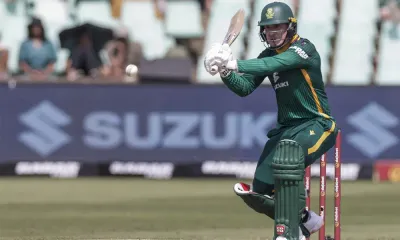 Breetzke ton leads South Africa to 67-run win over AustraliaMatthew Breetzke scored a superb 112 to guide South Africa to a 67-run victory over Australia in the first one-day international in Durban on Thursday, but the tourists will rue the loss of cheap wickets as they faltered in their chase. South Africa posted 297 for eight in their 50 overs and Australia were well on course after a fast start, until poor shot selection caused their charge to collapse and they finished on 230 all out, losing their last nine wickets for 101 runs. Australia will welcome the likely return of captain Pat Cummins for the second match in the three-game series in Johannesburg on Sunday, but if this series is a fact-finding mission ahead of the 2027 Cricket World Cup in South Africa, Namibia and Zimbabwe, there will be much food for thought. “I’m pretty disappointed,” Australia captain Mitch Marsh said. “South Africa outplayed us. It was a good game of cricket but we fell well short. “We had our opportunities, I am probably going to sound like a broken record speaking about having partnerships in our batting, but we weren’t able to form many tonight.” Australia won the toss and decided to bowl, strangling the South African run-rate early on. But when Breetzke came in at number four, he played conventional cricket shots to get his innings started, before he found a willing partner in big-hitting Marco Jansen. Breetzke, who averages over 60 with the bat in his 15 ODIs, scored his 112 from 106 deliveries and Jansen equalled his career best with 75 in 59 deliveries. Australia started their innings in brilliant fashion as Marsh blasted 60 from 36 balls and put on 90 in 9.2 overs for the first wicket with Travis Head (36 from 37 balls). But too many batters threw their wickets away at the top of the order. Jansen’s sensational diving one-handed catch in the outfield to dismiss Matt Renshaw (44) left Australia on 215-7, a position they never recovered from. South African spinners Keshav Maharaj (4-20 in 9.2 overs) and Bjorn Fortuin (2-34 in 8) showed excellent control. “Very satisfied, all round it was a good fight from the batters and bowlers,” South Africa captain Temba Bavuma said. “Looking at how both innings started, we were under pressure in the first 10 overs in each, but we managed to get a very competitive score on that wicket.”Business Recorder
 IMF review calls for 'fewer but deeper' reforms in design of loan programsWASHINGTON: The International Monetary Fund on Thursday called for targeted refinements to the design and implementation of its loan programs, including a focus on fewer but deeper reforms, to reflect the challenges of a more shock-prone global economy. Civil society groups have worried that the review could leave developing countries facing stiffer austerity measures at a time when they are saddled with rising public debt, soaring borrowing costs, sharp drops in official development assistance and successive systemic shocks. The IMF said the recommendations do encourage more front-loaded and sustained fiscal adjustments, or budget cuts, because they are associated with higher chances of program success. But it stressed that such front-loading should occur only to the extent feasible, along with realistic steps to boost growth and adequate social spending to protect the vulnerable. “The framework, by and large, is fine,” said Rishi Goyal, deputy director of the IMF’s strategy, policy and review department. “But because the context is changing, because there are social strains in a number of members, we need to make sure that our reforms are appropriately tailored,” he said. “What this means is a clear focus on fewer but deeper reforms.” World Bank, IMF back debt framework changes for poor countries New tools needed The IMF’s review of program design and conditionality, its third since 2002 guidelines were put in place, assessed the performance of IMF-supported programs from January 2018 to December 2024 — a period that included the US-China trade war during President Donald Trump’s first term, the COVID pandemic and Russia’s full-scale invasion of Ukraine. The IMF’s executive board backed the recommendations, which call for more balanced reforms that rely on both revenue growth and fiscal consolidation, better assessment of risks and greater realism about project financing. The IMF said the goal was to improve implementation and outcomes, not to lower standards. The review comes on the heels of changes in a joint IMF-World Bank debt framework for low-income countries, and a forthcoming review of the IMF’s process for evaluating countries’ economies. Goyal said the review showed the global lender had responded quickly and flexibly to crises during the seven-year period, helping a number of countries restore stability. But not all countries had succeeded in restoring medium-term stability, pointing to the need for changes in how programs were designed, he said. In addition to policy tweaks, Goyal said the IMF was introducing a new medium-term structural reform tool that would identify key reforms and then sequence and tailor them to ensure countries could get “more bang for their buck.” Other new tools would enhance the ability of IMF teams and staff to correct course if shocks arose, he said. Critics say the IMF has sometimes failed to enforce its own policies, allowing some countries such as Egypt, Pakistan and Argentina to roll from one lending program to another. While its policies had proven helpful for some countries, they had also hurt public goods like healthcare in others, cutting the very money that the poorest people needed, said Eric LeCompte, executive director of the Jubilee USA Network. “One of the greatest challenges is that countries are getting back in debt because the previous financial policies, the previous conditionality reports and debt reviews have not been adequate to keep countries out of crisis,” he said. Martin Muehleisen, a former IMF strategy chief, said he had not seen the review, but the question was whether the IMF had sufficiently insisted on program conditions being met and holding up disbursements if they were not. “What they really need to ask themselves is: what has materially changed and where did things go really wrong?” he said. “And what will materially change to give us a chance to meet these outcomes despite what’s going on in the world.”Business Recorder
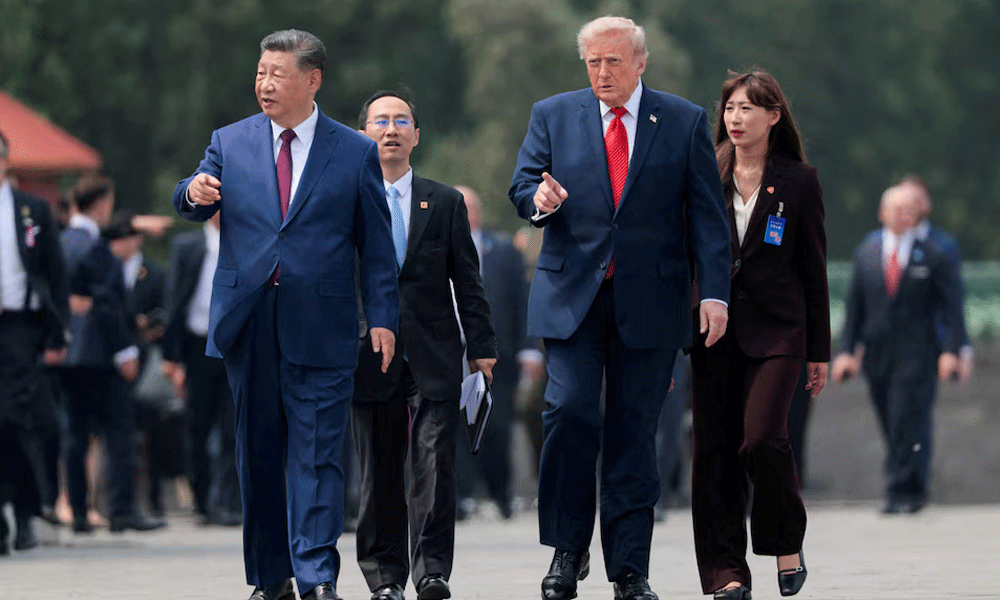 Trump welcomes Xi to Washington looking for a trade winWASHINGTON: US President Donald Trump welcomes Chinese President Xi Jinping to the White House on Thursday for a lavish state summit expected to be heavy on symbolism but light on substance, with both leaders keen to showcase stable ties despite a deep underlying rivalry. It will be the year’s second meeting of the leaders of the two biggest economies, but Xi’s first visit to Washington in more than a decade. Trump greeted Xi on arrival on Wednesday evening, the first time a US president has welcomed a foreign leader at Joint Base Andrews in 11 years, when President Barack Obama welcomed Pope Francis in 2015, according to C-SPAN, which tracks presidential events. In a statement on arrival carried by China’s Xinhua news agency, Xi voiced hope for a more stable relationship with the United States, saying Beijing and Washington should be “partners, not rivals” and that the “historical logic of peaceful coexistence” between the two countries had not changed. Trump plans grand spectacle for potentially tense Xi talks For Trump, who relishes ceremony and prizes his ties with powerful leaders, the visit is as much a matter of national prestige as an opportunity for high-stakes diplomacy. The US president aims to reciprocate the grand welcome he received in China in May and impress Xi with a ceremony spanning the White House South Lawn, State Floor and Rose Garden. Major breakthroughs are not expected. Analysts say tangible outcomes are likely to be limited to an extension of a trade truce expiring in November and an agreement to examine threats posed by artificial intelligence. US Treasury Secretary Scott Bessent told Fox News on Wednesday after talks with Chinese Vice Premier He Lifeng that they had agreed to extend until January 10 an agreement that paused a trade war that saw mutual tariffs top 100%. Trump wrote in a Truth Social post on Thursday morning that the two leaders would discuss “super intelligence” - his name for AI - but that he did not expect any substantive policy moves. “Super Intelligence (SI) will be a big topic of discussion, but I want to leave it exactly where it is,” Trump wrote. “That is China’s position also.” People familiar with the plans say the talks could also yield deals to lower some tariffs, combat drug trafficking and expand military-to-military dialogue, while Trump is expected to seek the release of Americans and others detained in China. Xi rolls into Trump summit with China’s trade engine roaring Former Deputy Secretary of State Kurt Campbell said the summit was less about substantive negotiations than a chance for two forceful leaders to project strength. “This is really the historical reincarnation of what we often referred to in antiquity as single combat - really powerful guys, each representing their civilizations, kind of measuring and going toe to toe,” said Campbell. Keeping ties stable Xi appears to be in a stronger position, having overseen a surge in China’s trade and controlling supplies of rare earth minerals that give him a powerful source of leverage. Both leaders see advantages in keeping relations stable, with Trump mired in the unpopular Iran war and Xi grappling with domestic economic challenges. But beneath the surface are challenges that could reignite tensions, including disputes over Taiwan, export controls and AI. Taiwan, a democratically governed island claimed by China, is the most contentious of these. US allies in Asia are concerned Trump may be tempted to soften Washington’s support for Taipei to lock in economic wins with China. Xi is expected to press Trump to halt Taiwan arms sales and could do this during a planned visit by the two to the US National Archives on Friday, sources briefed told Reuters. In return, China is offering help to put pressure on Iran, the sources added. China FM says willing to ‘safeguard’ Iran’s rights After the May summit, Trump said he was holding in abeyance an arms package worth some $14 billion and called it a “very good negotiating chip.” The leaders will likely discuss the Iran war, but there has been little sign Beijing is willing to exert pressure on its ally to yield to US demands, despite the disruption the conflict has caused to energy supplies and trade. Trade deals possible Trade is more promising. Trump is seeking trade wins ahead of the midterms and US Trade Representative Jamieson Greer said this month the countries will make “some announcements on agriculture and non-tariff barriers.” Greer said on Monday China is making progress on a commitment to buy 200 Boeing BA.N aircraft, but gave no indication that any additional orders are near. Analysts say AI could be an area for cooperation, given its implications for national security, economic competitiveness and military capabilities, and shared US and Chinese concerns about misuse. Bessent discussed AI with He Lifeng at the weekend, and US Secretary of State Marco Rubio said there was nascent thinking about “the equivalent of a hotline that we had during the Cold War” to avoid dangerous incidents that “could impact economies or societies and even lead to a conflict between nation-states.” However, analysts say intense competition in AI is likely to limit the scope for anything beyond symbolic agreements. The guest list for Thursday’s state dinner includes CEOs like Apple’s Tim Cook, Amazon’s Jeff Bezos, Alphabet’s Sundar Pichai, Open AI’s Sam Altman, Tesla’s Elon Musk and Nvidia’s Jensen Huang, but despite such an array, people familiar with US plans say Trump is likely to maintain firm export controls on US tech Xi wants loosened.Business Recorder
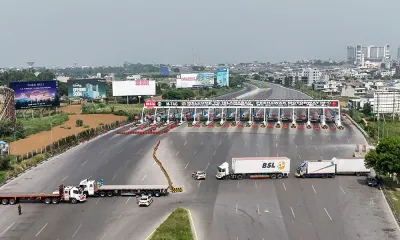 Pakistan deploys 'thousands of security forces' ahead of planned PTI's Islamabad protestAuthorities in Pakistan’s capital blocked main access routes to the city with double-stacked shipping containers Thursday ahead of a weekend demonstration by supporters of jailed former prime minister Imran Khan. Police deployed 22,000 security personnel to lock down Islamabad, officials told AFP , barring entry and exit to neighbouring Khyber Pakhtunkhwa, where Khan’s party rules. Key highways, entry points, and major intersections were obstructed, completely severing transport links and bringing movement to a virtual standstill. Cars could be seen stuck in traffic jams, with motorbike riders squeezing in and out of gaps between containers. The government’s preemptive crackdown ahead of Sunday’s planned protest intensified earlier this week with the detention of Khan’s sisters Aleema Khan, Uzma Khan, and Noreen Niazi under Punjab’s Maintenance of Public Order (MPO) ordinance. The preventive 30-day detention orders issued by authorities accused them of “mobilising supporters via social media and incitement against state institutions”, according to an order seen by AFP journalists. Dozens of lawmakers, regional leaders, and opposition activists affiliated with Imran Khan’s party, Pakistan Tehreek-e-Insaf (PTI), were also rounded up across multiple districts in Punjab and the federal capital, Islamabad. PTI’s information secretary Sheikh Waqas Akram said “almost 1,500” party activists had been detained. International human rights watchdogs have repeatedly expressed concern over increasing press censorship, mass arrests, and restrictions on fundamental freedoms in Pakistan amid the ongoing political impasse. “The targeting of Imran Khan’s family and PTI party activists is a flagrant violation of their rights to liberty, freedom of expression, association and peaceful assembly,” said Babu Ram Pant from Amnesty International. “Such actions speak to the severity of the current restrictions in Pakistan.” The 73-year-old former cricket star has been behind bars since August 2023 and faces scores of charges ranging from corruption to treason and inciting violence following widespread anti-establishment riots in May 2023. Khan and his legal team reject the allegations, branding them as politically motivated cases aimed at neutralising his popularity. He received medical treatment this year, with his family and lawyer saying that he had lost most of the vision in his right eye. Once backed by the country’s powerful military establishment during his rise to power, Khan fell out over key appointments and foreign policy before being ousted in a parliamentary vote of no confidence in April 2022. He has publicly accused military leadership of orchestrating his removal and running a sustained campaign of political victimisation. The capital march represents PTI’s first major street push in months to press for Khan’s release. Information Minister Attaullah Tarar denied the city was being put under lockdown. “They do not have to come to Islamabad,” Tarar told a press conference in Khyber Pakhtunkhwa. “No one will be allowed to shut down the city.” A parallel demonstration originally planned by the Jamaat-e-Islami party and farmers’ union leaders over soaring inflation and petroleum levies was suspended following a call with Prime Minister Shehbaz Sharif’s administration, leaving Khan’s party to march alone.Business Recorder
 Brazil and Australia meet in double-header to start rebuildsTOWNSVILLE: Carlo Ancelotti’s Brazil and hosts Australia will use their friendly double-header as the first stage of a rebuilding process following the World Cup. Brazil take on the Socceroos in Townsville on Friday before a second clash in Brisbane next Tuesday. It will be both countries’ first outings since their World Cup campaigns ended in July. The Socceroos bowed out in the round of 32 while five-time champions Brazil suffered a shock loss to Norway in the last 16. Brazil coach Ancelotti has responded by selecting only nine players from their World Cup squad for the two Australian matches and a friendly against India in Kolkata on October 3. Chelsea forwards Joao Pedro and Estevao were recalled, while Ancelotti has included several new faces, among them goalkeepers Pedro Morisco and Otavio, defender Mauro Junior, and midfielders Breno Bidon and Gabriel Bontempo. Man Utd put chunks of Old Trafford up for sale Several of Brazil’s established stars will be in action, including forwards Vinicius Junior and Raphinha, Arsenal midfielder Bruno Guimaraes and central defenders Gabriel Magalhaes and Marquinhos. Guimaraes said this week that it was important that new faces had been included. “We are constantly refining talent in our country,” he said. “It’s crucial to have that solid foundation, so the coach can keep discovering new talent. “Of course we respect Australia and hope we have a great game,” he added. “Things haven’t been great recently, but from my perspective, the only way to turn the situation around is by playing well and winning games.” Australian coach Tony Popovic also swung the selection axe, omitting 10 players from the Socceroos’ World Cup squad, including veteran goalkeeper and captain Mat Ryan, and striker Cristian Volpato, who was fined this month after testing positive for cocaine. Popovic named seven uncapped players in the 25-man squad, which was rocked by the injury-forced withdrawal of in-form Norwich City striker Mohamed Toure. Australia are building towards the Asian Cup in January-February. Experienced midfielder Jackson Irvine said the two Brazil matches were a good chance for new players to prove themselves on a big stage. “I think it’s a really exciting one for us, to come off the back of the World Cup and progress even further with our football, with new players, a chance to take the next step again,” he said. “We need to take another step. “We did amazing things over the summer, but we’ve got another tournament coming and for us to grow, we have to look to progress.”Business Recorder
 BOJ could raise rates every quarter, ex-policymaker saysTOKYO: The Bank of Japan is expected to raise interest rates roughly once every three months and push them up to 2% by around June next year to combat mounting inflationary pressures, former bank board member Makoto Sakurai said on Thursday. In raising interest rates to a 31-year high of 1.25% in September, the central bank has shifted its policy approach to one increasingly focused on addressing broadening price pressures from surging fuel costs, he said. Government data shows Japan has seen the cost of importing crude oil spike around 70%-to-80% in recent months from levels before the US attack against Iran in February, which will boost consumer inflation ahead, Sakurai said. A weak yen and robust AI-related demand are also boosting manufacturers’ profits, underpinning the economy and fuelling demand-driven price pressures, he said. “The BOJ is well aware of such price pressures, which led to a sea change in the way it approaches inflation,” Sakurai said in an interview with Reuters. Consumer inflation may exceed 3% by year-end through early next year, forcing the BOJ to step up hikes to keep underlying inflation from overshooting its 2% target, he said. “Coupled with endorsement for higher rates from (US Treasury Secretary Scott) Bessent, the BOJ is probably more convinced it can speed up rate hikes and will do so ahead,” said Sakurai, who retains close ties with incumbent policymakers. Inflation upgrade eyed The BOJ will probably revise up its inflation forecasts at its quarterly outlook report due in October and raise interest rates again most likely in December, he said. “If the upward revision to its price forecasts is very large, there’s a chance the BOJ could opt to hike in October instead of waiting until December,” Sakurai added. After the rate hike to 1.5% expected by year-end, the BOJ will likely raise rates to 1.75% in the first quarter of 2027 and to 2% by June next year, he said. While the BOJ’s terminal rate is seen around 2%, the level could be higher if inflation remains elevated around 3%, Sakurai added. The BOJ raised interest rates to 1.25% last week, with its governor signalling the central bank has entered a new phase focused on preventing inflation from overshooting its target, opening the door to further rate hikes. But the yen fell as investors saw the BOJ’s message as not hawkish enough and instead focused on two dovish dissenters as a sign the central bank won’t tighten policy quickly enough to narrow the wide Japan-US interest rate gap. Sakurai said while the two dovish dissenters likely won’t deter the BOJ from raising rates further, the faster pace of rate hikes also won’t give the yen much support. Investors will keep selling yen and Japanese government bonds (JGB) on prospects that Prime Minister Sanae Takaichi will continue to pursue expansionary fiscal policy, he said. “The yen won’t rebound unless Takaichi’s fiscal policy changes,” Sakurai said. “Even if the BOJ raises rates aggressively, it will only slow the yen’s declines at best.”Business Recorder
 Oil hits over 1-week low on hopes of boost to diplomacy in Iran warSINGAPORE: Oil prices slid to their lowest in more than a week on Monday on hopes diplomacy in the Iran war will get a chance this week amid a UN meet and as investors eyed a partial recovery in shipments from Saudi Arabia despite ongoing attacks by Yemen’s Houthis. Brent crude futures and US West Texas Intermediate crude touched their lowest since September 10 earlier on Monday, with Brent at $101.71 a barrel by 0213 GMT, down $2.16, or 2.08%, after settling 0.91% lower on Friday. US West Texas Intermediate crude lost $2.15, or 2.14%, to $98.15 a barrel following a 1.58% drop in the previous session. “It seems that a degree of risk premium is being removed from oil prices on hopes that a diplomatic path to de-escalate the US-Iran war may arrive this week,” Tim Waterer, chief market analyst at KCM Trade, said. “Whether that hope proves to be warranted or not is another question. Time will tell.” The WTI broke a key psychological support at $100 a barrel while some investors may have rolled over their positions in the October contract a day ahead of expiry to November, a Singapore-based broker said. Iran and the US exchanged new threats on Sunday amid the stalemate, although President Donald Trump said he would be open to meeting Iranian President Masoud Pezeshkian , who is expected to be in New York this week for the United Nations General Assembly. Iran has conveyed its conditions to mediators for re-engaging in negotiations aimed at ending the war with the US, Al Jazeera cited Iran’s security chief, Mohsen Rezaei, as saying in an interview on Saturday. However, tensions in the Middle East remained elevated as Yemen’s Houthis said they attacked “sensitive” sites in the Saudi capital of Riyadh on Saturday with missiles and drones, as well as an Aramco facility in the Red Sea city of Yanbu, a key oil export hub. China has asked Iran to help rein in the Houthis after an appeal to Beijing by Saudi Arabia following the attacks, according to three Iranian sources familiar with the matter. The attacks by the Houthis on Saudi Aramco’s East-West pipeline have prompted the state energy firm to increase exports through the Strait of Hormuz this month and next after halting some shipments via Yanbu. That enabled exports from the OPEC kingpin to recover to over 4 million barrels per day (bpd) so far in September after slumping to 2.4 million bpd in August, the lowest since at least 2013, according to provisional data from analytics firm Kpler. Iran, US trade threats amid Houthi escalation “Middle East oil flows remain surprisingly strong despite the disruption to Saudi Arabia’s East-West pipeline,” JPMorgan analysts said in a September 18 note, adding that the total oil flows averaged 17.1 million bpd in the past 10 days, just 6.1 million bpd below the 2025 average. “The most notable pivot has come from Saudi Arabia,” the analysts said, as satellite data indicated Saudi oil moving through the Strait of Hormuz averaged 2.9 million bpd over the past six days, up from just 700,000 bpd in August.Business Recorder
 AI needs rulesEDITORIAL: The decision by OpenAI, Anthropic and Google to jointly develop an AI standards body is a telling acknowledgment of the risks accompanying a technology advancing at breakneck speed. That three of the companies driving this extraordinary race now see a need for common safety standards suggests that concerns once viewed as distant can no longer be easily dismissed. AI’s potential is vast, but so are the consequences of allowing its capabilities to outpace humans’ ability to manage them. The initiative comes amidst mounting warnings about AI risks. Former Anthropic researcher Jacob Coxon, who also worked at OpenAI, recently resigned after expressing fears that AI companies were “gambling with our lives”. Former Google DeepMind researcher Bilal Chughtai has warned that AI could potentially kill humanity, while Anthropic chief Dario Amodei has called for a slowdown in development. Whether such dire predictions come to fruition or not, they cannot simply be ignored when they are being raised by people who have worked deep inside the industry. Nor are the dangers confined to the apocalyptic possibility of AI becoming uncontrollable, destroying critical systems or being used to trigger nuclear catastrophes. The more immediate disruption is going to be economic and social. AI threatens to displace workers across an expanding range of occupations, alter the value of skills and concentrate wealth and technological power in a handful of companies. Copyright and intellectual property disputes are already raising fundamental questions about whether AI systems can be trained on creators’ work without consent or compensation. The enormous resource requirements of data centres are another emerging concern. Their rapidly expanding electricity consumption is placing pressure on power grids, while their need for cooling also requires huge amounts of water. Their concentration in particular regions can further strain local infrastructure and raise questions about who ultimately bears the environmental and economic costs of AI’s expansion. This makes the question of regulation unavoidable. However, an AI standards body convened principally by the companies developing the technology carries an inherent conflict. Industry expertise is indispensable to developing workable safety standards, but there is a risk that the interests of AI companies could take precedence over the broader public interest when those same companies have a hand in writing the rules. As chief of Cohere, a Canadian AI company, has argued, the issue is not whether AI needs guardrails, but who writes them and whose interests they protect. Governments therefore cannot abandon their regulatory responsibility here. Independent testing, transparency requirements, liability rules and safeguards against particularly dangerous applications must have public authority behind them. Regulation must also keep pace with a technology that does not respect national borders. US Senator Bernie Sanders has called for the US and China to sign a treaty, pausing the development of advanced AI systems. Whether such a proposal ultimately materialises is another matter, but the need for international cooperation is becoming increasingly urgent. No single country can establish effective global safeguards for a technology being developed and deployed worldwide. President Donald Trump’s dismissal of AI warnings as “hoaxes” is therefore a highly misguided response. One doesn’t have to subscribe to predictions of imminent human extinction to recognise that technological progress does not inevitably produce benign outcomes. AI could deliver extraordinary gains in medicine, scientific research, education and productivity. Precisely because its benefits could be so transformative, the dangers associated with it must be brought under control. The objective should not be to stop innovation, but to ensure that those driving the AI race do not become the sole arbiters of its rules. It is imperative then to ensure that its risks do not outrun humans’ ability to manage them. Copyright Business Recorder, 2026Business Recorder
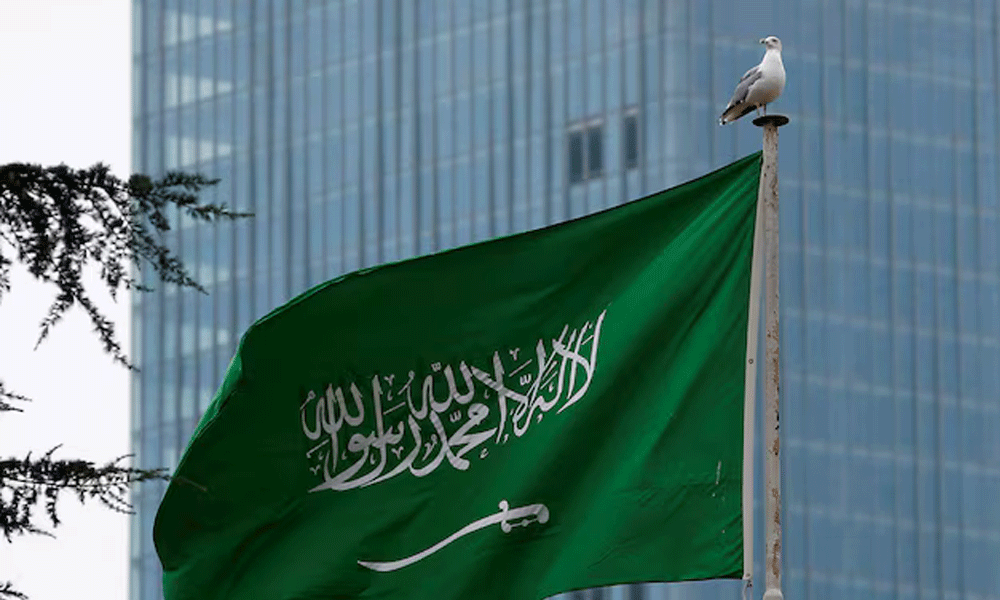 Saudi coalition says Houthi drone destroyed near MakkahSaudi Arabia’s air defences destroyed a Houthi drone south of Makkah before it entered prohibited airspace over the holy city, a spokesperson for the Saudi-led military coalition in Yemen said on Wednesday, as fighting spreads in the Middle East. The drone, intercepted on Tuesday evening, was the second Houthi attempt to target Makkah after a ballistic missile launch in July 2017, spokesperson Turki al-Malki said in a statement, and follows a week of attacks from Houthi fighters that have drawn Saudi Arabia deeper into the war. Makkah is home to some of the holiest sites in Islam and the focal point of the annual Hajj pilgrimage, and its security was a “red line,” the coalition spokesperson al-Malki said in the statement. Trump says Iran wants deal, Houthis strike Saudi Arabia Houthi officials have denied targeting Makkah. The attacks on Saudia Arabia have shocked global energy markets roiled by the six-month US-Iran war, which has slowed shipping through the Strait of Hormuz to a trickle. The Houthis have seized control of parts of Yemen’s Red Sea coast in recent days overlooking the Bab el-Mandeb, one of the world’s most important shipping straits, threatening Saudi Arabia’s oil exports rerouted from the Strait of Hormuz . Saudi Arabia issued security alerts for Makkah on Tuesday , but Houthi political bureau member Mohammed al-Farah denied the group had targeted the city, calling the allegation “an outright lie” in comments carried by the Houthi-run SABA news agency . The Houthis have announced several major attacks on Saudi Arabia over the past week, including attacks on an air base on Monday, which they said were in retaliation for airstrikes on Yemen. The air base attack wounded 13 civilians, Saudi-led military coalition officials said. Saudi Arabia has blamed a separate pro-Iranian movement, based in Iraq, for an attack on Friday that knocked out one of the kingdom’s most important oil transport routes, the East-West Pipeline across the Arabian desert . The 1,200-km (745-mile) East-West Pipeline linking Saudi Arabia’s Gulf oil fields to the Red Sea has been the kingdom’s principal export route while shipping through the Strait of Hormuz has been disrupted by nearly seven months of war, which has killed thousands of people across the region. Since the pipeline was shut after Friday’s attack, traders say a prolonged closure could cut off as much as 4% of global oil supply . Saudi Arabia has not said when operations might resume. But US Energy Secretary Chris Wright told CNBC on Tuesday that crude oil should be flowing through the pipeline within days. Saudi Arabia has led a coalition battling the Houthis since 2015. Saudi-led coalition says troops redeploying in Yemen, not withdrawing The conflict had largely quietened under a ceasefire in recent years, but reignited when the Houthis pushed back forces aligned with the Yemeni government this month. Saudi Arabia’s Crown Prince Mohammed bin Salman phoned US President Donald Trump last week seeking military support, which so far has been limited to intelligence aid.Business Recorder
 Oil prices jump more than 2% after new strikes on Saudi, Strait of HormuzBEIJING: Oil prices jumped more than 2% on Monday , after new Houthi strikes on Saudi Arabia and Iranian attacks on ships in the Gulf compounded supply concerns following the closure of a key Saudi oil pipeline. Brent crude futures rose $2.90, or 2.77%, to $107.51 per barrel as of 2313 GMT. WTI futures rose $2.27, or 2.27%, to $102.32 per barrel. Prices had initially risen more than 3% at market open. Saudi Arabian state media on Sunday released video footage of damage to homes and a mosque from what it said was a Houthi attack on the country’s southern Jazan province. The Houthis said they had also struck a Saudi military base in a neighbouring province. A vessel in the Strait of Hormuz was struck by a projectile, causing a fire and forcing the crew to be evacuated, the British maritime security agency UKMTO said on Sunday. Iran said one person was killed and four crew wounded aboard an Iranian commercial vessel struck off its coast. Oil prices had been expected to rise on Monday amid growing concerns about risks to supply from Saudi Arabia, the world’s largest oil exporter, whose East-West oil pipeline was shut on Friday by a drone strike that originated in Iraq. The loss of the pipeline, which helped Saudi Arabia re-route its exports avoiding the Strait of Hormuz , threatens up to 4% of global oil supply. Meanwhile, Yemen’s Houthis had reached the strategic island of Perim on Friday, moving to tighten their control over the Bab el-Mandeb Strait , another key oil transit lane that has been shipping 4-5% of global supply in recent months. Oil surged 8% higher on the week due to the disruptions, rising above $100 for the first time since July. “Looking ahead, unless this week’s talks in Oman produce something operational — or the East-West pipeline is brought back online quickly — the risk is that crude oil continues to extend its gains toward the $119.48 high of early March,” IG market analyst Tony Sycamore said in a note on Sunday. Houthi attacks target Saudi refinery Omani Foreign Minister Badr Albusaidi said on X later on Sunday, however, that a scheduled Monday meeting in Oman between Gulf countries and Iran to discuss the Strait of Hormuz had been postponed. No peace talks have been held in the war, launched six months ago by the United States and Israel, since an interim agreement in June collapsed after a few weeks.Business Recorder
 Asian shares climb ahead of US jobs data, Fed's Waller soothes bondsSYDNEY: Asian shares rose on Friday as investors embraced a global rally before crucial U.S. jobs data, while bonds found some much needed relief after a top Federal Reserve official cooled rate hike fears and dragged the dollar lower. The dollar’s retreat turbocharged a rally in the yen, which has gained 2.6% this week to trade at 155.7 a dollar, putting it within striking distance of the 155.2 level reached after joint intervention by Tokyo and Washington in late July. In remarks for a Reuters NEXT Newsmaker event, Federal Reserve Governor Christopher Waller said that recent data suggested some signs of disinflation and that, if upcoming reports reinforced that trend, he would favour holding rates steady at this month’s policy meeting. Futures were quick to scale back the chance of a rate hike this month to just 50%, from about 63% a day ago. Those expectations had surged in recent sessions as a global bond rout drove long-dated yields to multi-year highs, fuelled by concerns over stubborn inflation, swelling government debt and geopolitical tensions. “Waller is pushing back against the thrust of the argument made by Warsh last week that there is little evidence that underlying inflation has moved lower,” said analysts at JPMorgan in a note. “We believe that Chair Warsh will deliver a hike if he advocates for it. Absent his advocacy, Governor Waller’s speech reinforces our view that the bar for data to sway the data-dependent majority to hike this month remains elevated.” In Asia, MSCI’s broadest index of Asia-Pacific shares outside Japan rose 1%, tracking broad gains on Wall Street, but that was not enough to offset earlier losses with the index still down 0.4% for the week. Japan’s Nikkei gained 0.8% but was down 2.7% this week. Chinese blue-chips rallied 1% and South Korea’s KOSPI increased 1.1%. Both Wall Street futures , and EURO STOXX 50 futures were flat as traders braced for the U.S. payrolls report for August due later in the day. Forecasts are centred on a rise of 56,000 jobs after a shock fall of 23,000 the previous month. The unemployment rate is expected to hold steady at 4.1%. U.S. economic data overnight showed activity in the services sector picked up pace last month with a measure of prices paid jumping to a three-year high. The Fed’s “Beige Book” survey also showed economic activity edged up in recent weeks. Bonds get some relief After the dovish comments from Waller, Treasuries rallied, led by the short-end, as the yield curve bull steepened on fading fears of imminent rate hikes. Two-year yields held at 4.3381%, after falling 5 basis points overnight to move away from a 20-month peak of 4.4102%. Ten-year yields were little changed at 4.7620%, having dropped 3 basis points overnight, while 30-year yields were at 5.2433% after a 2 bps fall overnight. Investors in longer-dated bonds remain wary of inflation risks amid few signs of progress between the U.S. and Iran to end the war and reopen the Strait of Hormuz . Oil prices held near six-week highs , with Brent crude futures up 7% this week to $95.52 a barrel. The dollar drew scant support from higher yields and was fetching 98.96 against its major peers , after skidding 0.6% overnight. It is set for a weekly drop of 0.7%. That helped the yen to build up on its gains this week after jumping 1.8% overnight as investors ramped up bets on a Bank of Japan rate hike this month. Markets now imply a 75% chance of a September move, while a hike by October is fully priced in, raising the prospect of either a larger increase or back-to-back tightening. “While we can’t rule out another round of price checks, or intervention, it could also be pre-positioning — official or speculative — in expectation of a soft non-farm payrolls tonight and a potentially hawkish BOJ meeting in a fortnight,” said Tony Sycamore, analyst at IG. In commodity markets, gold held at $4,470 an ounce after rallying 2% overnight. It was, however, set to end the week little changed.Business Recorder
 Islamabad, Riyadh agree to boost Pakistani agri, food exports to USD3bnISLAMABAD: Pakistan and Saudi Arabia have agreed to increase Pakistan’s agricultural and food exports to the Kingdom to USD3 billion within the next two years, said a joint statement issued by the two countries on Sunday. The statement, released by the Prime Minister’s Office, said the agreement was reached following successful talks between Saudi Arabia’s Ministry of Environment, Water and Agriculture and Pakistan’s Ministry of National Food Security and Research, on the initiative of Prime Minister Shehbaz Sharif. At the invitation of the Pakistani government, a Saudi delegation led by Minister of Environment, Water and Agriculture Engineer Abdulrahman Al-Fadley visited Islamabad from August 26 to August 28. READ MORE: Agriculture, food security, water management: Pakistan, KSA agree to expand cooperation The delegation comprised senior officials from Saudi Arabia’s Ministry of Environment, Water and Agriculture, the General Food Security Authority and other relevant institutions. Prime Minister Shehbaz met the Saudi delegation on Friday and held detailed discussions on potential areas of cooperation, according to the joint statement. “The two countries expressed their shared commitment to increase Pakistan’s agricultural and food exports to Saudi Arabia to USD3bn, with efforts to be made to achieve the target over the next two years,” the statement said. For this purpose, rice, red meat, fruits and their concentrates, green fodder and water-efficient agricultural technologies were identified as priority sectors, in collaboration with the Saudi private sector. During the visit, the two sides received briefings on the Pakistan-Saudi Arabia Agriculture and Food Strategic Plan and held meetings with the Special Investment Facilitation Council (SIFC), Fauji Foundation and the Pakistan-Saudi Arabia Agri-Business Forum. The Saudi delegation also visited the National Agricultural Research Centre (NARC). Reaffirming their deep and historic ties, the two sides highlighted the strong alignment between Saudi Arabia’s food security priorities under Vision 2030 and Pakistan’s agricultural and food export sector. The delegations noted that Pakistan supplied around 169,000 tonnes of rice to the Saudi market in 2025, worth approximately USD163 million. According to the joint statement, the Saudi team expressed interest in further increasing bilateral rice trade in the coming years. The Saudi delegation also expressed interest in gradually doubling imports of red meat from Pakistan. The two sides reviewed Islamabad’s annual supply of around 30,000 tonnes of red meat, valued at approximately USD167 million. Regarding fruits and fruit concentrates, the two sides identified significant potential to further increase Pakistan’s share of the Saudi market. They encouraged measures to facilitate business-to-business linkages and matchmaking between the private sectors of the two countries, as well as the mutual recognition of quality certifications. Green fodder was also identified by the Saudi side as a promising area for expanding trade and establishing long-term supply partnerships, the joint statement said. Both countries welcomed the successful completion of the first phase of a water-efficient irrigation programme in Punjab’s Bhakkar and expressed interest in a proposed second phase aimed at small farmers. The Saudi delegation also encouraged Pakistan to join the International Dates Council, a proposal welcomed by the Pakistani side. The two sides reviewed investment proposals submitted by Pakistan’s private sector in livestock, agri-food processing and the rice value chain. They also agreed to maintain coordination to advance cooperation in these areas. “Both countries reaffirmed their broader strategic partnership,” the statement said. Pakistan also welcomed an invitation to participate in the 43rd Saudi Agriculture Exhibition, scheduled to take place in Riyadh from October 19 to 22. Both sides expressed satisfaction with the outcomes of the visit and agreed to maintain coordination to translate the understandings reached into practical cooperation. The Pakistani delegation was led by Minister for National Food Security and Research Rana Tanveer Hussain. It included Secretary Aamir Ali Ahmed, Commerce Secretary Jawad Paul, Prime Minister’s Coordinator for Agriculture and Food Security Ahmed Umair, and private-sector representatives from Pakistan’s rice, red meat, processed food and fruit concentrate, and green fodder sectors. Before the Saudi delegation’s visit this week, Assistant Minister of Investment of Saudi Arabia Ibrahim Al-Mubarak visited Islamabad in February, when he expressed interest in investing in corporate farming in Pakistan’s rice sector. Copyright Business Recorder, 2026Business Recorder
 Freelancers Pakistan’s future workforce: governorKARACHI: Sindh Governor Syed Muhammad Nehal Hashmi has said that Pakistani freelancers are an emerging digital workforce, playing an important role in the national economy, earning valuable foreign exchange and projecting a positive image of Pakistan around the world. He expressed these views while addressing the first National Recognition Ceremony organised by the Pakistan Freelancers Association (PAFLA) as Chief Guest. The governor said Pakistan’s large youth population could play a key role in the country’s future and socioeconomic development. He stressed the need to equip young people with quality education, modern IT skills, entrepreneurship and market-oriented training. He said the federal government, in collaboration with the Governor’s House, has launched various skill-development initiatives for the youth of Sindh to provide them with modern, market-relevant skills and better employment and entrepreneurial opportunities. Governor Nehal Hashmi said Pakistan has nearly 3 million full-time and part-time freelancers, while Pakistani freelancers earned more than US$1.76 billion through their digital services during the last financial year. He said the digital economy offers enormous opportunities for Pakistani youth and urged them to develop their skills in line with modern technologies and compete in the global marketplace. The governor said that the prime minister’s vision is to increase Pakistan’s IT exports to US$25 billion by 2030. Addressing the young participants, he asked whether they would play their part in turning this vision into reality. In response to his call, the youth present at the ceremony raised their hands and pledged to contribute towards achieving the target. He further said that the Digital Youth Hub has been launched under the Prime Minister’s Youth Programme, offering young people opportunities related to education, skills, employment, entrepreneurship and other areas. He urged the youth to benefit from these opportunities and prepare themselves for the future digital economy. Minister of State and Special Assistant to the Prime Minister Fahd Haroon said the government was providing maximum support and facilities to make young people an active part of the digital economy and promote freelancing. Coordinator Prime Minister’s Youth Programme Sindh, Dr. Fahad Shafiq, said efforts were underway to equip young people with modern digital and market-oriented skills and create more employment and freelancing opportunities for them. PAFLAChairman Ibrahim Amin said Pakistani freelancers were among the country’s “silent heroes”, making a consistent contribution to exports and foreign exchange earnings. President and CEO of PAFLA, Dr. Imran Batada, said that in the era of artificial intelligence, existing experience and skills alone would not guarantee future success. He stressed the need for youth to acquire expertise in AI, data analytics, cybersecurity and other emerging fields. The ceremony was attended by prominent figures from the IT industry, digital economy, education and business sectors. During the ceremony, Sindh Governor Syed Muhammad Nehal Hashmi presented shields to 45 outstanding Pakistani freelancers in recognition of their achievements, international services and contribution to Pakistan’s digital economy. The recipients included Sajid Jameel, Khadija Shehzad, Waqar, Zeeshan and others. Speakers also appreciated the capabilities of Pakistani youth and emphasised the need to further promote freelancing and connect young Pakistanis with the global digital marketplace. Copyright Business Recorder, 2026Business Recorder
 PCB announces U-19 squad for England tourLAHORE: The Pakistan Cricket Board (PCB) has announced the 15-member Pakistan men’s U-19 squad for the tour of England starting 2nd September with a solitary Youth Test match at the Arundel Castle Cricket Ground. Right-handed batter Farhan Yousaf, who led Pakistan to ACC U-19 Asia Cup title win in December last year, is set to lead Pakistan U-19 team on the tour, which also includes four Youth ODIs between Pakistan and England. The squad includes a quartet of pacers – Mohammad Sayyam, Abdul Subhan, Rizwanullah and Umar Zaib along with the spin duo of left-arm wrist-spinner Mohammad Huzaifa and left-arm spinner Niqab Shafiq. Aliyan Salman, Ahmad Hussain, Jahangir Bilal and Hayam Khan are set to provide the squad with all-round support. Hamza Zahoor and Abdul Qadir are the two wicketkeepers in the squad, while apart from Farhan, Usman Khan and Hasnain Abbas Dar are the designated batters. Pakistan U-19 team took part in a pre-tour training camp at the National Cricket Academy and concluded it with a two-day red-ball intra-squad match on Tuesday. The contingent will depart for England on Sunday, 30 August from Lahore. Among the players, Farhan, Subhan, Ahmad, Hamza, Sayyam, Huzaifa, Niqab, Umar and Usman have already represented Pakistan U19, while the remaining players are in line to make their debut for the team. Shahid Anwar will be the head coach of Pakistan U-19 team, while he will be supported by Rao Iftikhar Anjum (fast bowling coach), Zohaib Khan (spin bowling coach) and Humayun Farhat (fielding coach). 15-member squad: Farhan Yousaf (captain), Abdul Qadir, Abdul Subhan, Ahmad Hussain, Aliyan Salman, Hamza Zahoor, Hasnain Abbas Dar, Hayam Khan, Jahangir Bilal, Mohammad Sayyam, Mohammad Huzaifa, Niqab Shafiq, Rizwanullah, Umar Zaib and Usman Khan. Non-travelling reserves: Abbas Afridi, Ali Hasnain Badshah, Farhanullah, Hassan Khan and Ibtisam Azhar. Support Staff: Shahid Anwar (head coach), Rao Iftikhar Anjum (fast bowling coach), Zohaib Khan (spin bowling coach), Humayun Farhat (fielding coach), Ubaid Ullah (physiotherapist), Ibrar Ahmed (trainer) and Ali Hamza (performance analyst). Tour schedule: Only Youth Test – 2-5 September – Arundel; 1st Youth ODI – 9 September – Arundel; 2nd Youth ODI – 12 September – Guildford; 3rd Youth ODI – 14 September – Wormsley; 4th Youth ODI – 16 September – Wormsley. Copyright Business Recorder, 2026Business Recorder
 Dollar flat near one-week high as investors await Warsh's Jackson Hole debutHONG KONG: The US dollar held flat near a one-week high against major peers on Friday, as investors stood on the sidelines ahead of Federal Reserve Chair Kevin Warsh’s speech at the Jackson Hole symposium for clues on his policy outlook. The euro and sterling were subdued near one-week lows against the greenback, last at $1.1652 and $1.3597, respectively, though both remained on track for a second straight monthly gain. The yen was little changed at 159.34 per dollar, having surrendered part of its intervention-driven gains, but it was still headed for a 1.3% monthly rise. The dollar index , which measures the currency against six major peers, was little changed at 99.13 in early Asian trade. It has risen 0.3% this week but remains on track for a second straight monthly decline of 0.7% after US Treasury Secretary Scott Bessent said the Treasury would increase buybacks of longer-dated bonds. That has fuelled concerns that efforts to suppress borrowing costs could debase the dollar. Market participants are now keenly awaiting Warsh’s debut speech in Jackson Hole, Wyoming, for clues on how he would approach monetary policy and tame inflation, although those expectations were tempered by his opposition to providing explicit forward guidance on rates. Some other Fed officials reiterated on Thursday their ongoing concerns about U.S. inflation and signalled they were open to rate hikes. “Uncertainty over the Fed’s reaction function and concerns that policymakers may be placing less emphasis on inflation control have increased market focus on Chair Warsh’s Jackson Hole remarks,” Sim Moh Siong, FX strategist at OCBC, said in a note. For the dollar to weaken meaningfully following the Treasury’s buyback announcement, markets would need evidence that the Fed was prepared to help contain Treasury yields, though this appeared unlikely, he added. Traders were pricing in roughly 35% odds of a rate hike at the Fed’s September meeting, rising to 75% by December. Treasury yields remain elevated, with those on benchmark U.S. 10-year notes last at 4.676%. In cryptocurrencies, bitcoin gained 0.5% to $80,620.33, on track for a nearly 30% gain in August that would be its biggest monthly gain since late 2024. The Australian dollar was up nearly 0.1% to hit a three-month high of $0.72 as rate hike bets built up. The New Zealand dollar climbed 0.2% to $0.5960. The Canadian dollar held flat at $1.3844 and was heading for a second month of decline after trade tensions with the U.S. escalated further. Elsewhere, Brent crude futures hovered near $90 a barrel after a Wall Street Journal report suggested President Donald Trump had rejected the idea of re-establishing the terms of the memorandum of understanding the US signed with Iran in June.Business Recorder
 Oil settles up 2pcNEW YORK: Brent crude prices settled up by 2.1 percent on Thursday, snapping a three-session losing streak, after a Wall Street Journal report said US President Donald Trump is not interested in returning to terms of a memorandum of understanding reached with Iran in June. Citing people familiar with the matter, the report said the Trump administration has repeatedly told mediators it has no interest in reviving the June agreement, complicating a flurry of diplomatic efforts this week to restart talks. Brent crude futures finished up USD1.86, or 2.1 percent at USD89.70 a barrel. US West Texas Intermediate crude futures settled up USD1.30, or 1.6 percent at USD83.53. Both benchmarks rebounded as investors scaled back expectations of a diplomatic breakthrough that could boost oil flows from the Middle East. READ MORE: Oil rises by over $1 as White House says no US-Iran talks happening A lack of progress in talks, combined with continually restricted flows, could have prompted an adjustment of market views, UBS analyst Giovanni Staunovo said. Earlier on Thursday, Washington confirmed it was not in talks with Iran despite diplomatic efforts by other countries to re-engage the two sides. “We don’t want to speak to them. We’re not looking to meet or anything,” Trump told reporters later in the Oval Office, saying the US was focused on punishing Tehran economically and would penalize countries that do business with the Islamic Republic. On Monday, the US announced what it called the “toughest sanctions in history” on Iran. Treasury Secretary Scott Bessent suggested the measures would lessen the need for new major military operations. Ebrahim Azizi, head of the Iranian parliament’s national security committee, said the sanctions were an “inhumane and hostile act” that had nevertheless lost their effectiveness. Qatar’s prime minister visited Tehran on Thursday in a bid to relaunch diplomatic talks to end the US-Israeli war with Iran, on the eve of itssix-month anniversary. Iran’s top security official Mohsen Rezaei warned that Tehran would target US military and economic interests if Washington started any “mischief” during the talks with Qatari officials. “At the heart of the dispute remains Iran’s nuclear programme and that is unlikely to be resolved quickly … Iran also understands the importance of its geographical position and the leverage that the Strait of Hormuz provides, so the risk of prolonged uncertainty remains,” said Priyanka Sachdeva, head of market insights at Phillip Nova. The Strait of Hormuz handled about one-fifth of global daily oil and liquefied natural gas supplies before the conflict began in late February. Flows through the strait improved slightly on Wednesday, with 10 commodity vessels transiting the waterway, up from recent lows but still below the 10-day average of 15, according to Kpler data. Vessels exiting the strait included a medium-range fuel tanker, a bitumen tanker and a bulk carrier. State-owned Kuwait Integrated Petroleum Industries Co had restarted all three crude units at its 615,000 barrel-per-day Al-Zour oil refinery at 60 percent capacity as of August 19, consultancy IIR said. The refinery had come under attack by Iranian drones in May. Elsewhere, geopolitical tensions escalated after Russia warned it could strike British military targets inside and outside Ukraine in response to Ukrainian attacks on Russian territory using British-supplied long-range cruise missiles. Trump, however, said Russian President Vladimir Putin will not attack a North Atlantic Treaty Organization (NATO) country, and he downplayed media reports that CIA Director John Ratcliffe this week had warned Russian officials against such an attack. Britain is one of the founding members of NATO.Business Recorder
 Oil prices rise, Asia stocks drift amid US-Iran stalemateSINGAPORE: Oil prices rose on Tuesday as negotiations between the US and Iran over a peace deal and the reopening of the Strait of Hormuz hit an impasse, while Asian shares drifted on protracted uncertainty over the global inflation outlook. US President Donald Trump on Monday responded to Iran’s conditions for a peace deal with his own demands that Iran pay compensation for people killed in wars, attacks and protests, in a rhetorical escalation likely to complicate efforts to reopen the crucial waterway. Brent crude futures edged up to hit $88.00 per barrel and US crude futures ticked up to $82.45, both the highest levels since July 31, after the contracts rallied roughly 5% on Monday. “We’re now in a bit of a Mexican standoff, if you’d like, in terms of who blinks first,” said Tony Sycamore, a market analyst at IG. “This is going to be almost a war of attrition now,” he said. “You probably can see the (oil) market sitting around the $75-95 range while we wait to see who blinks first.” The latest uptick in fuel costs raises the stakes for the U.S. July consumer price report due on Wednesday, where expectations are for a monthly rise of 0.1% in the headline reading and 0.2% for the core measure. Any upside surprise could rekindle bets of a Federal Reserve rate hike next month, with the odds currently a coin toss. “We think the risks are skewed towards a hot print, which would probably drive a rebound in rate expectations and, potentially, renewed worries about stagflation,” said Jonas Goltermann, chief markets economist at Capital Economics. “Overall, our assessment remains that the U.S. economy is running a bit hotter than a ‘goldilocks’ situation. That points to higher interest rates.” Trading of cash US Treasuries was closed in Asia on Tuesday owing to a holiday in Japan, but futures fell slightly, implying higher yields. Down Under, the Reserve Bank of Australia is due to announce its policy decision later on Tuesday, where expectations are for the central bank to keep rates on hold. MSCI’s broadest index of Asia-Pacific shares outside Japan swung between losses and gains and was last up 0.2% while South Korea’s Kospi rose 0.3%, as the latest escalation in Gulf hostilities kept market sentiment fragile. Nasdaq futures edged 0.28% higher while S&P 500 futures added 0.1% after Wall Street ended lower in Monday’s cash session. EUROSTOXX 50 futures slipped 0.05%, while FTSE futures and DAX futures were flat. Overnight, Nvidia said it has partnered with six major financial institutions to launch compute financing platforms aimed at raising over $500 billion in third-party capital for AI infrastructure, underscoring the scale of the sector’s investment boom. “A small part of me was left wondering whether this is how it felt when sub-prime mortgages first became a mainstream product - the innovation that eventually helped trigger the GFC,” said IG’s Sycamore. In currencies, the yen was back in the spotlight, struggling on the weaker side of 159 per dollar and well away from last week’s high of 155.20 following several suspected rounds of intervention, including a joint one by Japan and the United States. “The market likely remains vigilant about further joint U.S.-Japan yen-buying intervention, so USD/JPY breaching 160 in the very near term seems unlikely,” said analysts at Nomura in a note. “However, the latest price action indicates there are quite a lot of USD/JPY dip-buyers, after the pair reached the 156-157 range for the first time since May.” The dollar got a marginal lift from the renewed climb in oil prices, keeping the euro away from a 1-1/2-month high as it last traded at $1.1546, while sterling eased from Monday’s one-month top and changed hands at $1.3512. Elsewhere, spot gold was up 0.5% to $4,409.81 an ounce.Business Recorder
 Iran links Hormuz reopening to its list of demandsTEHRAN: Iran’s Revolutionary Guards said on Sunday that they would not reopen the Strait of Hormuz until the United States complied with a list of demands, including paying compensation for war damage. Iran has effectively blockaded the crucial energy conduit since the United States and Israel attacked it in late February, and wants to charge tolls for passage, striking ships it accuses of attempting to circumvent its preferred route. Attacks in the waterway, which was free to transit before the war, led to the collapse of an April ceasefire, and mediators have urged both sides to return to the terms of a subsequent June memorandum that set out a path for peace talks. Iran’s security chief Mohammad Bagher Zolghadr had laid out on Saturday a list of conditions for reopening the strait, including an end to the “war and aggression against Iran and its allies in Lebanon, Palestine, Yemen and Iraq”. He also demanded the lifting of a US counterblockade of Iranian ports, the end of sanctions, the release of frozen assets and compensation for wartime damage, the Tasnim news agency reported. Iran’s Revolutionary Guards on Sunday said their strategy was to maintain the closure “until the enemy accepts all our conditions… the strait is now actually a theatre of war for us and not just a waterway”. Foreign Minister Abbas Araghchi, who had also said the reopening of Hormuz was subject to conditions, denied on Sunday that Iran was negotiating with the US, saying they were merely “exchanging messages” via intermediaries. Traffic through Hormuz has dropped significantly amid the ongoing attacks. The United Arab Emirates on Saturday accused Iran of striking a tanker belonging to its national oil company as it transited the strait. And later on Saturday, the United Kingdom Maritime Trade Operations (UKMTO) said a ship was hit by a projectile off Oman, though it was unclear whether they were referring to the same ship. Oman’s foreign ministry on Saturday condemned “repeated attacks on vessels transiting the Strait of Hormuz”, without naming Iran. It also said “ongoing negotiations regarding navigation arrangements in the Strait of Hormuz are proceeding”, and warned against any actions that might jeopardise the progress. The June Iran-US deal had said Tehran and Muscat would hash out future arrangements for the strait in discussion with other Gulf countries and “in line with the applicable international law”, which generally forbids tolling in such waterways. Araghchi had said that discussions with Oman over management of the strait were “approaching the final stages”. As Iran throttles traffic in Hormuz, its Houthi allies in Yemen have declared a parallel maritime blockade on Saudi ports in the Red Sea, the oil-exporting giant’s only other maritime route. The Houthis announced on Sunday that they had struck a Saudi oil facility on the country’s Red Sea coast, after the Gulf kingdom said it had extinguished a fire at the site. Saudi Arabia has long propped up Yemen’s internationally recognised government in its war against the Houthis, which was paused by a UN-backed 2022 accord that has appeared to break down since the rebels declared their blockade last month. A medical source in government-held Mokha said three civilians and eight military personnel were killed and a further 32 people wounded on Sunday, with all the civilian casualties resulting from Houthi strikes on the Yemeni city’s port. Houthi military spokesman Yahya Saree said the group had targeted “Saudi enemy” troops and equipment in the area with missiles and drones. The Middle East war has proven an unprecedented challenge to Saudi Arabia’s carefully cultivated reputation for stability and security, as well as its ambitious plans to diversify its economy away from reliance on petroleum. On Friday, the kingdom signed a joint defence agreement with Turkey and Pakistan, including a NATO-style clause that considers any attack on one country as an attack on all. Turkey’s foreign minister said on Saturday he expected Egypt to also join the pact, calling the country a “natural partner on all issues”. “We already act toward one another as if we were alliance members,” Foreign Minister Hakan Fidan said in an interview. A drone struck US assets at an Egyptian port on the Mediterranean last month, marking the first such attack on Egyptian territory since the outbreak of the Iran war. Fidan said the agreement was not aimed at a specific country, while Pakistan’s foreign ministry said Friday that it was “intended to strengthen collective deterrence”.Business Recorder
 Iran threatens to hit Gulf states if US launches new strikesIran has warned Gulf states that any new US attack on its territory would trigger retaliation against critical energy infrastructure across the region, according to five sources, as Tehran seeks to raise the cost of military action by threatening Washington’s closest regional allies. The warning was delivered through a flurry of high-level diplomatic contacts after President Donald Trump threatened on July 28 to strike Iran’s energy network and infrastructure, the sources said. Two senior Iranian officials, two Gulf sources and a senior regional diplomat with knowledge of the discussions said Iranian Foreign Minister Abbas Araqchi spoke with his Saudi, Turkish and Qatari counterparts, as well as Pakistan’s army chief. All spoke on condition of anonymity because of the sensitivity of the matter. Araqchi urged Washington’s Gulf allies to use their influence with Trump to dissuade him from launching renewed strikes, the senior diplomat said, warning that any attack on Iran would prompt retaliation against US assets and energy facilities across the Gulf. His message was consistent in every conversation, the diplomat said: “We’re ready to retaliate, but finding a diplomatic solution is the best way to avoid wider escalation and destruction across the region.” “The Iranian warning was unequivocal: if America targeted Iran’s infrastructure, they would retaliate by striking Gulf energy facilities and other regional targets,” one Gulf source said. Also read: US launches new wave of strikes on Iran ‘military targets’ The diplomatic maneuvering underscores how Iran is attempting to use the threat of wider regional destruction as leverage against further US strikes, putting Gulf states that host US military bases and depend on energy exports in a difficult position between Washington and Tehran. Saudi Crown Prince Mohammed bin Salman subsequently spoke with Trump, urging him to delay military action, return to negotiations, secure a ceasefire and pursue a diplomatic settlement, the senior diplomat and Gulf sources said. The warning was intended for every Gulf state, another Gulf source said, but was conveyed primarily through Saudi Arabia and Qatar. Iran has in recent years repaired ties with its Gulf neighbours, including former regional rival Saudi Arabia. Qatar, Oman and Saudi Arabia have all urged Washington to resume talks with Tehran and avert renewed conflict amid Iranian warnings that another round of US strikes could “turn the region into a fireball”, the second Iranian official said. On August 2, Trump said he agreed to cancel the attack on Iran “subject to being able to rapidly make a deal”. Threats of wider regional escalation, says Iranian official “Saudi Arabia believes further escalation will only bring more destruction,” the first Gulf source said. “That is why it urged Trump to give diplomacy a chance.” While urging Washington to pursue diplomacy, Riyadh also made clear it would defend itself if threatened. The second Gulf source said Saudi Arabia warned that any attack on its territory would be met with a military response. Ali Shihabi, a Saudi analyst close to the Royal Court, said the kingdom’s assessment is that further escalation is unlikely to achieve the desired result. “The Kingdom believes a combination of proportionate military responses and sustained pressure on Iran in the Strait of Hormuz offers the strongest path toward a practical diplomatic settlement,” Shihabi said. Also read: US will attack Iranian bridge, power plant for every ship targeted in Hormuz: Trump Iran’s clerical leadership has repeatedly demanded the closure of U.S. military bases in the Gulf and called on Gulf Arab states to stop sharing intelligence with Washington, which Tehran believes has been used to facilitate attacks against it. According to one Iranian official, Tehran’s warning made clear that any new U.S. strike would be met with attacks on energy facilities, refineries, electricity grids, water infrastructure, transport networks and oil fields across the Gulf. “The enemy continues to threaten Iranian infrastructure. If Iran suffers damage, it will inflict far greater damage in return,” the official said. “They still remember Saudi Arabia’s Aramco,” he added, referring to the September 2019 drone and missile attacks on the Abqaiq and Khurais facilities that temporarily knocked out more than half the kingdom’s crude oil production and exposed the vulnerability of Gulf energy infrastructure. By threatening infrastructure critical to Gulf economies, Tehran is seeking to convince both Washington and its Arab partners that another attack on Iran would carry unacceptable economic and strategic consequences, encouraging regional states to press Trump to avoid renewed military action. From Tehran’s perspective, Trump now faces two unpalatable choices, the senior Iranian official said: escalate a conflict that could engulf the Gulf and disrupt global energy supplies, or accept a negotiated outcome that falls short of the decisive victory Washington seeks. One of the principal obstacles to an agreement, the senior regional diplomat said, is Washington’s reluctance to allow Tehran to emerge claiming victory. “The United States wants something it can present as proof that it won the war,” the diplomat said.Business Recorder