
How Lafarge tried to ‘frustrate’ Dangote’s cement expansion in Africa – Obasanjo
“The people who really didn't want Aliko to succeed in cement production is a French company called Lafarge, and they put every obstacle on Aliko's way, just as they are still doing to us today,” Mr Obasanjo said.
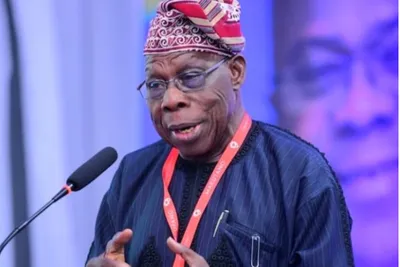
Former President Olusegun Obasanjo [PHOTO: NAN]
Former Nigerian President Olusegun Obasanjo has revealed how cement company Lafarge allegedly put obstacles in the way of Aliko Dangote’s efforts to expand cement production across Africa.
Mr Obasanjo made the allegation in Nairobi, Kenya, while speaking at the groundbreaking ceremony of a $16 billion oil refinery project in Lamu, Kenya.
The meeting with Kenyan and other East African institutional investors is part of activities surrounding the ongoing initial public offering of Dangote Petroleum Refinery and Petrochemicals FZE.
Mr Obasanjo governed Nigeria between 1999 and 2007.
Mr Obasanjo said Lafarge was particularly opposed to Mr Dangote’s expansion into cement production and described the company’s actions in Senegal as a “traumatic” experience for the Nigerian businessman.
“The people who really didn’t want Aliko to succeed in cement production is a French company called Lafarge, and they put every obstacle on Aliko’s way, just as they are still doing to us today,” Mr Obasanjo said.
He recalled that after Mr Dangote completed a 5-million-tonne cement plant in Senegal, local residents, allegedly instigated by Lafarge, challenged his ownership of the land on which the factory was built.
Follow us on Google News and never miss breaking stories, investigations, and in-depth reporting.
“I took Aliko to President Wade and he gave us everything, and Aliko completed the 5 million tonnes cement project in Senegal for two years, they could not do anything.
“Lafarge instigated some local people and said the land on which he built the cement factory is their land. They went to court. Aliko won.
“They still didn’t leave him. We won, and Aliko had to pay $12 million. Am I correct? $12 million to be able to operate his cement factory two years after it has been completed,” he said.
According to the former Nigerian president, the dispute was part of efforts by Lafarge to prevent Dangote from challenging its position in Africa’s cement market.
“Lafarge, who wanted Aliko not to produce cement in Africa, they want to monopolise. Lafarge is out of Africa today. Aliko dominates cement production in Africa,” he said.
Mr Obasanjo used the account to illustrate how Nigerian government policy and private-sector investment combined to start Dangote Group’s cement production in Nigeria.
He recalled that in 2003, while Nigeria was still importing cement despite having produced it for decades, he summoned Mr Dangote to discuss why he was importing rather than producing the commodity locally.
According to Mr Obasanjo, Mr Dangote told him that importing cement was more profitable than producing it. He said he subsequently introduced a policy linking cement import licences to plans for domestic production.
Mr Obasanjo said Dangote Group’s chairman initially submitted plans to produce five million tonnes of cement, despite Nigeria having produced less than three million tonnes annually for decades.
He said the policy eventually helped Mr Dangote establish large-scale cement plants in Nigeria before expanding into other African countries, including Tanzania, Ethiopia and Senegal.
“Just a few days before I left the government, we commissioned the first 5 million tonnes cement project in Nigeria.
“Then Aliko didn’t stop there. He went on and did another 5 million tonne project. I had to take him out. We went to Tanzania. We went to Ethiopia. We went to Senegal,” Mr Obasanjo said.
Mr Obasanjo also linked Dangote’s success in cement manufacturing to the development of his oil refinery, saying the experience provided the businessman with the confidence and inspiration to undertake the refinery project.
He said he recently visited the refinery and recalled that Mr Dangote publicly credited him for the policies that helped his cement business.
“Without this man, I would not have been in cement production. And it is the cement production that provided the encouragement, the inspiration for the refinery,” Mr Obasanjo quoted Dangote as telling refinery workers.
Mr Obasanjo said the Dangote Group’s expansion beyond Nigeria demonstrated the potential of African economic integration and urged the continent to take integration seriously.
“I am particularly happy that I see this day where and when we in Africa are taking integration very, very seriously. Where East Africa and West Africa are being brought together with the commitment of our leaders, and with the courage and commitment and enterprise of one man, Aliko Dangote,” he said.
Mr Obasanjo said the same approach was now being applied to the refinery, with the project expected to strengthen trade and economic ties between Nigeria and other African markets.
Earlier in September, Dangote Petroleum Refinery launched the public share sale, offering 4.1 billion ordinary shares at N525 each with a minimum subscription of 10 shares as it seeks to raise $1.6 billion (N2.2 trillion).
The proceeds of the transaction will help finance the refinery’s next phase of expansion, expected to double processing capacity at its location on the outskirts of Lagos to 1.4 billion barrels per day by 2030.
Another refinery, able to process 700,000 barrels of crude per day, is in the works in Lamu, Kenya, and is projected to serve the energy needs of the East African region.
All content is Copyrighted © 2025 The Premium Times, Nigeria