
Nigeria can’t afford to gamble with power sector — Shettima - Tribune Online
Vice President Kashim Shettima has said Nigeria cannot afford to gamble with its energy security, stressing that reliable electricity
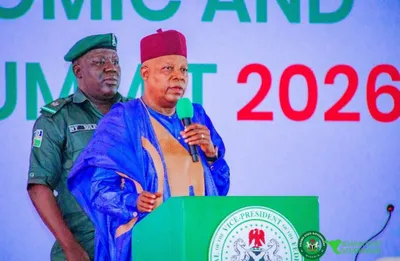
Vice President Kashim Shettima has said Nigeria cannot afford to gamble with its energy security, stressing that reliable electricity remains central to national development and economic survival. Shettima spoke on Wednesday at the groundbreaking ceremony for the new ultramodern National Control Centre of the Nigerian Independent System Operator (NISO) in Osogbo, the Osun State capital. The Vice President, who was represented by his Senior Special Adviser on Legal Services, Bashir Maidugu, said the electricity sector powers industries, supports businesses, enables hospitals and schools to function, and drives the growth of communities and enterprises.
“For Nigeria, therefore, the question of electricity is not merely a question of infrastructure. It is a question of national development,” the Vice President said. He noted that transforming the power sector required more than increasing generation capacity and expanding transmission lines, stressing the need to build institutions that are clearly defined, professionally managed and accountable. Shettima said the Electricity Act 2023 provides the framework for the transformation of the sector, including the integration of renewable energy into the national grid.
According to him, the new National Control Centre would provide NISO with a modern platform for real-time grid monitoring, system control, operational coordination, communications, data management and enhanced security. The Vice President, however, warned that infrastructure alone would not transform the electricity sector without strong institutions to manage and operate it. “Infrastructure alone will not transform the electricity sector.
The institutions operating that infrastructure must also uphold the highest standards of professionalism, transparency, accountability and technical discipline,” he said. In his remarks, the Minister of Power, Mr Joseph Tegbe, said the new ultramodern control centre would equip NISO with the capacity to monitor developments across the national grid and respond promptly to emerging challenges. Tegbe, who commended President Bola Tinubu for his determination to address the underlying weaknesses affecting electricity supply and deliver improved results for Nigerians, said the existing control centre, built 64 years ago, could no longer meet the demands of NISO’s current responsibilities.
“The National Control Centre is an integral part of our national power infrastructure. Generation plants and transmission lines depend on effective coordination to deliver electricity safely. “Through NISO, the centre supports the continuous balancing of electricity supply and demand, monitors grid network conditions and coordinates responses to disturbances,” Tegbe stated. Giving details of the project, the minister said the main building would comprise a basement, ground floor and first floor, accommodating operational, technical and support functions.
He said the facilities would provide an enabling environment for modern grid monitoring and control, while giving operators clearer and timely information on developments across the national grid. Tegbe added that once equipped, tested and commissioned, the centre would strengthen coordination across the electricity industry and improve the ability of operators to respond to disturbances before they spread and coordinate restoration when interruptions occur.
He said the facility would also support the safe integration of renewable energy resources and Nigeria’s operational coordination within the West African Power Pool. In his welcome address, the Managing Director of NISO, Engr. Bello Mohammed, described the ultramodern control centre as a foundation for the future of Nigeria’s electricity grid. “The true measure of this project will not be the size of the building or the sophistication of its equipment.
Its true measure will be the difference it makes to the operation of the Nigerian power system and, ultimately, to the lives and economic activities that depend on reliable electricity,” Mohammed stated.