
New Supreme Court term begins with a climate change case seeking to hold energy companies liable
The justices return from summer break to hear arguments in Boulder, Colorado’s lawsuit against Exxon Mobil and Suncor Energy.
WASHINGTON — The Supreme Court kicks off a new term Monday, with the justices hearing an attempt by oil companies to throw out lawsuits brought by cities and counties alleging they should pay damages for the impacts of climate change. Although the case concerns a specific lawsuit the city and county of Boulder, Colorado, brought against Exxon Mobil and Suncor Energy, the ultimate decision could have broad ramifications for more than two dozen similar lawsuits around the country.
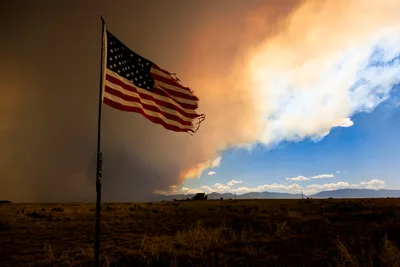
Boulder officials say they face increasing costs because of the impacts of climate change, including efforts to minimize risks from wildfires. Just this summer, Colorado has experienced extreme heat, drought and multiple fires. The lawsuit, bringing claims under state law, says Exxon and Suncor misled consumers about the impact greenhouse gases that their products produce would have on the climate. The companies deny the allegations and warn that if the Boulder lawsuit and others like it are able to move forward to trial, they and other energy companies could face crippling damages in the billions of dollars.
They also argue climate change is such an inherently national and international issue that it cannot be the subject of litigation in state courts. The case is the first to be argued in the courtroom as the new nine-month term begins after a summer break for the justices. Other major cases already on the docket involve a challenge to bans on AR-15 semiautomatic rifles and two about the Trump administration’s hard-line immigration policies.
The oral arguments will take place Monday with just eight justices, as conservative Justice Samuel Alito announced last week that he would step aside. He did not say why; liberal groups have said for months that he should recuse himself because he owns stocks in other oil companies that could benefit from a ruling in favor of Exxon and Suncor. Alito’s decision was a surprise, as the court had told NBC News in May there was no need for him to step aside.
The absence of one member of the court’s conservative majority is viewed as a blow to the oil companies, as his vote might have been crucial. It also raises the possibility of a 4-4 split that would leave the big legal issues unresolved and allow the Colorado lawsuit to move forward. “Obviously that wasn’t welcome news from our perspective,” Michael Williams, West Virginia’s solicitor general, said of Alito’s recusal at a briefing last week.
His state joined a brief backing the oil companies. The companies have two main arguments. The broader argument is that under the Constitution, states simply do not have the authority to do anything related to greenhouse gas emissions because they would effectively be regulating outside their own borders. Only the federal government can set policy in inherently nationwide issues that also have foreign policy implications, the lawyers said in court papers.
“Because air and water are shared natural resources that flow without concern for political borders, the States each have their own potentially conflicting interests. By joining the Union, the States surrendered their right to resolve those conflicts by resorting to their own law in lieu of a neutral, uniform federal law,” the lawyers wrote. Second, the companies say such lawsuits are trumped by the federal Clean Air Act, which regulates air pollution.
Boulder’s lawyers countered in court papers that state courts have long handled cases on issues that have nationwide impacts, such as product liability. They also pointed out that the lawsuit does not seek to cap any emissions in Colorado and that it is focused solely on the allegation of consumer deception, the type of issue state courts routinely address. “That exercise of traditional state power has never been thought unconstitutional,” they wrote.
The litigation is playing out amid a broader battle between oil companies and their allies on one side and groups advocating for action on climate change on the other. State courts have become a focus, in part, because of a lack of action at the federal level, with the Trump administration rolling back Obama- and Biden-era policies seeking to reduce carbon emissions and speed up the transition to cleaner energy. The administration, which filed a brief backing Exxon and Suncor, has also sought to block renewable energy projects, with President Donald Trump calling climate change a “hoax.”
In a ruling in 2011, the Supreme Court shut the door to making certain claims against energy companies over climate change in federal court, saying they were displaced by the Clean Air Act. The proxy war over the issue has also focused attention on a chapter about climate science in a reference manual for federal judges. It was abruptly withdrawn this year after conservatives alleged the authors had a conflict of interest.
Some also called for liberal Justice Elena Kagan to recuse herself in Monday’s case because she wrote a foreword to the manual. She later said she did not even read the climate chapter and gave no indication she would step aside.