Iran, China: Toward Building a Shared Future in a New World
TEHRAN, Sep. 28 (MNA) – Parliament Speaker Mohammad Bagher Ghalibaf has referred to the long history of relations between Iran and China as two ancient civilizations, stressing the expansion of bilateral cooperation.
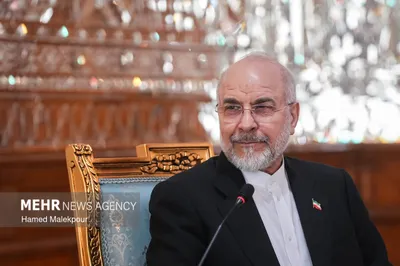
Speaker Ghalibaf who is also Iran's special representatives for Chinese afffairs, wrote a note full text of which is as follows:
The 55th anniversary of the establishment of diplomatic relations between the Islamic Republic of Iran and the People’s Republic of China is not only an opportunity to commemorate the past, but also to reflect on the future. Fifty-five years ago, Tehran and Beijing established formal diplomatic relations, and today the world, too, stands at a different point in its history.
Developments in recent years have taught us that many of the assumptions underlying the past international order are no longer capable of explaining today’s world, and that the future depends more than ever on the decisions made by independent nations today.
Iran and China, two ancient Asian civilizations, have experienced many ups and downs throughout their histories. Yet one experience is deeply rooted in the historical memory of both nations: no nation can build a stable and dignified future unless it determines its own destiny. The Iranian people, in recent years and particularly in the face of war, external pressure, and attempts to impose political will through military and economic power, have once again demonstrated that defending national independence is not merely a political slogan for them.
Iran does not seek war, but neither will it surrender to force. The experience of the Iranian people’s resistance has shown that military and economic superiority, in and of itself, does not guarantee the imposition of political will on a determined nation.
The message that Iran draws from this experience for the world is not a message of war; it is a message of peace through mutual respect. We believe that lasting security takes shape when all countries, large and small, enjoy equal rights to sovereignty, development, and the choice of their own future path. The use of war, unilateral sanctions, economic threats, and interference in the internal affairs of countries is not only inconsistent with the principles of the Charter of the United Nations, but in a highly interconnected world, it also puts the security and prosperity of others at risk.
Iran and China share an experience in this regard. Both nations understand the value of independence, national sovereignty, and development based on domestic capacities, while also recognizing that independence does not mean isolation. Rather, genuine independence remains sustainable when accompanied by cooperation, trade, people-to-people connectivity, and responsible participation in the international community.
One of the most important realities of our time is the gradual end of an era in which a single power or a limited group of powers could determine the rules of the world and expect others to comply. The world today has become more pluralistic. Asia has emerged as one of the world’s major centers of economic activity, technology, and population; countries of the Global South have assumed a greater role in the international economy; and economic and technological power has become more widely distributed among a larger number of actors.
These developments should not be regarded as a threat to the global order; on the contrary, they can be viewed as an opportunity to create a more just and stable order.
However, a multipolar world does not simply mean an increase in the number of major powers. Multipolarity without fair rules, mutual respect, and responsibility can itself become a source of instability. The new world therefore needs norms commensurate with its realities: respect for the sovereignty of states, opposition to double standards, the peaceful settlement of disputes, respect for the diversity of civilizations, inclusive development, and a fairer distribution of economic and technological opportunities.
In this context, the Islamic Republic of Iran follows with attention and interest President Xi Jinping’s vision of building “a community with a shared future for mankind,” as well as China’s initiatives in the areas of global development, global security, global civilization, and global governance. The significance of these ideas should be viewed as part of a broader effort to find new answers to global challenges—answers based not on unilateral domination, but on dialogue, development, and cooperation.
Iran welcomes every idea and initiative capable of strengthening genuine multilateralism, the central role of the United Nations, respect for the independence of countries, and greater participation by developing countries in global governance.
We are following with interest China’s development trajectory during the period of the 15th Five-Year Plan. China’s emphasis on high-quality development, scientific and technological innovation, new quality productive forces, the digital economy, green development, strengthening economic resilience and supply chains, while continuing high-level opening-up to the world, is important not only for the Chinese economy; these orientations also create new opportunities for China’s partners. Iran can be one of those partners.
The Iranian economy should not be viewed merely through the lens of oil and gas. Iran has an educated population, considerable scientific and engineering capabilities, vast energy and mineral reserves, industrial and agricultural capacities, a large domestic market, and, most importantly, a unique geographical position connecting Central Asia, the Caucasus, the Persian Gulf, the Sea of Oman, the Indian subcontinent, the Middle East, and Europe.
Synergy between Iran’s capacities and the priorities of China’s 15th Five-Year Plan can open a new chapter of cooperation: from renewable energy, petrochemicals, and mining industries to artificial intelligence and the digital economy; from pharmaceuticals and medical equipment to advanced agriculture and food security; and from railways, ports, and logistics to the establishment of joint production and supply chains.
From this perspective, Iran should not be merely a supplier of energy to China, nor should China be merely a buyer of oil or an exporter of goods to Iran. The goal should be to move toward partnership in production, technology, investment, and regional connectivity.
Our Chinese friends know that there is a strong political will in Iran to develop relations with China. However, genuine friendship requires that we also speak openly and respectfully about the past. Relations between the two countries in recent years have not always progressed in proportion to the true potential of Iran and China. At times, administrative complexities, shifting priorities, the effects of external pressures, insufficient knowledge among economic actors of each other’s markets, and the gap between political agreements and their economic implementation have prevented part of the potential for cooperation from being realized.
This situation should not be regarded as a sign of a strategic disagreement between Tehran and Beijing. On the contrary, it should be viewed as an invitation to institutionalize relations. Stable relations should not depend solely on the will of governments or temporary international circumstances. Banks, companies, universities, technology centers, provinces, cities, chambers of commerce, tourists, students, and the peoples of the two countries should all become carriers of Iran-China relations.
The 25-year Comprehensive Cooperation Plan can serve as one of the frameworks for this endeavor, but the success of any strategic document is ultimately measured by the projects implemented on the ground. We must move from “announcing cooperation” to “implementing cooperation,” and from a list of memoranda of understanding to a set of tangible and measurable shared economic interests.
Iran, in the recent imposed war, demonstrated, relying on its indigenous and popular capabilities, that an order based on unilateralism is destined to fail. A strong Iran today has a unique role in the international arena, and security and prosperity in West Asia are shaped through cooperation with Tehran. China’s role in rejecting unilateralism and power politics, as well as in fostering convergence and dialogue among countries in West Asia, is prominent, and cooperation with Iran as a reliable and stable partner can open a new chapter of peaceful coexistence, development, and security.
Geographically, Iran is situated at a point that connects East and West Asia. The Belt and Road Initiative, the Shanghai Cooperation Organization, BRICS, and other regional cooperation mechanisms have created opportunities that can transform Iran’s historic geographical position into a shared economic advantage.
The development of China–Central Asia–Iran rail routes, their connection to Türkiye and Europe, the development of the North-South Corridor, the use of Iran’s southern ports, and the establishment of joint logistics and production centers can turn Iran into one of the important links connecting China to West Asia and beyond. But this cooperation is not only about Iran and China. Our region needs development.
West Asia has paid a heavy price over the past decades for war, extremism, foreign intervention, and deficiencies in some economic infrastructures. The time has come to strengthen a different logic in the region: security through development and development through cooperation. Iran is ready to cooperate with China and other countries of the region on energy security, the development of transport corridors, joint investment, supply-chain security, combating climate change, and expanding trade.
Iran is a gateway to a much larger set of markets in Central Asia, the Caucasus, West Asia, and Eurasia. We welcome long-term investment by Chinese companies, technology transfer, the establishment of joint ventures, investment and joint production for third-country markets, and participation in Iran’s infrastructure projects.
I would also like to say to the people of China that relations between countries become lasting when their peoples know one another.
For the people of China, Iran is the land of the Silk Road, poetry and literature, thousands of years of history and civilization, and a hospitable people; just as China is, for Iranians, not merely a major economic power, but a great civilization that has made a prominent contribution to knowledge, culture, and the advancement of humanity over thousands of years. Travel between the two countries should become easier, the number of students should increase, universities should cooperate more closely, and the peoples of Iran and China should gain a deeper understanding of one another.
The greatest guarantee for the strategic relations between the two countries is understanding and trust between their peoples.
Fifty-five years of diplomatic relations between Iran and China have demonstrated that the two countries can preserve their friendly relations despite major international developments. Now we must take a step further. The new era requires that relations between Tehran and Beijing be elevated from an important political and commercial relationship to a sustainable, institutionalized, and forward-looking partnership—a partnership that connects politics, economics, technology, culture, and people-to-people relations.
China has demonstrated over the past decades that a nation can, by relying on its own capabilities, pursuing long-term planning, and engaging with the global economy, embark on a remarkable path of development. Iran, too, is determined to build a safer and more developed future for its people by relying on its national capacities and cooperating with trusted friends and partners.
As the two countries enter the 56th year of their diplomatic relations, Iran’s message to its Chinese friends is clear:
We respect the history of our friendship, but our eyes are on the future.
Tehran is ready, alongside Beijing, to elevate relations between the two countries from potential capacities to tangible achievements, from agreements to projects, and from government-to-government cooperation to people-to-people partnership. Iran and China are two ancient civilizations, but our task today is to build the future—a future in which Asia is not an arena for competition among powers, but one of the centers of peace, development, and cooperation for the shared future of humanity.