For whom Israeli PM Netanyahu speak for at UNGA??
TEHRAN, Sep. 26 (MNA)–Israeli Prime Minister Netanyahu’s address at 81st UN General Assembly cannot be viewed merely as a routine diplomatic speech. What transpired in New York was, above all, a reflection of Israel’s standing on international stage.
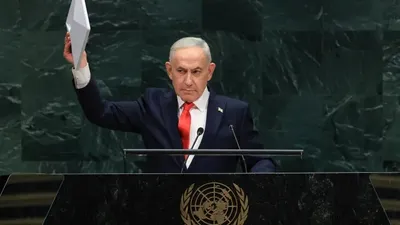
What happened in New York was, above all, was a reflection of Israel’s standing on the international stage—a picture that diverged sharply from the narrative promoted by the regime’s prime minister. Netanyahu sought to portray Israel as a triumphant, powerful nation enjoying the world's covert support; yet, the world’s cameras captured a different scene: a procession of delegations walking out of the hall, rows of empty seats, and a prime minister who began his address by attacking those unwilling to listen to his words.
According to figures published in Israeli media, 77 delegations were absent from the hall during Netanyahu's speech; some had left before the address began, while others had not attended at all. Agence France-Presse (AFP) also confirmed the walkout by dozens of delegations, reporting it as a protest against Israel's policies and the war in Gaza.
The significance of this figure, of course, lies not merely in the number of delegations; the true importance lies in the image projected to global public opinion. The United Nations serves as the world’s most important multilateral platform, and the Israeli prime minister was set to use this stage to address Israel’s security, the war in Gaza, Iran, and the threats he perceives facing the regime. Yet, before his arguments could even be heard, the spectacle of delegations walking out became the defining image of the speech.
Netanyahu’s own reaction further underscored this image. Addressing the delegations that had walked out, he remarked that if there were any other "moral cowards" who had not yet left the hall, they could do so right then. This statement demonstrated that the walkout by the representatives was not merely a peripheral matter for the Israeli Prime Minister; it was significant enough to command a substantial portion of his attention at the very start of his speech. Israeli media also gave the incident extensive coverage, with *Yedioth Ahronoth* describing it as a rare and dramatic act of protest.
The answer cannot be sought solely in the person of Netanyahu or his oratorical style. The issue stems from an accumulation of political, humanitarian, legal, and diplomatic crises over several years. The war in Gaza, the high Palestinian death toll, the widespread destruction of civilian infrastructure, the expansion of settlements and settler violence, and international legal proceedings have created a different image of Israel in the eyes of parts of the global public.
Israel rejects all allegations of genocide, viewing its operations as self-defense against Hamas; however, an independent UN commission of inquiry concluded in 2025 that Israel had committed genocide in Gaza—a conclusion Tel Aviv has rejected. Meanwhile, in November 2024, the International Criminal Court issued arrest warrants for Netanyahu and Yoav Gallant on charges of war crimes and crimes against humanity.
Under these circumstances, Netanyahu once again rejected the accusation of genocide at the United Nations, labeling it the "greatest lie of the century." However, the problem with his narrative was that he was no longer facing merely a political opponent or a critical media outlet; rather, a host of international institutions, governments, human rights organizations, and segments of global public opinion were raising serious questions about Israel's conduct.
Thus, the challenge for Netanyahu is no longer simply about persuading a single government or media outlet; the issue lies in the widening gap between Israel's official narrative and the global perception that a genocide is being committed by Israel.
From this perspective, the content of Netanyahu’s speech is also noteworthy. Over the course of a roughly 40-minute address, he presented a long list of his adversaries and critics—ranging from Iran and Qatar to Turkey, European nations, and New York Mayor Zahran Mamdani. A significant portion of his remarks was even dedicated to rebutting his critics. Netanyahu sought to demonstrate that the problem did not lie with Israel, but rather that the world was mistaken in its stance against the country. Yet, this very extensive list of enemies could itself be an indication of a crisis.
When the prime minister of a regime—speaking from the world’s most important diplomatic podium—devotes a significant portion of his address to responding to a long list of critics rather than outlining a vision for ending the war, the region's future, or a path out of the crisis, the question arises: is the issue merely "the world's hostility toward Israel," or is Israel facing a serious crisis in the realm of diplomacy and international persuasion?
This question becomes even more significant when Netanyahu’s speech is viewed against the backdrop of Israel’s domestic political landscape. Parliamentary elections are scheduled for October 27, meaning the speech took place just 33 days prior to the vote. Israeli media have also noted this timing; outlets such as *Haaretz* and *Yedioth Ahronoth* have suggested that a substantial portion of the Prime Minister’s remarks was aimed at a domestic audience rather than being designed to sway the opinions of critical governments.
In fact, one might ask: for whom was Netanyahu speaking at the United Nations?
For the delegations—77 of which were absent from the hall? For the governments that have sharply criticized Israel’s policies? Or for the Israeli voters who will head to the polls in just one month?
Other signs also reinforce this hypothesis. Netanyahu’s trip to New York was very brief, and unlike many previous visits, a meeting with Donald Trump was not on the official agenda. The Associated Press also analyzed his speech against the backdrop of an impending domestic election and mounting international criticism.
Amidst this, a major contradiction is evident in Netanyahu’s behavior. On one hand, he sought to portray Israel as a regime defending "civilization"—and even other nations—claiming that many leaders who walked out of the hall privately expressed gratitude for Israel's actions. On the other hand, the reality visible within that very hall was that dozens of delegations refused to remain for his speech at the General Assembly.
Furthermore, the claim regarding private expressions of gratitude by leaders was merely Netanyahu’s own assertion and cannot be regarded as a verified, independent fact. This gap between narrative and reality is perhaps the most significant takeaway from Netanyahu’s trip to New York.
Israel is now reviled and isolated on the global stage. The signs of the rising diplomatic cost of its policies cannot be ignored. The walkouts by dozens of delegations, widespread protests in New York, mounting international legal pressure, and growing criticism of the war in Gaza form a pattern of indicators that take on collective significance. For this reason, perhaps the most telling image of Netanyahu’s speech was neither the display of hardware, the threats against Iran, nor his claims of victory; the truer image was that of the empty seats.
Netanyahu tried to speak in a louder voice to demonstrate Israel's strength, but the empty hall posed another question to the world: if Israel is so confident in its narrative, why does it struggle so much to get that narrative heard?