Zelensky Urges China, India to Pressure Russia as Weekly Strikes Top 2,200 Drones
President Volodymyr Zelensky said Russia launched more than 2,200 drones, about 1,650 guided aerial bombs (KABs) and at least 38 missiles at Ukraine this week. He urged China, India, Brazil, South Africa and other Group of 20 (G20) countries to use their influence over Moscow to help end Russia’s aggression.
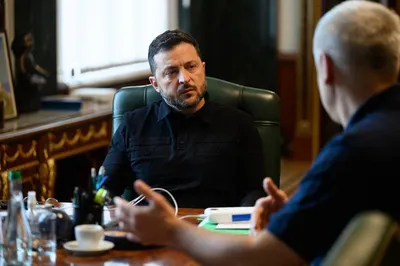
In brief: President Volodymyr Zelensky said Russia launched more than 2,200 drones, about 1,650 guided aerial bombs (KABs) and at least 38 missiles at Ukraine this week. He urged China, India, Brazil, South Africa and other Group of 20 (G20) countries to use their influence over Moscow to help end Russia’s aggression.
President Volodymyr Zelensky called on China, India and other major non-Western powers to take a stronger stance on Russia, saying Moscow had launched more than 2,200 attack drones, about 1,650 guided aerial bombs (KABs) and 38 missiles at Ukraine this week alone.
In a statement posted to Telegram on Sunday, Sept. 27, Zelensky said overnight Russian strikes killed three people in Zaporizhzhia region and a man in Kyiv, while Russian forces struck a data center twice in the morning of that same day.
Follow our coverage of the war on the @Kyivpost_official .
“Unfortunately, there is a lack of a consistently strong position from China and India, Brazil and South Africa, the G20 countries and the Global South,” Zelensky said, adding that “each of these countries has influence over Russia and can help make peace a reality.”
Ukraine continues working with its partners, including the US, EU, Canada, Japan and Australia, to strengthen its defense and pursue diplomacy.
“Building guaranteed, dignified security here in Ukraine means adding to security and stability globally,” he said.
According to Zelensky, a significant share of the 38 missiles Russia launched this week were ballistic.
Three people, including two children, were injured in the first of the two strikes on the Kyiv data center, he said, adding that overnight strikes also hit residential buildings, energy facilities and other civilian infrastructure in the Odesa, Kharkiv, Sumy, Mykolaiv, Kherson, Poltava, Zhytomyr and Kyiv regions.
Earlier, Kyiv Mayor Vitali Klitschko said a woman and two 16-year-olds had been hospitalized after the strike in the capital’s Shevchenkivskyi district .
On Saturday, Russian forces struck Kyiv’s Cosmonova data centers , affecting local television broadcasts and overall civilian ability to receive critical information.
The attack followed an almost three-week campaign against data centers, with four already hit on Wednesday.
China and India are the two largest buyers of Russian crude oil globally, providing revenue that helps sustain Moscow’s war effort. Beijing also supplies Russia with weapons-making components, while India remains one of largest buyers of Russian arms.
Brazil and South Africa, along with China and India, are fellow members of the BRICS bloc with Russia, which is why they have largely avoided taking sides – at least publicly – in the war against Ukraine.
Although US President Donald Trump gained new legislative powers to target Russia’s major oil and gas buyers with tariffs of up to 100% after signing the Lindsey O. Graham Sanctioning Russia and Iran Act into law on Sept. 18, it remains unclear whether he will use them against China. Imposing such tariffs could potentially undermine the trade stability Washington is seeking to preserve with Beijing, despite the fact that cutting out Russia’s oil revenue would prove significantly meaningful to Ukraine.
Zelensky has repeatedly called on Trump to exercise his new rights as Russia increases its strikes on civilian infrastructure across Ukraine.
His latest remarks came only two days after Russian PresidentVladimir Putin revived claims that Russian speakers’ rights were being violated in the Baltic states – the same rhetoric the Kremlin used to justify its invasion of Ukraine.
While Zelensky continues to appeal to countries with significant economic ties to Russia, NATO faces a growing wave of Russian hybrid attacks, with the line between sabotage and direct aggression increasingly blurred.
Meanwhile, Kyiv and Washington continue working jointly on brokering an end to the war.
On Wednesday, 51 countries backed a joint statement at the 81st United Nations General Assembly (UNGA) urging the Kremlin to agree to a full ceasefire and enter meaningful negotiations.
Washington has also invited Putin to the Group of 20 (G20) summit in Miami in December, with Trump urging him to “ settle the war .”
Moscow, however, has shown no sign of backing down. Russian Foreign Minister Sergey Lavrov said the Kremlin would not pause its “special military operation” even during negotiations, while Putin blamed Kyiv for stalled diplomacy and has so far rejected every proposal for a direct meeting.
“It has been the same with him for years – and all our partners feel it. He is looking for excuses to keep waging the war,” Zelensky said on Saturday, Sept. 26.
“It always sounds the same – and our recent meeting with the US President showed that.”
Kyiv Post is Ukraine’s first and oldest English news organization, reporting since 1995. Its international reach – 97% of readers are outside of Ukraine – make it truly Ukraine’s global voice.