
UN congress ends in UAE; how 'Pledge4Justice' will benefit people in over 50 countries
When 121 countries gathered in Abu Dhabi for the 15th United Nations Congress on Crime Prevention and Criminal Justice , the expectation was familiar: Six days of high-level dialogue, a closing declaration, and a return home. What they left with was something different. For the first time in the congress's 70-year history, participating nations were asked to put numbers to their commitments.
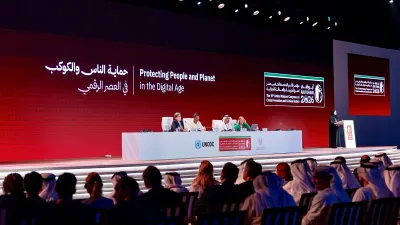
When 121 countries gathered in Abu Dhabi for the 15th United Nations Congress on Crime Prevention and Criminal Justice , the expectation was familiar: Six days of high-level dialogue, a closing declaration, and a return home. What they left with was something different.
For the first time in the congress's 70-year history, participating nations were asked to put numbers to their commitments. The result was Pledge4Justice, a UAE-launched initiative that produced 61 time-bound pledges, from 58 member states and three intergovernmental organisations, each tied to a specific action and a deadline of 2031. The UAE was the first country to submit.
What is Pledge4Justice, and why does it matter?
Previous UN crime congresses have produced declarations. Pledge4Justice was designed to move past that. Rather than agreeing on principles and leaving implementation to individual governments, the initiative asks each country to commit to a specific, measurable action, with progress monitored by the UN Commission on Crime Prevention and Criminal Justice and all pledges published by the UN Office on Drugs and Crime. In practical terms, it means that for the first time, the international community has a mechanism to track whether commitments made in Abu Dhabi translate into results by 2031.
Stay up to date with the latest news. Follow KT on WhatsApp Channels.
What is the Abu Dhabi Declaration?
Adopted on the congress's opening day, the Abu Dhabi Declaration is the principal outcome of the gathering, comprising 18 articles and 67 paragraphs that form a framework for international cooperation on crime prevention and criminal justice for the next five years. It addresses four priorities: strengthening prevention and community resilience; tackling evolving criminal threats; building fair and inclusive justice systems; and expanding international cooperation. It also names four forces reshaping crime and justice in this decade: digital transformation, shifting crime patterns, socioeconomic change, and environmental challenges.
The UAE's own priorities, including women, children, youth, the environment and artificial intelligence, are embedded in the text.
Why should the average reader care?
Because the crimes the declaration targets are no longer abstract. They include AI-generated voice cloning used to impersonate a family member and request a bank transfer. Drug trafficking conducted through messaging apps using products designed to look harmless. Online fraud networks that span continents and are run by trafficking victims forced to work in scam compounds.
These are not crimes that stop at borders, and the declaration's central argument is that responses cannot either. With 121 countries and more than 205 international organisations represented in Abu Dhabi, the congress closed with a clear message: cooperation that produces measurable outcomes is the only answer to crime that evolves faster than any single country can respond.
"The congress concludes today," said Abdullah Sultan bin Awad Al Nuaimi, UAE Minister of Justice and President of the Congress, in his closing remarks, "but the work begins today."
UAE says countries cannot 'fight serious crime alone', urges international cooperation
UAE launches ethics code for use of AI in legal processes that affect people
UAE experts warn youth of AI voice cloning, digital drug traps
UAE turns to AI to detect drug trafficking patterns, stresses international cooperation
62 Emiratis, other youths shape the future of crime prevention ahead of UN congress