
Cheap Iraqi oil for India carries four risks after US exit
Cheap Iraqi oil for India carries four risks after US exit
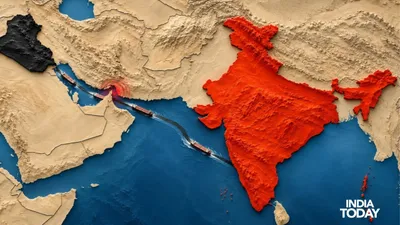
Sometime between Oct. 22 and 31, a tanker will load two million barrels of Basrah Medium crude at Iraq’s Basra terminal for Indian Oil Corp, which agreed on Oct. 1 to pay “$32 a barrel below Dubai prices,” Reuters reported. The deal came a day after the last US troops left Iraq, ending a presence that began with the 2003 invasion. Baghdad declared “Days of Sovereignty”. But the journey of those barrels to India is not that simple. With US forces gone, Iraq still faces vulnerabilities across its finances, defence, internal security and vital oil route through HormuzThink of any product’s journey: from where it is made to when it reaches the customer, it passes through several stages.
Iraq’s oil has four such stages: producing it safely, moving it out, securing the money it earns, and protecting the infrastructure around it. Each has a vulnerability; India’s barrels pass through almost all of them, and the scale of India’s dependence means it cannot afford to ignore Iraq. The following visualisation by India Today OSINT explains the alternative routes Iraq has adopted after the Strait of Hormuz was choked, through Syria and Turkey.
However, combined, these routes still cannot match the export volumes Iraq once moved through Hormuz. According to the Indian Embassy in Baghdad, “Iraq has been India’s second-largest crude supplier after Russia since the Ukraine war.” In 2025-26, it supplied “47.11 million tonnes, or 19.16% of India’s oil import value”India Today’s OSINT team analysed India’s crude buying from Iraq alongside Iraq’s export recovery, drawing on Kpler tanker tracking, Kpler-reported figures and Indian trade data to trace how the flow changed through the war. India’s Iraqi crude imports rose over threefold in September 2026 to 538,000 bpd, from 163,000 bpd in August, but remained below pre disruption levels of 900,000-1 million bpdThe numbers tell a story of collapse and comeback: India was taking roughly 931,000 barrels a day from Iraq on average between September 2025 and February 2026.
By April, that flow had almost disappeared. It stood at just 163,000 barrels a day in August, before surging to about 538,000 barrels a day in September - more than three times the previous month, although still below the pre-war level. For India, that rebound comes with a catch: the four strategic gaps that constrain Iraq’s oil trade are vulnerabilities in the supply chain India increasingly depends on. Iraq sells oil and receives dollars which go to the Central Bank of Iraq and become foreign reserves with part held at the New York FedFirst, Iraq has to get the oil out of the ground.
That sounds like the easy part. It isn’t. Oil facilities around Basra, including the giant Rumaila field, have been targeted by drones. So the risk to an Indian barrel can begin before that barrel even leaves Iraq. Then comes the journey. Think of a truck leaving a factory but having only one major highway to reach its customer. For much of Iraq’s oil, that highway is the Strait of Hormuz. Nearly all Iraqi crude leaves through Basra, and Kpler says “most of Iraq has no route around the Strait of Hormuz.”
Iraq’s exports recovered to about 2.6 million barrels a day in September. But, as Kpler put it, “The volume recovered. The route did not.” India has already seen what happens when that route becomes risky. In July, Reuters reported that IOC cancelled a planned two million-barrel Iraqi crude lifting from Basra after attacks on vessels crossing Hormuz, citing three people familiar with the matter. Around the same time, India’s Directorate General of Shipping advised against deploying Indian seafarers through the Strait of Hormuz.
Its July 15 advisory said companies should “avoid deploying Indian seafarers” on vessels passing through the strait until further orders. In simple terms, the oil may be available, and the buyer may be ready. The difficult part is getting that barrel safely to India. And that is exactly what makes the current recovery interesting. The route may be risky, but the oil has not stopped moving. India imported about 538,000 barrels a day of Iraqi crude in September, according to Kpler-reported data, bringing the flow back sharply from the lows seen during the disruption. But there is a catch.
We can see the oil moving. We cannot always see the ships carrying it. In its analysis of Sept. 21 satellite imagery, Kpler found five tankers loading at Al Basrah. All five had switched off their Automatic Identification System (AIS), the signal that tells the world where a ship is. However, the concern goes well beyond Iraq’s borders. The problem is, Iraq’s militias do not have to hit Iraqi oil to affect India. Kataib Hezbollah and Harakat al Nujaba have resisted disarmament, with the deadline now pushed to June 30, 2027.
Their actions can threaten oil infrastructure beyond Iraq too. In September, Saudi Arabia said drones launched from Iraq struck its East-West oil pipeline, an important alternative to Hormuz. For India, that matters because the Middle East supplied nearly half of its crude imports in the first 10 months of FY26. A strike on oil infrastructure elsewhere in the region can therefore become India’s problem too. And finally, there is the money.
Imagine selling something worth billions, but the money lands in an account you do not fully control. That is roughly the problem Iraq faces. Oil accounts for about 90% of its state revenue, while its oil revenues are held at the Federal Reserve Bank of New York. That arrangement gives Washington leverage over Baghdad’s access to dollars. For India, this is what the journey looks like: the oil has to be produced safely, moved through a vulnerable route, protected from wider security threats, and eventually paid for through a financial system Iraq does not fully control.
Indian barrels pass through almost all of those weak points. At India’s scale of dependence, these are not four separate Iraqi problems. They are four points at which India’s Iraqi oil supply can be disrupted. That is the contradiction for New Delhi: Iraqi crude is getting cheaper just as the system carrying it becomes harder to secure. The discount comes with a risk premium of its own. In Iraq, the end of the US military presence has left security gaps.
Around Hormuz, US and allied forces have helped keep the sea lane open, yet Indian-linked vessels and seafarers have still come under attack. For India, the risk runs from an insecure oil producer to a vulnerable shipping route. The tanker will load at Basra, cross Hormuz and, if the route holds, reach India. The question is whether the route can stay secure enough for cheap Iraqi crude to remain worth the risk.- Ends