
Nobel prize awarded for research into controlling brain cells with light
American scientist Karl Deisseroth and German researchers Peter Hegemann and Georg Nagel have won the 2026 Nobel Prize in Physiology or Medicine for discoveries that gave scientists a way to control nerve cells using light. The Nobel Assembly at Karolinska Institutet announced the award in Stockholm on Monday.
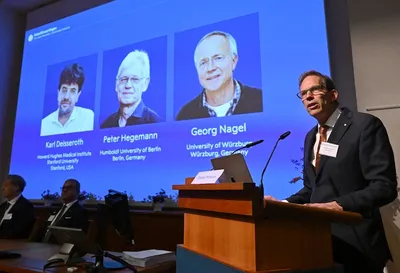
The three scientists received the prize for their work on light-gated ion channels and optogenetics, a technique that lets researchers switch selected nerve cells on and off using light.
The method has changed how scientists study connections between brain activity, memories, emotions and behaviour.
“Optogenetics provides opportunities for mapping the brain in a way that we could once only dream of,” Nobel Committee chair Per Svenningsson said.
The research began with studies of Chlamydomonas, a single-celled alga that responds to light. Hegemann studied how the organism detects light, while work by Hegemann and Nagel identified channelrhodopsin, a protein that forms an ion channel when exposed to light.
The researchers showed that placing the protein in other cells made those cells sensitive to light.
Deisseroth later applied the discovery to neuroscience at Stanford University. In 2005, he showed that introducing the gene for channelrhodopsin into rat nerve cells allowed researchers to trigger electrical signals with blue light. He later demonstrated the technique in living mice.
Scientists now use optogenetics to identify neural circuits involved in behaviour, memory and neurological and psychiatric conditions.
Research has also started to move towards medical applications. Clinical trials have tested optogenetic techniques in people with retinitis pigmentosa, a disease that damages light-sensitive cells in the retina.
The Nobel Assembly said the technique has provided researchers with tools to investigate how individual neural circuits influence memories, feelings and behaviour.
Deisseroth, 54, works at Stanford University and the Howard Hughes Medical Institute. Hegemann, 71, is affiliated with Humboldt University of Berlin, while Nagel, 73, works at the University of Würzburg.
The three scientists will share 12 million Swedish kronor in prize money.
The medicine award starts this year's Nobel announcements. The physics and chemistry prizes follow on Tuesday and Wednesday, with literature and peace later in the week. The economics award will be announced next Monday.
The laureates will receive their awards on 10 December, the anniversary of Alfred Nobel 's death.