Trump rejects Iran’s Hormuz offer backed by Khamenei. What happens now?
Trump rejects Iran’s Hormuz offer. What happens now?
 Hormuz Closure Chaos$HCC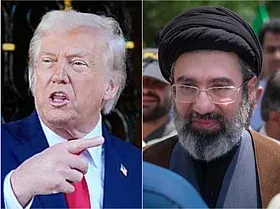
Dubai: US President Donald Trump has rejected Iran’s proposal to reopen the Strait of Hormuz within seven days, even as Tehran revealed that the offer had been coordinated with Supreme Leader Mojtaba Khamenei and backed by a team empowered to negotiate on Iran’s behalf.
The development leaves nearly seven months of war at a critical diplomatic juncture: Both Washington and Tehran say they want an agreement, but neither appears willing to surrender its main source of leverage first.
“They want to make a deal and I think that’s fine,” Trump told reporters on Saturday. “I’d like to make a deal, too. But that deal would not be acceptable.”
Iran, meanwhile, has sought to remove one of the uncertainties surrounding its proposal — whether President Masoud Pezeshkian has the authority to deliver what Tehran promises.
Pezeshkian said the proposal had been coordinated with Khamenei and that a six-member team involving representatives of the military, parliament, government and other institutions had authority to make decisions.
“If the US accepts it and fulfils its obligations, we will do the same,” Pezeshkian told CBS.
That means the latest impasse is no longer simply about whether Iran’s president can secure approval at home. The more immediate obstacle is the terms themselves — and which side must act first.
Trump: ‘Iran wants to make a deal’ but Tehran ‘not ready’ yet
The Hormuz dilemma
Iran’s proposal would reopen the Strait of Hormuz within seven days if Washington meets a series of conditions largely reflecting those contained in the June memorandum of understanding.
Tehran wants the US naval blockade lifted, access to at least $12 billion in frozen Iranian assets and sanctions relief allowing it to increase oil exports. It also wants hostilities across the region brought to an end.
For Iran, reopening Hormuz before receiving those concessions would mean surrendering perhaps its strongest bargaining chip while US economic and military pressure remained in place.
Washington sees the equation differently.
WHAT TEHRAN OFFERED
•
Hormuz reopens in seven days: Iran says the strategic waterway could reopen quickly under an agreement.
•
End the naval blockade: Washington would lift restrictions on Iranian ports.
•
Release frozen assets : Tehran wants access to at least $12 billion held abroad.
•
Oil sanctions relief : Iran wants restrictions eased so it can increase crude exports.
•
End wider hostilities: Tehran wants fighting across the region addressed as part of an agreement.
•
Further negotiations: Initial reciprocal steps would clear the way for talks on wider disputes.
•
Authority to deliver: Pezeshkian says the proposal was coordinated with Khamenei and a six-member team representing key Iranian institutions has decision-making authority.
WHY TRUMP SAID NO
•
The terms are unacceptable : Trump has said he wants an agreement with Iran but explicitly rejected the proposal currently on the table.
•
Washington wants to retain leverage: Sanctions and the naval blockade are central sources of US pressure on Tehran.
•
Iran wants major concessions upfront : Tehran is seeking blockade relief, frozen assets and oil-sanctions relief as part of the process of reopening Hormuz.
•
The sequencing remains unresolved : Iran wants Washington to ease pressure first; the US wants Iranian movement before surrendering its leverage.
•
Trump believes Iran is under pressure: He said Saturday that Tehran wanted an agreement because it was “losing so badly”.
•
Diplomacy remains possible : Trump also said, “I’d like to make a deal, too,” leaving the door open to different terms.
Iran-US trade fire again: Why Tehran’s hardliners think they can outlast Trump
The Trump administration believes sanctions and the naval blockade have increased pressure on Tehran. Giving them up before securing Iranian concessions would therefore mean surrendering much of the leverage Washington has spent months building.
That leaves the two sides caught in a sequencing trap: Iran wants US pressure eased before reopening Hormuz; Washington wants movement from Iran before easing that pressure.
Talks continue despite threats
The rejection does not necessarily mean diplomacy is over.
US and Iranian representatives held about three hours of indirect discussions through mediators in New York on Tuesday, their first such talks in months.
Secretary of State Marco Rubio subsequently described the talks as good and said Washington was open to further contacts. US officials had also described conversations with mediators as positive and constructive.
Yet the diplomatic contacts have unfolded alongside increasingly harsh rhetoric.
Trump used his UN General Assembly address to threaten devastating consequences for Iran, while Pezeshkian said Iran would fight “until our last breath”. In the final moments of his speech, however, the Iranian president reiterated Tehran’s willingness to pursue diplomacy.
What’s next in Iran war? Trump ends talks, tightens squeeze as Tehran vows to break US naval blockade
Why November matters
The November midterms may also help explain why Washington sees little urgency to compromise.
Pezeshkian has made clear that Tehran would prefer an agreement before the elections, saying: “We don’t want it to get to the midterm elections.”
Trump has suggested a different timetable, saying an agreement with Iran could come after the elections.
A former senior US diplomat said the approaching vote may also be limiting Trump’s appetite for renewed military escalation for now. Separately, the Wall Street Journal has reported that Trump told aides he expects strikes on Iran to resume after the midterms, although his position could change.
The competing timelines suggest Tehran and Washington may be making very different calculations about whether time strengthens or weakens their bargaining positions.
Saudi Foreign Minister Prince Faisal bin Farhan told the UN General Assembly on Saturday that attempts to block Middle East waterways threatened global energy security and accused the international community of failing to assume its responsibilities in confronting threats to international peace and security.
His warning underscored how reopening Hormuz has become more than a negotiating issue between Washington and Tehran.
What happens now?
Mediators still have room to search for a phased arrangement in which neither side is required to surrender all its leverage at once.
That could involve reciprocal steps towards reopening Hormuz and easing economic pressure, followed by negotiations on the more difficult questions dividing Washington and Tehran.
But Trump’s rejection shows how wide that gap remains.
Iran can now argue that its proposal has approval at the highest levels of the state and that its negotiators have authority to implement an agreement. Washington, however, has made clear that those assurances alone do not make Tehran’s terms acceptable.
So the central question has changed.
It is no longer simply whether Iran has the political authority to make a deal.
It is whether Washington and Tehran can devise a sequence in which neither believes it is giving away its leverage first.