
Skulls Reveal Evidence of Human Sacrifice in Egypt 5,000 Years Ago
Royal tombs at Abydos were surrounded by numerous other burials. In the 1920s, an Egyptologist questioned whether all those people could have died naturally at the same time.
In the 1920s, Egyptologist Flinders Petrie theorized that numerous ancient Egyptian burials in Abydos represented human sacrifices. Around 100 years later, another Egyptologist has found evidence that he was likely right.
Roselyn Campbell , an Egyptologist and bioarchaeologist at Purdue University, studied dozens of ancient Egyptian skulls that Petrie had excavated. The previously overlooked injuries she identified on the skulls strongly suggest that many early burials in Abydos belong to members of the royal household who had been sacrificed in the wake of a king’s death, also known as retainers.
“I was drawn to these retainers partly because, even though they were buried around royalty, they are mostly relegated to footnotes in the grander narrative,” Campbell, sole author of a study published today in Frontiers in Environmental Archaeology, said in a Frontiers statement. “Who were these people and how did they view the ruler and their own role in his or her life and death?”
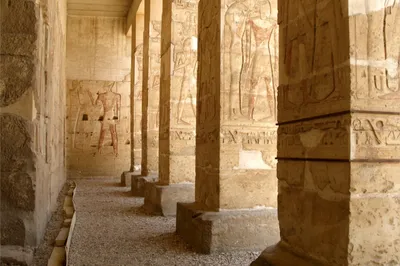
The first kings of a unified Egypt constructed funerary complexes at Abydos —today a hugely important ancient Egyptian archaeological site—around 3,000 BCE. The complexes included the royal tombs, chamber tombs and enclosures likely employed for funerary rituals, and surrounding subsidiary burials. A subsidiary burial consisted of a simple chamber, and some of the people buried in one had a simple coffin. Most had been laid to rest with a small number of burial objects, Campbell explained.
Petrie also found some grave markers with official titles, which appear to mostly indicate artisans and mid- or lower-level officials. Some royal tombs are surrounded by hundreds of these subsidiary graves, and Petrie thought it impossible for so many people to have naturally died at the same time. He suspected retainer sacrifice but did not find evidence of fatal wounds on the skeletons, which weakened his hypothesis.
“Retainer sacrifice is a type of human sacrifice where those close to a ruler are killed when the ruler dies,” said Campbell. “In many cultures, retainer sacrifice is practiced because of beliefs that the sacrificed individuals will continue to serve the ruler in some kind of afterlife, but retainer sacrifice can also be a visceral display of the ruler’s power. Some retainers might have volunteered to die to achieve eternal life or honor, others may have been chosen or even forced.”
A century later, Campbell essentially checked some of Petrie’s work with modern forensics. She investigated his notes and 46 skulls he had excavated and sent to the United Kingdom and found that 18 of them had traces of significant cranial trauma. The injuries consisted of linear fractures that Petrie appears to have thought were natural damage. Forensic science today reveals them to be perimortem injuries.
“The injuries on the preserved crania are generally linear fractures, which would likely cause rapid unconsciousness, internal bleeding, and death,” said Campbell, who is also author of the forthcoming book, State-sanctioned Violence and Human Sacrifice in Early Dynastic Egypt . Some of the 18 skulls also carried evidence of sharp-force trauma, such as a chopping injury on one person’s eye.
We can’t know exactly how these people died, but the indication is that at least 39% of people in these subsidiary graves could have been intentionally killed by getting struck to the head, supporting Petrie’s original theory.
Linear fractures usually occur from a flat, wide weapon or because of a fall. But someone who fell hard enough to crack his or her skull would have likely also broken other bones—injuries that aren’t documented in Petrie’s detailed photographs or notes. Petrie reburied most of the remains he dug up, excluding the skulls.
What happened to people in other subsidiary burials is also still unclear. Some may have died naturally or been killed by a method that doesn’t leave traces on the skeleton, like suffocating. Or they may have been killed in a way that Petrie wasn’t able to identify, but scientists today could if they had access to the skeleton.
“If I had unlimited resources, I would love to figure out where the bodies of these individuals might be and analyze them!” Campbell concluded. “Still, this study shows how much new information about the past can be revealed when we revisit previous data armed with updated methods and knowledge, even for datasets that are incomplete and imperfect like this one.”