
Netanyahu says coalition with Arab parties would ‘dismantle’ Israel
Opposition leader Gadi Eisenkot has opened the door to a once improbable alliance with ultra-Orthodox Jews that could involve the external support from the Arab-majority Joint List.
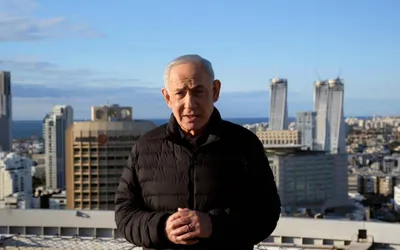
Israeli prime minister Benjamin Netanyahu echoed claims by far-right European politicians that parts of the continent have come under Islamic law, warning that Israel could face a similar scenario. (GPO/EPA Images pic)
JERUSALEM: Israeli prime minister Benjamin Netanyahu said on Saturday that a potential coalition between opposition parties and Arab lists would lead to the collapse of the country.
The statement came on the eve of the announcement by Israeli president Isaac Herzog of who will be tasked with forming the next government following last week's vote, with Netanyahu's rivals increasingly optimistic about removing the country's longest-serving prime minister.
The opposition, led by Gadi Eisenkot, a former military chief and political newcomer who has sought to appeal to secular and liberal Israelis, has opened the door to a once improbable alliance with ultra-Orthodox Jews.
It could give Eisenkot the numbers to form a coalition that might also include the moderate Islamist party Raam, whose leader has recognised Israel as a "Jewish state", and receive the external support of the Arab-majority Joint List.
"Such a government, dependent on Islamists, will dismantle the State of Israel from within, as is happening in European countries, and far worse than that," Netanyahu said in a pre-recorded speech, echoing the language of far-right politicians on the continent who claim parts of Europe have come under Islamic law.
Neither side reached a majority in the Oct 27 election, in a country deeply polarised by Netanyahu's hard-right rule and worn down by three years of war.
Speaking on Thursday after consultations with all parties, Herzog, who must select a candidate to form the next government, acknowledged it would be logical to give the mandate to Eisenkot, who was recommended by factions representing 67 lawmakers as opposed to 46 for Netanyahu's bloc.
The president has also sent signals that he would like to explore a national unity government bringing together Jewish Israelis from the two camps.
On Saturday, Netanyahu reiterated his support for that idea.
"I call for the establishment of a national unity government that will include all the parties of the national camp and all the Zionist parties that want to safeguard our state, the one and only state of the Jewish people," he said, stopping short of claiming that he should lead such a coalition, as he has done in another recent speech.
In response, Eisenkot's Yashar party called on Netanyahu's allies and members of his Likud party to form a unity government led by Eisenkot.
"If Likud and its allies are suddenly interested in 'unity' and a broad government, they are more than welcome to publicly announce the dissolution of their alliance with the extremists... and their willingness to join a government under Prime Minister Eisenkot," Yashar wrote on X.