
Can Mamata Banerjee and Left copy the Keralam formula?
Politics runs on possibilities. When Trinamool Congress (TMC) leader Mamata Banerjee picked up the phone to speak to CPI(M) general secretary M A Baby, something unthinkable for three decades became ordinary for an afternoon. There is no history of her speaking with a general secretary of the party she built her career against. In 1998, Banerjee walked out of the Congress because she believed the West Bengal unit had grown soft on the communists.
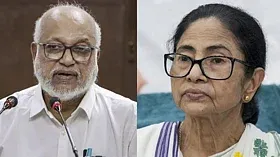
Politics runs on possibilities. When Trinamool Congress (TMC) leader Mamata Banerjee picked up the phone to speak to CPI(M) general secretary M A Baby, something unthinkable for three decades became ordinary for an afternoon. There is no history of her speaking with a general secretary of the party she built her career against.
In 1998, Banerjee walked out of the Congress because she believed the West Bengal unit had grown soft on the communists. From the birth of the TMC to the Bharatiya Janata Party's rise in the state after 2016, her political fight had one address. She brought down a Left Front that had ruled for 34 years. Until a few months ago, a civil conversation with the CPI(M)'s top leader was a category error.
The I.N.D.I.A. bloc did not change that. What has changed is the ground under both parties. On May 4, her 15-year chief ministership ended. The BJP took roughly 207 of the 294 Assembly seats.
Mamata Banerjee reaches out, but Congress, CPI(M) keen to keep TMC at arm’s length in Bengal
The TMC did not survive the loss. Within a month, a majority of the TMC’s 80 MLAs installed expelled legislator Ritabrata Banerjee as Leader of the Opposition. In New Delhi, 20 of the 28 Lok Sabha MPs merged with the Nationalist Citizens Party of India and lined up behind the BJP-led NDA. Several Rajya Sabha members too left. On September 17, the Election Commission of India froze the TMC name and the symbol. The next day her Nandigram candidate, Sanchita Pradhan Dey , withdrew after meeting Chief Minister Suvendu Adhikari, leaving her without a nominee in the seat that made her a name in 2007. She said her faction would back the Congress . She is fighting for relevance, not only office.
A personal vote cannot replace that organisation. To oppose the BJP nationally, she needs partners beyond her base. From 1998, she reduced the West Bengal Congress to a remnant, yet kept a working relationship with Sonia Gandhi and has built one with Rahul Gandhi. Mamata Banerjee reaching out to the CPI(M) is an admission that the map has shrunk.
Baby's September 23 letter asked for a joint line on the ECI and Chief Election Commissioner Gyanesh Kumar, amid the dispute over the Special Intensive Revision (SIR) of electoral rolls. Banerjee wrote back, then called. Baby later said they had agreed to work together, and that she had spoken of a Delhi meeting after talks with Rahul Gandhi. She also said protest had become difficult under the new government. This is not an alliance. It is the first conversation in which both sides need something.
Suvendu targets Mamata over Delhi visit, says she has 'Jamaat in one hand, dimagi naxals in other'
The CPI(M) is not offering the strength it lacks. In West Bengal, it sits at the edge of the Assembly, and is absent from the Lok Sabha. It lost Tripura in 2018 and, in 2026, its presence in the Keralam Assembly was reduced to 35 seats. No Indian state is now run by a communist party.
Indian politics has housed stranger tables. JD(U) leader Nitish Kumar ran governments with the BJP, and against it. The Samajwadi Party fought alongside BSP’s Mayawati a few times in the past. In West Bengal, the CPI(M) and the Congress shared a platform to stop Mamata Banerjee. In 1989, the BJP and the Left both gave outside support to the V P Singh's National Front government.
The usable precedent is Keralam. There, the Congress and the Left are bitter political rivals at the state level, but come together to oppose the BJP at the national level.
No one serious should expect a TMC-Left ‘understanding’ in West Bengal. Moreover, with Assembly polls a good five years away, it is too early to form such alliances. What is immediate is the 2029 general elections, and both the Left and the TMC are fighting for survival against a common political rival — the BJP.
If the BJP settles into West Bengal, Mamata Banerjee risks the margin of a state she defined, and the Left risks remaining a memory with a flag. There is little sign the CPI(M) can rebuild here alone, or that Mamata Banerjee can rebuild a party from a frozen symbol and a personal vote.
If her faction is crowded out of the opposition space, the Congress and the Left are the only older claimants left, and that’s a contest that can wait. The clearer bet is 2029, where anti-incumbency among the young and the expose about Kumar can snowball into a big anti-government campaign. Whether Mamata Banerjee and Baby can copy the Keralam model of political alliance will depend on poll arithmetic and personal egos.
At the Centre they could still be useful to each other. In West Bengal they will remain rivals. The distance between those two facts is the size of the opening.
( Sayantan Ghosh, the author of Battleground Bengal, teaches at St Xavier’s College (Autonomous), Kolkata.)
(Disclaimer: The views expressed above are the author's own. They do not necessarily reflect the views of DH.)