SIR-EC dissent row | Election Commission says all SIR orders had unanimous approval, letter to Cabinet Secretary not related to policy matters
The Election Commission on Saturday maintained that all decisions related to the Special Intensive Revision (SIR) of electoral rolls were approved unanimously by its three members, amid a controversy over reported differences between Chief Election Commissioner Gyanesh Kumar and Election Commissioners Sukhbir Singh Sandhu and Vivek Joshi.
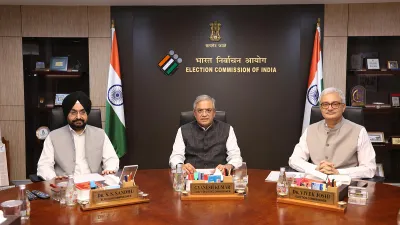
The Election Commission on Saturday maintained that all decisions related to the Special Intensive Revision (SIR) of electoral rolls were approved unanimously by its three members, amid a controversy over reported differences between Chief Election Commissioner Gyanesh Kumar and Election Commissioners Sukhbir Singh Sandhu and Vivek Joshi.
The poll panel said the SIR orders issued across the country had the approval of all three Election Commissioners and that the changes relating to Form 6, used for enrolment of new voters, had been upheld by the Supreme Court .
In a statement issued with the approval of the full Commission, the EC said the letters written by Sandhu and Joshi to the Cabinet Secretary did not concern any policy decision of the Commission or its IT division. Instead, they related to the functioning of an officer on deputation to the poll panel.
The Commission also clarified that work-reallocation orders issued by the officer were never implemented after directions from the two Election Commissioners. It said supervision of the IT division by the Deputy Election Commissioner (DEC) was also never withdrawn.
The poll panel said it had taken several major decisions in recent months, including the rollout of SIR in different parts of the country.
The SIR order issued on June 24, 2025, covering all states and Union Territories, beginning with Bihar and subsequently West Bengal and 30 other states and UTs, was approved unanimously by the Commission, it said. The Supreme Court upheld the order in its May 27, 2026 judgment, according to the EC.
It said the schedules for SIR in 12 states and UTs, issued on October 27, 2025, and in another 19 states and UTs, issued on May 14, 2026, were also approved unanimously.
CEC and ECs meet after expose on rift in Election Comm; projects united face; subtle admission of lacunae highlighted by 2 ECs; to review ECINET to 'double-check' it complies with law; Agenda for full EC meetings to be circulated in advance; SIR decisions unanimous @DeccanHerald pic.twitter.com/OKeNsGLh78
— Shemin (@shemin_joy) September 26, 2026
The Commission said the final number of electors would be available only after the final publication of electoral rolls in the remaining 12 states covered under Phase III.
"The declaration attached to Form 6 for SIR has been upheld by the Hon'ble Supreme Court. For the non-SIR period, the Forms applicable as per Rules (the Registration of Electors Rules 1960) will be used," the statement said.
The EC further said agendas for all its meetings would be circulated in advance and minutes would be issued. Directions issued by the Commissioners to officers of the poll panel, it added, would be "meticulously complied with".
The statement came days after The Indian Express reported that Sandhu and Joshi had raised objections on several occasions over decisions and orders concerning SIR. The report triggered demands from the Opposition parties for Kumar's removal and for the SIR exercise to be scrapped.
It was the second statement issued by the poll panel on the matter. The first came after the newspaper's initial report on differences within the Commission.
The EC also addressed the issue of voters left out of the revision process in Goa. It said the state's Chief Electoral Officer had instructed the concerned Booth Level Officers (BLOs) to visit such voters at their homes and collect their forms.
Of the 97 voters identified, 81 had already submitted Form 6 for inclusion in the electoral rolls, it said.
The Commission further clarified that people who receive notices during SIR need not appear for a personal hearing except in exceptional circumstances.
The poll panel maintained that differing views and observations are a normal part of institutional deliberations and reiterated that its decisions carry full legal sanction and are taken in accordance with statutory procedures.
(With PTI inputs)