
'Ram Rajya' can be inspiration for governance, Sengol a cultural marker: NCERT Class 9 textbook
New Delhi: The government can draw inspiration for governance from epics like the Mahabharata, Ramayana and other vedic texts, a revamped book on social sciences released for Class 9 this week by the National Council of Educational Research and Training (NCERT) states. It further says that for Mahatma Gandhi, the ideal form of governance was Ram Rajya , the rule under Ram.
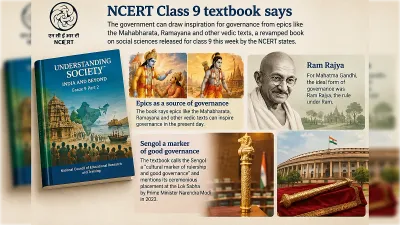
New Delhi: The government can draw inspiration for governance from epics like the Mahabharata, Ramayana and other vedic texts, a revamped book on social sciences released for Class 9 this week by the National Council of Educational Research and Training (NCERT) states. It further says that for Mahatma Gandhi, the ideal form of governance was Ram Rajya , the rule under Ram. The textbook also calls the Sengol a “cultural marker of rulership and good governance” and mentions the sceptre’s ceremonious placement at the Lok Sabha by Prime Minister Narendra Modi in 2023.
A chapter on governance and policy in the social science textbook, ‘Understanding Society: India and Beyond Grade 9 Part 2’, states that Gandhi “visualised an ideal model of governance” in Ram Rajya, which the book says is rooted in the principles of “probity, transparency, compassion, welfare, and people centric orientation” in governance and public policy. It further says that Gandhi’s views reflect the “collective imagination” of Indians. “ Ram Rajya is one of the best examples of good governance and a good collective life”.
Revamped class 9 NCERT textbook replaces western revolutions with Indian regional resistances
“From the Vedic period to the Ramayana and the Mahabharata, Indian tradition has consistently viewed governance as a sacred responsibility rather than merely a means of exercising power,” a line from the chapter reads.
After Independence, the book states, Indian institutions have continued to draw upon and adapt from traditional ideas. For examples, India’s adoption of ‘ Satyamev Jayate ’ (truth alone triumphs) from the Mundaka Upanishad as its motto from the British ‘ Order of the Star of India ’ phrase ‘Heaven’s Light ’, and the Supreme Court of India’s adoption of its motto ‘ Yato Dharmastato Jayah ’ from the Mahabharata which means ‘where there is dharma (justice), there is victory’.
The tradition of using the Sengol, the chapter states, is as a “mark of righteous governance” which began during the Chola dynasty a thousand years ago. And on the midnight of August 15, 1947, when India gained Independence, Jawaharlal Nehru, India’s first prime minister received the Sengol from the Adheenam Saints (an old Shaivite tradition) of Tamil Nadu.
From Naiki Devi to Abbakka Chowta, NCERT brings forgotten women rulers into focus
In a chapter on regional resistances to Colonial powers, the chapter speaks about regional warfare techniques, including the guerilla technique of the Maharana Pratap in the Battle of Haldighati in 1576, boat and river warfare systems of the Ahoms called ‘paik’ in the Battle of Saraighat in 1671, and the strategic alliance and diverse territories of the Marathas in the Deccan. A financial instrument called ‘ hundi ’ in medieval India has been compared to modern bank cheques.
A section of the chapter on regional resistances speaks about the spread of Sufism which is identified as a “mystical dimension” of Islam with a “comparative liberal outlook”, and that Akbar adopted the philosophy of Sulh-i-Kul leading to a more “inclusive” approach during his reign.