
From Kashmir’s pottery wheels to India’s Diwali homes, a fading craft finds new buyers
Srinagar: As earthen lamps light up homes across India for Diwali, a young entrepreneur in Kashmir is finding an opportunity to revive an occupation that has been steadily disappearing from the Valley. At a pottery workshop in Ishber Nishat, Mohammad Umer and his family have prepared around 40,000 diyas this year, compared with 25,000 last year. Orders have come from within and outside Kashmir, with social media helping the family reach customers beyond the Valley.
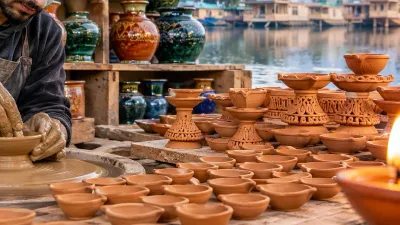
Srinagar: As earthen lamps light up homes across India for Diwali, a young entrepreneur in Kashmir is finding an opportunity to revive an occupation that has been steadily disappearing from the Valley.
At a pottery workshop in Ishber Nishat, Mohammad Umer and his family have prepared around 40,000 diyas this year, compared with 25,000 last year. Orders have come from within and outside Kashmir, with social media helping the family reach customers beyond the Valley.
A commerce graduate who learnt pottery from his father, Umer believes traditional crafts can find new markets by adapting to changing consumer preferences.
“We started making diyas in 2020-21 after receiving orders. The response encouraged us to expand production. This year, we have prepared around 40,000 lamps,” he said.
The workshop produces several varieties, including small lamps, diyas with stands and decorative arrangements.
Mysuru Deepavali: Demand for designer traditional lamps rises, but handmade clay lamps lose ground
Kashmir’s traditional potters, locally known as ‘krals’, once supplied households with earthen utensils, cooking vessels and water containers.
But stainless steel, aluminium, plastic and factory-made crockery gradually displaced handmade products, pushing many families away from the occupation.
Abdul Gaffar, a traditional potter from north Kashmir’s Bandipora, said pottery was struggling to remain economically viable.
“People have shifted towards factory-made utensils. Traditional artisans are finding it increasingly difficult to compete,” he said.
Festivals, however, continue to offer seasonal opportunities and bring communities together through trade.
“During Eid, they make products for us and get employment. Similarly, during Diwali, we make products for them and get employment,” Umer said.
Beyond seasonal production, Umer is exploring new designs, online marketing and the revival of Kashmir’s distinctive glazed pottery, known for colours such as deep green, blue, brown and ochre.
The ‘tumbaknari’, a traditional percussion instrument played at Kashmiri weddings, is another product of this craft.
But the shortage of suitable clay is threatening production. Umer said his workshop, which earlier sourced clay from Baramulla, was now struggling to secure adequate supplies.
Younger generations are also reluctant to take up the physically demanding occupation with uncertain earnings.
On September 22, the Union Ministry of Textiles sanctioned Rs 14.90 lakh to the Craft Development Institute, Srinagar, for specialised training programmes in glazed pottery and copperware under the National Handicrafts Development Programme.
The glazed pottery programme in Baramulla will train 30 artisans.
Artisans say training needs to be backed by raw material access, affordable production facilities and marketing support. Contemporary tableware, planters and decorative products could help expand demand beyond festivals.
With archaeological roots in the Neolithic settlement of Burzahama, dating to between 3000 and 1200 BC, Kashmir’s pottery tradition has survived centuries of change. The challenge now is to make it a viable livelihood for another generation.