
Limits and price of politics according to Burnham
British Prime Minister Andy Burnham’s keynote speech at this year’s Labour Party conference was intended as a declaration of radical change in how the country was going to be run,...
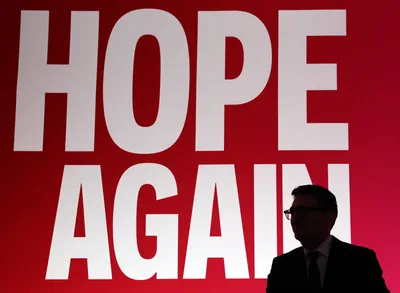
British Prime Minister Andy Burnham’s keynote speech at this year’s Labour Party conference was intended as a declaration of radical change in how the country was going to be run, offering the “hope” that he had repeatedly emphasized earlier. There was certainly a great deal of excitement around the supposedly bold vision and much-vaunted courage of the new leadership. In fact, many in the audience were reportedly moved to tears by Burnham’s speech, especially when he recounted stories about his father, who had passed away only recently.
Even some of his critics could not resist praising his communication skills, as well as his unique ability to persuade a certain sector of the population simply by presenting himself as one of their own. Cynics may doubt his sincerity, of course, but ultimately, he will be judged by his deeds.
Burnham spoke of many things, ranging from housing and energy to electoral reform and foreign policy. The common theme was that Britain had been “on the wrong path” for a long time, that the people needed hope, and that they wanted to see in power those capable of delivering it. Burnham promised that he would not “leave this job without doing everything” he could “to change things.” Taking pride in and looking back wistfully on what he regards as the Labour Party’s traditional values and its many achievements in the postwar era, he attacked the “ideological” decisions taken by former British Prime Minister Margaret Thatcher in the 1980s.
To some, this was nothing more than a mere appeal to nostalgia, while others saw it as a genuinely forward-looking project. Importantly, for much of what he promised, Burnham noted that he expected to pay a “political price.” By this, he could hardly have meant losing popularity among the electorate, except perhaps among pensioners, since his promises were largely borne out of the criticisms the electorate had leveled at his predecessor.
He might have had in mind a potential clash with such elusive entities as the “bond markets,” though he had already reassured them that he would act in a “fiscally responsible” manner.
Why exactly, then, would Burnham expect to pay any price for “doing politics differently” and instilling hope in the hearts of millions? Was he not supposed to challenge the very system that makes such a price the cost of hope in the first place? His own approach to the immigration debate offers a hint. Burnham could have followed his predecessor in trying to outbid Reform U.K. on immigration, or taken the opposite position advocated by the Green Party.
Instead, he barely mentioned that issue in his hour-long speech. He incurred no apparent political price precisely because he refused to play by the established rules.
So, if Burnham is serious about “the rewiring of the British state” and all that comes with it, he must be prepared to disregard the artificial constraints imposed by the old wiring, so to speak. His optimism has already earned him a lead in the polls, and unless he starts drawing imaginary red lines around what he can and cannot do, there is scope for him to build on this momentum. On this path, there will surely be immense pressure coming his way as well, including pressure to “care as much about unleashing the animal spirits of enterprise as he does about rebuilding the power of the state,” as the Financial Times editorial board has recommended.
The rejection of “politics as usual” can serve as a meaningful central motif only if the rejection is substantial. Burnham’s remarks about paying a “political price” suggest that he has yet to fully embrace the implications of his own rhetoric. If hope is to be something more than an aspiration offered within the status quo, it cannot itself become a variable in a political calculation, with its promise weighed against the political price it might incur.
Otherwise, the old wires will merely have been reconfigured, and the promise of change will remain subject to the very constraints that real change would naturally overcome.