
French student protests boil over as clashes rock high schools
Riot police clashed with high school students across France on Friday as a growing protest movement over overcrowded classrooms, teacher shortages and deteriorating school building...
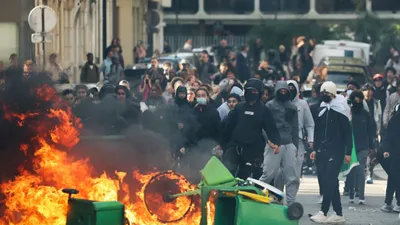
Riot police clashed with high school students across France on Friday as a growing protest movement over overcrowded classrooms, teacher shortages and deteriorating school buildings intensified into street violence, putting fresh pressure on President Emmanuel Macron's government.
Tear gas filled streets in Strasbourg, fireworks were directed at police lines in Marseille and protesters set fire to garbage bins in Rennes. In Pantin, northeast of Paris, demonstrators burned fences and other objects and threw firecrackers at riot police before fleeing.
In La Ciotat, near Marseille, an education authority spokesperson said a young person sprayed petrol at a teacher. BFM TV broadcast footage showing a hooded person wearing a face covering spraying a liquid from a bottle at a man clutching his face, although Reuters could not independently verify the circumstances.
The unrest has spread rapidly since protests began in the Paris region last week, with more than 1,200 high schools affected during the week and about 400 schools closed Friday, according to Education Minister Edouard Geffray.
Interior Minister Laurent Nunez said police had arrested about 5,000 people since Monday, most of them teenagers. Justice Minister Gerald Darmanin said parents of minors who damage property should be responsible for paying reparations.
The government held a crisis meeting Thursday as officials sought to contain the violence. A source close to Prime Minister Sebastien Lecornu said the movement had shifted from a protest campaign into urban violence, while Darmanin accused "outsiders" of hijacking the demonstrations.
Teachers' unions, however, said the unrest reflected years of frustration over conditions in France's public schools. They called a nationwide teachers' strike for Tuesday, one week after public-sector workers staged a separate walkout.
"The violence is regrettable, but when demands go unheard for years, and given the political and geopolitical context, there are several conditions that put students in a real state of anxiety," teacher Sandra Champain-Seller said.
The protests have become a major political flashpoint just months before France's next presidential election, with Macron and his government facing persistent public dissatisfaction and mounting criticism over plans to reduce government spending.
Students have complained about overcrowded classrooms, teacher shortages and aging or poorly maintained buildings.
"We are 35 per class, we don't have enough chairs in classrooms, the one-hour lunch break is too short for everyone to get food," 15-year-old Kesia said in Pantin before running away as police fired tear gas.
At Lycee Le Corbusier in Aubervilliers, north of Paris, students said schools in poorer neighborhoods were bearing the brunt of the problems.
Maisa, 17, said she had taken her French high school exam last year without a French teacher and argued that students in disadvantaged areas deserved the same educational opportunities as those elsewhere.
"These are not conditions to study in," she said.
Amelia, 15, who protested alongside Maisa, carried a sign reading, "Our address should not decide our future."
She said she was demonstrating because students in the suburbs should have the same rights and opportunities as those in other parts of France.
"The education authority is not investing enough in the suburbs. It's classist and racist," she said.
At Lycee Le Corbusier, several classes, including mathematics, humanities, English and physical education, have been canceled since the start of the academic year because of teacher shortages, according to Karima Kara Ali, an elected parent representative.
In the Seine-Saint-Denis department, two-thirds of high schools participated in protests Thursday, according to the CGT labor union. Students, teachers and parents in several towns have also raised concerns about unsanitary facilities and shortages of nurses, social workers and other support staff.
Louise Paternoster, a representative of the CGT education union in Seine-Saint-Denis, said the department was not receiving enough resources for its student population.
A union survey found that two-thirds of schools in the department have unfilled teaching positions.
"Our students are losing out on study time. Some schools don't have drinking water. We are not equal to other departments," Paternoster said.
The union has blamed government cuts that eliminated 3,256 teaching positions nationwide in 2026.
In Pantin, teacher Dilan Roche joined her students during the demonstrations, saying she wanted to support their demands and protect them amid confrontations with police.
"What they wrote on banners, we wrote in a letter to the local education authority: overcrowded classes, no nurses, no social workers, which is problematic for students with learning difficulties, many living in precarity," Roche said.
The government's draft 2027 budget, presented Thursday, proposes increasing education spending by 1.7% to 65.53 billion euros ($74 billion), excluding teacher pensions. The increase is below the expected rate of inflation.
Education Minister Geffray said education remained a government priority and attributed the relatively small increase partly to France's declining population.
The education budget has traditionally been France's largest area of government spending. Under the draft budget, however, debt-servicing costs are expected to reach 74.5 billion euros next year.
According to the OECD, France's education spending falls around the middle of the range among member countries. Government data show average spending per secondary student stood at 11,660 euros in 2024, little changed from 11,910 euros in 2010.
The latest protests have also renewed a debate over unequal access to public services in France's poorer urban areas.
Political scientist Ulysse Rabate of Paris 8 University said the demonstrations showed how marginalized neighborhoods were increasingly influencing national politics.
"When there is a collapse of the public service, of public education, those who feel it the most, and the most violently, are those at bottom," he said.
The government has also faced accusations of excessive force in its response to the demonstrations. Rights groups have criticized police tactics involving batons, tear gas and nonlethal projectile weapons, particularly when used against minors.
French authorities have opened several investigations into alleged police violence. One concerns a 16-year-old who reportedly suffered an eye injury after police fired rubber bullets into a crowd, according to friends of the teenager.
Nunez described the unrest as an "unacceptable climate of violence" and called for order.
Government officials have also faced accusations of politicizing the protests. Intelligence agencies told the government's crisis meeting that politicians from the hard-left France Unbowed party had helped initiate the movement. Senior France Unbowed lawmakers rejected the allegation and accused the government of using the unrest for political purposes ahead of the election.
The demonstrations began in the Paris suburbs, where poverty rates are high, before spreading to Paris and cities including Marseille, Strasbourg, Tours and Lille.
The current movement echoes a major nationwide high school protest campaign in the 1990s, when students demanded additional funding after the government expanded access to the baccalaureate without providing schools with enough resources.
That campaign eventually secured additional funding, but spending per student later stagnated even as schools took on new responsibilities.
Professor Clemence Cardon-Quint of Paul Valery University, who researches education funding, said students and teachers now face additional pressures, including the university admissions system Parcoursup, introduced in 2018 and criticized by some students and teachers as opaque and discriminatory.
"In a period of budgetary restraint, it is more difficult to reduce inequalities," Cardon-Quint said.