
China’s fuel export halt could deepen diesel squeeze, with Asia in the firing line
China’s reported suspension of fuel exports for October could tighten diesel supplies in Asia and have knock-on effects on markets further afield, analysts say.
China’s reported suspension of fuel exports for October could tighten diesel supplies in Asia and have knock-on effects on markets further afield, analysts say.
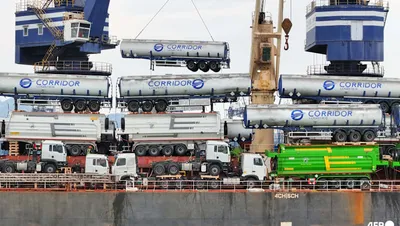
Fuel tankers are loaded onto a ship for export to Mali at the port in Yantai, in China’s eastern Shandong province, May 18, 2026. (Photo: AFP/CN-STR)
This audio is generated by an AI tool.
BEIJING: China’s move to halt fuel exports could squeeze diesel supplies in parts of Asia, although increased production elsewhere in the region should help cushion the impact, say analysts.
Reuters reported on Oct 1 that Chinese refiners had suspended oil product exports for the month, citing sources. China has not made an official announcement.
The pause reflects concerns over domestic supplies amid heightened uncertainty around global energy flows disrupted by the Iran war, observers say.
It also comes as pump prices hit record-high levels in the United States and parts of Europe, with governments weighing measures to keep supplies flowing while reining in costs.
CNA Games
Guess Word
Crack the word, one row at a time
Buzzword
Create words using the given letters
Mini Sudoku
Tiny puzzle, mighty brain teaser
Mini Crossword
Small grid, big challenge
Word Search
Spot as many words as you can
Show More
Show Less
Analysts add that the effects could also ripple beyond Asia as buyers seek replacement barrels, potentially tightening supplies in markets further afield.
“In the wider context of global diesel shortages, China’s diesel export suspension is a blow to the Atlantic Basin balances,” June Goh, a senior oil market analyst at oil-market analytics firm Sparta Commodities, told CNA, referring to diesel supply and demand in markets around the Atlantic Ocean.
China began its week-long Golden Week holiday without giving major refiners the green light to export fuel products to regions other than Hong Kong and Macau in October, according to the Reuters report.
Beijing relaxed fuel export curbs in July after tightening them in March following the outbreak of the Iran war. The country currently manages diesel, gasoline and jet fuel shipments monthly.
At the heart of Beijing’s latest decision is a familiar priority - ensuring adequate fuel supplies at home.
“China has been consistently driven by domestic energy security,” Goh said.
“Suspending the product export quotas is a signal to the market that China is not confident that the crude flows from the Middle East are going to remain protected from further attacks in the Strait of Hormuz,” Goh said.
The Strait of Hormuz, a vital artery for global energy flows, has faced repeated disruptions since the Iran war began in February. Recent attacks around the Bab el-Mandeb Strait, which links the Red Sea to the Gulf of Aden, have added to supply concerns.
The suspension also gives China time to calibrate against any new developments amid its Golden Week holiday, she added. The holiday runs through Oct 7.
China has the world's largest refining capacity, but Beijing has made fuel exports contingent on local stocks recovering to pre-war levels, Reuters has reported.
The country’s commercial gasoil and diesel inventories were about 20 million barrels below that threshold, with gasoline roughly 9 million barrels short, Zameer Yusof, a senior manager for clean oil products at commodities data firm Kpler, told Reuters in late September.
China does not publicly disclose fuel inventory data.
China’s halt comes at an especially sensitive time for diesel, with global supplies already strained by disruptions to Middle Eastern production and Ukrainian attacks on Russian refineries.
Russia is the world’s second-largest diesel exporter after the United States. It imposed an export ban in July after the attacks squeezed domestic supplies and has since extended the restrictions through October.
Asia is particularly exposed to China’s suspension.
Excluding Hong Kong, Singapore is the largest importer of diesel from China this year, followed by Australia, Malaysia, Bangladesh and the Philippines, according to Kpler data. Vietnam and South Korea are also among the top 10 destinations.
However, imports into Singapore, a major regional oil trading hub, do not necessarily reflect domestic consumption. Singapore also produces diesel for both local consumption and export.
“The decision to limit exports means that Chinese outflows will not cushion prices in the near term,” Michal Meidan, head of China energy research at the Oxford Institute for Energy Studies, told CNA.
“The most exposed are the lower-income economies that would struggle to pay for alternative cargoes,” he added.
Goh from Sparta Commodities highlighted that China’s diesel is typically exported to Southeast Asian countries and also Australia.
“But the market has enough buffer in the short term as other Asian nations are running up their refineries to produce diesel as well, particularly in (South) Korea and India,” she said.
India is “well-placed to fill the void” from China’s fuel export suspension, Reuters columnist Gavin Maguire wrote in an Oct 5 commentary, citing the country’s rebounding crude oil imports and recent tax cuts on fuel exports.
But those replacement barrels could have consequences beyond Asia.
“Although China’s diesel barrels do not necessarily directly flow to Europe, they would potentially cause Indian barrels to divert back to Asia if the arbitrage is open,” said Goh, referring to a price difference large enough to make shipping Indian diesel to Asian markets commercially more attractive.
“This means Europe’s diesel shortage becomes further exacerbated.”
The benchmark European diesel futures contract has hit highs above US$1,500 a metric tonne since the Iran war began, levels last seen after Russia’s invasion of Ukraine in 2022, Reuters reported.
Europe has turned increasingly to the US to plug a diesel supply gap caused by disruption from the Iran war.
But surging fuel prices in the US have also put pressure on President Donald Trump to bring down costs ahead of November’s midterm elections, prompting his administration to consider curbing diesel exports.
Trump ruled out a ban on Friday (Oct 2) after the G7 agreed to release 100 million barrels of diesel and crude from emergency reserves.
Goh said the G7 decision should ease Europe’s diesel squeeze “in the short term”.
The bigger question for Asia is how long China stays out of the market.
It was not clear whether Beijing will resume permitting refiners to export fuel after the Golden Week holiday ends on Oct 7, Reuters reported, citing sources who said the decision could depend on domestic fuel inventories and refining output.
“China is likely to resume the exports once China ascertains there is no big risk of curtailment of flows from the Strait of Hormuz and they have built up enough product inventory after the high-demand season of the Golden Week holidays,” Goh said.
Our chief editor shares analysis and picks of the week's biggest news every Saturday.
An automated curation of our top stories to start your day.
Get our pick of top stories and thought-provoking articles in your inbox