
Trump links French school protests to ‘out of control mass migration’
Donald Trump attributed the ongoing school protests in France to 'out of control mass migration' and Islam, amidst escalating violence and unrest among students over education conditions. Source
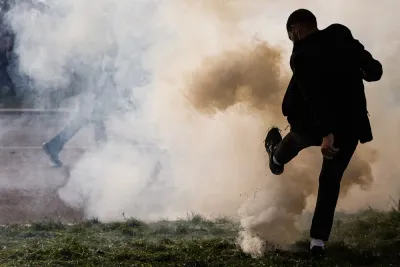
Donald Trump has blamed the school unrest in France on “out of control mass migration” and on Islam.
Students in France have been protesting for over a week. The main reason is the perceived lack of school funding and the poor conditions in which education takes place.
The protests have taken violent turns in many French cities, though, with school gates and buildings set on fire and officers attacked. Prime Minister Sébastien Lecornu has condemned what he called “ultra violence” against schools, while his government has accused the left-wing La France Insoumise (LFI) party of orchestrating the movement, which LFI denies.
This has caught attention in Washington.
“What’s happening in France is nothing less than out of control mass migration. This isn’t about schools, this is about Islam wanting to take over a once great Country!” Trump wrote on Truth Social on October 6.
Mike Waltz, the US ambassador to the United Nations, echoed him, saying that where there were open borders and “this pro-migration, unchecked immigration kind of policy” the result was “a level of frustration boiling to the surface”.
Popular political pundits shared the sentiment.
Glenn Beck called the unrest a warning to the rest of the West and the work of “an international network of socialists working to dismantle the West”. Dave Rubin warned it would “come to America if the Democrats take power again”.
Paris has pushed back. Foreign Minister Jean-Noël Barrot said that if France did not write its own account of events, others would write it for the country, adding that rivals, adversaries and partners alike were trying to read the movement in their own way.
LFI leader Jean-Luc Mélenchon said on X that Marine Le Pen was supplying Trump with what he described as a fantasised account of the causes of violence in France.
Student groups, teachers and the French Government have described the movement as a protest over staffing, overcrowded classrooms, dilapidated buildings and education funding. No link has so far been established by the French authorities between the movement and religious or identity-based demands.
It began on September 17 when pupils at the Lycée Saint-Exupéry in Créteil, southeast of Paris, joined a teachers’ strike, and has since spread to blockades and street demonstrations in Paris, Lyon, Strasbourg, Rennes and elsewhere.
France’s Interior Ministry reported that more than 6,100 people had been arrested since September, the overwhelming majority of them minors.
By October 5 the Justice Ministry had recorded 5,060 taken into custody, 87 per cent of them under 18, with 14 people remanded in custody.
Édouard Geffray, the education minister, put pupils and school staff injured at 190.
Lecornu later gave a higher count, telling lawmakers that about 215 pupils had been hurt, mostly in accidents or at the hands of people from outside the schools, along with 85 education staff, including 34 heads and deputies, and 715 police and gendarmes. He described it as the heaviest toll on the school system in decades.
On October 6 the Interior Ministry counted 266,000 demonstrators, 56,000 of them in Paris; the unions said 450,000.
President Trump posted on Truth Social that "What's happening in France is nothing less than out of control mass migration." 🇫🇷
"This isn't about schools, this is about Islam wanting to take over a once great Country!"
France's immigrant population at 8 million about 11.6…
— Donald J Trump Posts TruthSocial (@TruthTrumpPost) October 6, 2026
Interior Minister Laurent Nuñez suspended stun grenades after a 15-year-old lost a hand in Lens, Pas-de-Calais, northern France.
The injury that changed the policing orders came on October 5, outside the Lycée Auguste Béhal in Lens. A 15-year-old had his hand torn off after contact with a police grenade.
The prefect of the Pas-de-Calais and the prosecutor at Béthune confirmed the wound. Prefect François-Xavier Lauch said crowd-control operations were not conducted to produce such an outcome and called for calm.
Today Nuñez told RTL there was “a strong possibility” it had been a stun grenade, and that he had ordered the day before that such grenades no longer be used “in the framework of the lycée movement, provisionally”, until the facts were clear.
The suspension does not cover other protests.
The police inspectorate has opened 18 inquiries, though Nuñez said not all of them concerned the use of intermediate weapons.
A separate officer who fired a launcher that badly injured a 14-year-old in the face at Saint-Ouen-l’Aumône, north of Paris, has been charged. The prosecutor judged that the self-defence claimed was not proportionate.
Nuñez had previously said he was giving the police no instruction to hold back, and that they should have the full range of intermediate weapons.
After a meeting at the Élysée on October 6 he said President Emmanuel Macron had “recalled the need to maintain order while asking us to do so with the greatest proportionality”.
Protests continued today, with 528 schools fully or partly disrupted, down about 41 per cent on the previous day. The education ministry said 86 per cent of schools were operating normally.
Grenade assourdissante : "Je suspends son usage pour le mouvement des lycéens tant que la lumière n'aura pas été faite sur ce qui s'est passé dans cette affaire"
Laurent Nuñez, ministre de l'Intérieur, face à @FogielMarcO dans #RTLMatin pic.twitter.com/KfUDdsTUut
— RTL France (@RTLFrance) October 7, 2026