
Nobel Peace Prize haunted by the ‘spectre’ of Trump
Donald Trump’s minimal chances of winning the Nobel Peace Prize have not stopped his ‘spectre’ from influencing the upcoming award announcement. Although Trump has campaigned for the prize since his return to the White House in 2025, experts do not consider his chances to be significant.
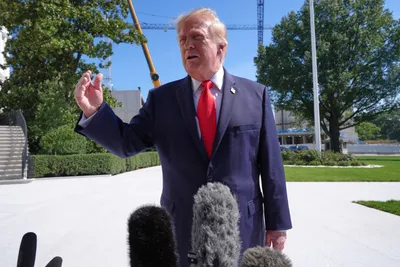
OSLO: Donald Trump’s chances of winning the Nobel Peace Prize are seen as minimal, but his “spectre” will cast its shadow over Friday’s announcement of the winner in Oslo, experts say.
The Norwegian Nobel Committee knows it will be under close scrutiny: since his return to the White House in January 2025, the billionaire Republican has campaigned intensively for the prize and hasn’t hidden his disappointment at not winning it yet.
The chances of him getting the nod are however undermined by his war against Iran, his territorial ambitions — sometimes at the expense of allies, as in Greenland — and his attacks on international cooperation institutions and the media.
Even though he has not been lobbying as openly for the Nobel in recent weeks, Trump remains on everyone’s minds, with strong chances that the committee’s pick will, regardless of who they choose, be interpreted as direct or indirect criticism of the US president.
Trump is “the spectre in the room,” said the head of the Peace Research Institute in Oslo (PRIO), Haakon Gjerlow.
He said the Nobel committee must be asking itself: “Is there any potential for this prize to create harm rather than good in awarding it?,” given the reactions that could emerge from the White House.
The Nobel Institute says it is unfazed.
“There’s always a lot of lobbying, and ultimately perhaps also attempts to exert pressure on the committee. So in one sense we’re very used to that,” the secretary of the committee, Kristian Berg Harpviken, told AFP.
“It’s not something we don’t discuss. Of course we have to discuss it, but it’s not like that influences the discussions in the room and decisions that come out,” he insisted.
Last year, the prestigious prize went to Venezuelan opposition leader Maria Corina Machado, a choice generally considered palatable to Trump.
Machado even gave him her Nobel gold medal, judging he deserved it after the capture of President Nicolas Maduro — though she failed to obtain his political backing in exchange.
Those events could prompt the committee to this year choose a laureate who enjoys broad consensus, such as an individual or organization working to protect children or humanitarian efforts.
That could include the Save the Children charity and Mykola Kuleba, a Ukrainian children’s rights activist campaigning for the return of kids illegally taken to Russia from occupied territories — a cause close to the heart of Trump’s wife Melania.
Sudan’s Emergency Response Rooms (ERR), a vast network of volunteers risking their lives to help people facing the double threat of war and hunger, could also be a potential laureate.
But the committee may also choose a laureate that could rub Trump the wrong way.
That could include the UN special rapporteur for the occupied Palestinian territories Francesca Albanese, Pope Leo XIV, press freedoms with an award to the Committee to Protect Journalists, or international justice bodies such as the International Criminal Court (ICC) and the International Court of Justice (ICJ).
“We live in an age of predators. We have Trump, Putin, Netanyahu,” said Nobel historian Asle Sveen.
“They don’t want to have an international order. They want to have big powers with spheres of influence. And this court stands in the way,” he said, referring to the ICC.
A total of 287 individuals and organizations have been nominated for the Nobel Peace Prize, though the names on the list are kept secret for 50 years.
But peace remains elusive in many parts of the world: 65 armed conflicts involving at least one state actor were registered in 2025, the highest number since 1946, according to PRIO.
“At an overall level, it is clear that the world is not developing in the right direction,” said Harpviken.
“At the same time ... there is no lack of good initiatives. There is no lack of organizations or individuals who do good work,” he said.
“A peace prize may make more sense than ever.”