
Nepal focuses on rehabilitation as it ends search and rescue after flood
Nepal has ended the search and rescue operation for the more than 5,000 people still missing after the devastating August flood.
Topic: Disasters, Accidents and Emergency Incidents
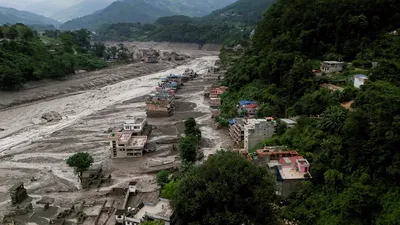
The flood destroyed hydro-electric projects, roads and farms. ( Reuters: Navesh Chitrakar )
Nepal has called off the search and rescue operation for those still missing after the devastating flood in August.
Authorities are considering how to legally declare the missing persons dead to allow their families or relatives to complete insurance, banking and other legal formalities.
Nepal will begin a high-stakes effort to drain four glacial lakes perched high in the mountains to reduce flood risks.
Nepal has ended the search and rescue operation for those still missing after the devastating flood in August that killed at least 1,455 people, officials say.
At least 5,285 people were still missing after the August 26 flood originating at Nepal's border with China's Tibet region.
Another 13,795 people were rescued.
"We are moving from the search and rescue phase to the search and rehabilitation phase," Phanindra Paudel, chief of the National Emergency Operation Centre, said.
He said authorities were considering how to legally declare the missing persons dead to allow their families or relatives to complete insurance, banking and other legal formalities.
"We are initiating due processes to complete required legal formalities," Mr Paudel said.
National Disaster Risk Reduction and Management Authority chief Dharam Raj Uprety said authorities would no longer actively search for bodies but would recover any remains, property or other valuables found during the rehabilitation process.
A woman displaced by the deadly flash floods at a temporary shelter on a hill in Betrawati. ( Reuters: Adnan Abidi )
Mr Uprety said emergency rescues would still be carried out if needed.
The flood also destroyed 12 hydroelectric projects, roads, bridges, farms and settlements.
Authorities have said they need nearly $7 billion for the early recovery and rehabilitation of the thousands of people displaced by the flood.
Nepal will begin a high-stakes effort to drain four glacial lakes perched high in the mountains as it scrambles to reduce flood risks, officials said.
"Our aim is to lower the risk of the lakes breaching their natural dams and reduce the risk of downstream floods," said Subash Tuladhar, an expert with a government research centre tasked with overseeing the new project.
Authorities say billions are needed to rebuild. ( Reuters: Nepal National Mountain Guide Association )
Canals will drain water into nearby rivers in a regulated way, he said, adding that workers faced health risks as a result of the lengthy periods of high-altitude work required, in addition to the dangers of sudden flooding.
There will be design work and detailed studies targeting the central and eastern lakes of Thulagi, Lower Barun, Lumding Tsho and Hongu II, authorities said.
The lakes, at heights ranging from 4,050 metres to 5,483m, rank among Nepal's most potentially dangerous, the United Nations Development Programme and the International Centre for Integrated Mountain Development said in a 2020 report.
The work of draining "through gated structures" will start after a detailed study, and could take up to six years to complete, said Sanjeeb Baral, the Centre's executive director.
It will encompass installation of sensors, a flood forecasting and warning system, and efforts to build downstream resilience and prepare communities for the risks.